Introduction: A Better Way to Clean the Yard
Weekly yard cleanup after mowing can be a time-consuming chore, often requiring raking, blowing, and hauling debris. For homeowners with larger lots, a tow-behind lawn sweeper offers a more efficient solution. The Agri-Fab 45-0293 is designed for properties around half an acre, handling a mix of open lawn, uneven terrain, and even gravel areas. This review examines its specifications, performance in various conditions, and overall value based on owner feedback and product analysis.
Performance Analysis
Grass Clipping Collection
The Agri-Fab 45-0293 excels at picking up grass clippings. With a 42-inch sweep path and adjustable brush height, it leaves a clean strip behind the mower. On damp spring grass, the middle brush setting captures the majority of clippings, with only minor stray clumps near the edges. A second pass with a 6-inch overlap results in a raked-by-hand appearance. The 25-cubic-foot hopper fills after approximately 1,500 square feet of thick, wet clippings. The dump lever tilts the hopper forward for clean emptying, though wet clumps may occasionally stick to the mesh sides and require a tap to dislodge. Dry summer clippings fill the hopper more slowly and slide out easily.
Leaf Collection: Wet and Dry
Dry leaves are handled effortlessly in a single pass, with the hopper’s airflow helping to pack them down. Coverage of about 3,000 square feet is possible before the hopper is full. Wet, matted leaves present a greater challenge. Lowering the brush to the lowest setting and reducing speed to 2 mph, along with making two passes in opposite directions, is effective. The hopper fills quickly with wet leaves, which are heavy—a full hopper of wet material can easily exceed 100 pounds. The dump mechanism assists, but emptying a full hopper of wet debris requires significant effort. Owners recommend emptying the hopper before it is completely full when dealing with wet material.
Handling Uneven Terrain
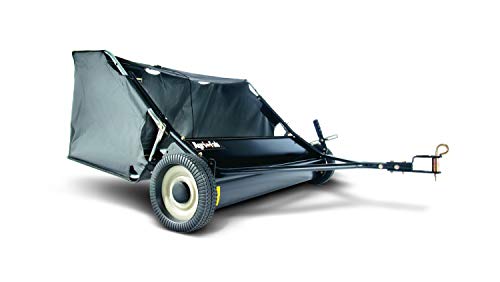
The steel frame and tow hitch attach to the mower’s drawbar. Two large pneumatic tires absorb shock on bumpy ground, and the sweeper tracks well behind the mower, even over 2-inch bumps. The brushes are mounted on a floating axle that maintains ground contact independently. On slopes, the sweeper remains stable, though on steep side hills, the hopper’s weight can cause a slight pull to the downhill side. Towing is smooth, with no reported rattling or scraping.
Brush Height Adjustment
A lever on the side of the sweeper offers four brush height positions. The highest setting is suitable for short, dry grass on flat lawns to avoid soil disturbance. The lowest setting is for thick, wet grass or matted leaves. The adjustment is easy to operate from the mower seat and clicks securely into place. On gravel, raising the brush to the highest setting prevents stone scattering while still picking up light debris.
Build Quality and Value
Frame and Construction
The frame is constructed from heavy-gauge steel with a dark green powder coat finish that resists rust. After extended use, including exposure to rain, no rust or peeling paint is reported. Welds are clean and strong. The hopper is made of heavy-duty woven polyester mesh with a steel frame, allowing airflow for debris packing and dust escape. It attaches with two large pivot pins, and the dump mechanism uses a spring-loaded latch that operates without binding. The polypropylene brushes show minimal wear after approximately 20 hours of use, retaining bristle stiffness and tuft integrity.
Value for the Price
The Agri-Fab 45-0293 is positioned in the mid-range for tow-behind lawn sweepers. Its steel construction and larger hopper justify a higher price compared to plastic-framed models with smaller capacities. The rust-resistant paint and steel frame suggest long-term durability. Compared to the cost of a leaf vacuum or lawn service, the sweeper can pay for itself in one season for homeowners who value time savings.
Who This Suits
Ideal Users
This sweeper is well-suited for homeowners with a riding mower and a lawn of half an acre or more. It is particularly beneficial for properties with many trees that drop leaves or for those who bag grass clippings for compost. The large hopper reduces the frequency of emptying. The pneumatic tires and floating brush axle handle uneven terrain effectively. The adjustable brush height allows for cleaning gravel driveways and paths without surface damage.
Who Should Skip It
For small lawns under a quarter acre, a walk-behind sweeper or rake may be more practical. The sweeper is heavy and requires storage space. Compatibility with zero-turn mowers with very low hitch heights should be verified, as some users have needed hitch bracket modifications. Individuals with physical limitations that make lifting a heavy hopper difficult may struggle with emptying it when full of wet debris, despite the dump mechanism.
Final Verdict
The Agri-Fab 45-0293 is a reliable and effective tow-behind lawn sweeper. Assembly takes time, and the full hopper is undeniably heavy, but the pros outweigh these cons. The large hopper capacity reduces emptying frequency, the steel frame offers durability, and the adjustable brush height provides control over various debris types. It tows smoothly over bumps and slopes and picks up grass clippings, leaves, and small twigs effectively. For homeowners seeking to streamline yard cleanup, this model is a solid choice that delivers on its promises.