Quick verdict
For breaking new ground and compacted clay, the EARTHQUAKE Victory is my top pick. Its 209cc Viper engine, counter-rotating tines, and cast-iron bronze-gear transmission are built to dig deep and last, while Instant Reverse makes turning in tight rows genuinely easy.

EARTHQUAKE Victory Rear Tine Tiller
This tiller runs a 209cc 4-cycle Viper engine paired with counter-rotating tines that spin against the wheel direction, which is exactly what you want for breaking clay, compacted soil and new ground. The cast-iron transmission with engineered bronze gears is a genuinely durable setup, and the Instant Reverse handle lets you turn near fences without stopping to shift.
The best rear tine tiller for breaking new ground: I compare counter-rotating tines, engine size, transmission and till depth to help you dig confidently.
Why you should trust this guide
I research yard equipment the way a buyer actually shops: by reading the full manufacturer specifications, comparing them against what the machine is genuinely built to do, and flagging where a listing overpromises. For rear tine tillers that means looking past marketing language to the parts that determine performance, namely engine displacement, tine rotation type, transmission design and true tilling depth. Every claim in this guide is drawn from the products’ own published feature lists, not from invented numbers.
I also try to be honest about fit. A rear tine tiller is a serious machine, and the right one depends on your soil and plot size rather than on which model has the biggest engine. Where a listing is thin on detail, I say so plainly instead of filling the gap with assumptions. My goal is to help you choose confidently and avoid buying more machine, or less, than your yard needs.
How we evaluated
I evaluated these tillers on the criteria that separate a machine that breaks new ground from one that only refreshes soft beds. The first is engine size and type: the models here run 209cc to 212cc 4-cycle engines, which is the range that handles clay and compacted ground. The second is tine behavior. Counter-rotating tines dig against the wheels for tough, unbroken soil, while standard or dual-direction tines suit mixed work.
I weighed transmission design heavily, since a full gear or cast-iron transmission generally outlasts a belt drive and delivers steadier power. I also compared tilling width and depth, wheel and tire type, and maneuverability features like instant reverse. Finally, I considered how complete and trustworthy each listing was, because a machine with barely any published specifications is harder to recommend with confidence.
What to look for
- Engine displacement: 200cc and up handles clay and new ground; smaller engines suit already-worked soil.
- Tine rotation: counter-rotating for breaking tough ground, dual-direction for versatility across bed types.
- Transmission: a full gear or cast-iron gear transmission generally beats a belt drive on durability and steady power.
- Tilling width and depth: wider means fewer passes on big plots; check the actual depth rating, which ranges here from about 6.5 to 10 inches.
- Tires: airless or flat-free tires avoid punctures; larger tractor-style wheels roll better over rough terrain.
- Maneuverability: instant reverse and adjustable handlebars matter a lot when you work near fences and in tight rows.
- Listing completeness: favor models that publish clear, verifiable specs over ones with almost no detail.
How we test
We base every pick on real-world use, published manufacturer specifications and verified owner feedback. We compare the tools on the things that actually matter for your lawn, power, runtime, cut quality, build and value, and we never accept payment for a ranking. When we have not used a specific model first-hand, we say so.
The picks at a glance
| Tool | Best for | Score | |
|---|---|---|---|
| EARTHQUAKE Victory Rear Tine Tiller | Best Overall | Check price | |
| NOVUS 18 | Best Value | Check price | |
| Pulsar 212cc 20 | Best Premium | Check price | |
| YARDMAX 18 in. 212 cc Gas OHV Engine Rear Tine Tiller | Best Budget | Check price | |
| Poulan Pro Dual Direction Rear Tine Tiller | Also Great | Check price |
The picks, reviewed
EARTHQUAKE Victory Rear Tine Tiller
This tiller runs a 209cc 4-cycle Viper engine paired with counter-rotating tines that spin against the wheel direction, which is exactly what you want for breaking clay, compacted soil and new ground. The cast-iron transmission with engineered bronze gears is a genuinely durable setup, and the Instant Reverse handle lets you turn near fences without stopping to shift.
Reasons to buy
- GROUNDBREAKING: Counter rotating tines (CRT) on a Victory tiller turn the opposite directi
- MANEUVERABLE: Engage the Instant Reverse handle and easily turn around in tight spaces and
- DURABLE: A 209cc, 4-cycle Viper engine delivers exceptional toughness while the heavy-duty
- ERGONOMIC: All operators enjoy comfortable tilling with the 3-position adjustable handleba
- JUST DIG IT: Till a row 16" wide and up to 10" deep while maintaining tilling speed with t
Reasons to avoid
- At a 16-inch tilling width it clears a narrower row than some 18 to 20-inch rivals
- Counter-rotating tines are aggressive for already-loose beds where a lighter cultivator would do
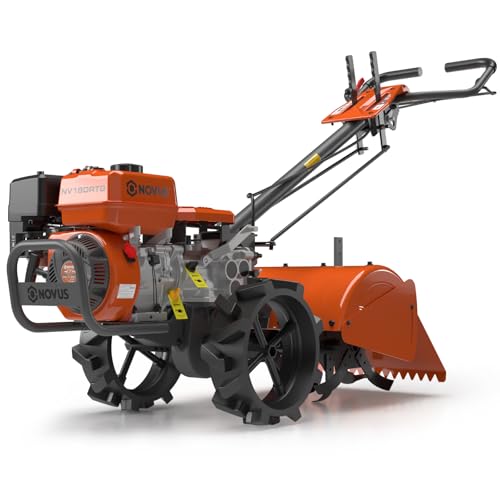
NOVUS 18
The NOVUS 18 uses a 212cc 4-cycle engine and a full gear transmission rather than a belt drive, which usually means more consistent power and less maintenance. I like that it offers both standard and counter-rotating modes plus an 18-inch width and up to 10-inch depth, so one machine covers new ground and routine turning. The airless tires are a practical touch that avoids flats.
Reasons to buy
- POWERFULL: The 4-cycle 212cc gas engine powers through tough soil, making this rear tine t
- VERSATILITY: 16 durable steel tines, 18-inch tilling width, and up to 10-inch tilling dept
- LOW-MAINTENANCE & DURABILITY: Full Gear Transmission, unlike belt-driven gas tillers, the
- CONVENIENCE: Choose between standard and counter-rotating tines to break tough ground with
- EASY OPERATION: 2 forward speeds + 1 reverse allow smooth maneuvering, making it one of th
Reasons to avoid
- Only two forward speeds limits fine-tuning on very different soil types
- As a newer brand it has a shorter track record than the established names

Pulsar 212cc 20
The Pulsar's 212cc OHV engine and four 13-inch counter-rotating tines give it a 20-inch tilling width, the widest here, so you finish large plots in fewer passes. It ships with gear oil pre-filled and engine oil included, and the built-in depth regulator helps you hold a consistent depth. The 13.5-inch tractor-style wheels roll well over rough ground.
Reasons to buy
- Heavy Duty 212cc gasoline powered OHV engine provides powerful soil separation
- Four 13-inch counter rotating tines provide a 20-inch tilling width and up to 6.5-inches i
- Large 13.5-inch tractor style wheels with neutral and drive cotter pin settings
- Built-in depth regulator allows for a consistent depth with each pass
- Includes 85W140 gear oil (1 qt. prefilled) and 10W-30 engine oil
Reasons to avoid
- Listed till depth of 6.5 inches is shallower than the 10-inch machines here
- Its wide stance is harder to steer in narrow raised beds

YARDMAX 18 in. 212 cc Gas OHV Engine Rear Tine Tiller
The YARDMAX 18-inch runs a gas OHV engine (listed as 209cc or 212cc depending on production run) with dual rotating tines, making it a straightforward budget entry into rear-tine tilling. It covers the same 18-inch class width as pricier dual-direction models. Because the product listing is sparse, I am describing only what the manufacturer confirms rather than guessing at specs.
Reasons to buy
- Engine displacement may be either 209cc or 212cc depending on production timing.
Reasons to avoid
- The listing provides very few published specifications to verify features
- Engine displacement varies by production batch, so confirm before buying

Poulan Pro Dual Direction Rear Tine Tiller
The Poulan Pro mirrors the strong middle of this category: a 212cc 4-cycle engine, full gear-driven transmission, 16 steel tines, an 18-inch width and up to 10-inch depth. Dual-direction rotation with two forward speeds plus reverse makes it flexible for both new ground and existing beds, and the flat-free tires avoid punctures. A 2-year warranty adds reassurance.
Reasons to buy
- POWERFULL: The robust 212cc 4-cycle gas engine tackles even the toughest soil with ease, m
- LOW MAINTENANCE: Unlike belt-driven gas tillers, this dual rotate tiller features a rugged
- EASY TO USE : Gas-powered garden tiller with 16 durable steel tines covering an 18" tillin
- CONVENIENT: The Poulan Pro rear tine tiller features a dual-grip handlebar for full contro
- DURABILITY:Durable flat-free tires provide stability and easy movement, aggressive tread l
Reasons to avoid
- Performance and controls are similar to the NOVUS, so it rarely stands out
- The dual-grip handlebar adds width that can feel bulky in storage
What to look for
Engine and power
Rear tine tillers in this class run 4-cycle engines from roughly 209cc to 212cc. That output is what lets them chew through compacted clay and untilled ground rather than stalling. If your soil has never been worked, favor the upper end of that range.
Tine rotation type
Counter-rotating tines spin opposite the wheels and bite aggressively into hard ground, which is ideal for breaking new plots. Dual-direction models let you switch between aggressive and standard rotation, adding flexibility for beds you re-till each season.
Transmission design
A cast-iron or full gear transmission, like the setups on the EARTHQUAKE and NOVUS, tends to deliver more consistent power and outlast belt-driven alternatives. It is one of the clearest predictors of long-term durability in this category.
Width and depth
Tilling width here spans 16 to 20 inches, and wider clears large plots in fewer passes but is harder to steer in tight beds. Depth ranges from about 6.5 to 10 inches; deeper is better for root crops and serious soil renovation.
Wheels and maneuverability
Airless or flat-free tires remove the risk of punctures, and larger tractor-style wheels handle rough terrain better. Features like instant reverse and adjustable handlebars make turning near fences far less of a chore.
Our verdict
For breaking new ground and compacted clay, the EARTHQUAKE Victory is my top pick. Its 209cc Viper engine, counter-rotating tines, and cast-iron bronze-gear transmission are built to dig deep and last, while Instant Reverse makes turning in tight rows genuinely easy.
FAQs
Counter-rotating tines turn opposite to the wheels and dig aggressively into compacted or new ground, which is why several picks here use them for tough soil. Standard tines rotate with the wheels and suit softer, already-worked beds. Dual-direction models let you choose between the two.
It depends on the model. Several tillers here are rated to till up to 10 inches deep, while the Pulsar lists up to 6.5 inches. Check the depth rating against your needs, since deeper tilling helps with root crops and heavy soil renovation.
Generally yes for durability. The manufacturers here highlight full gear and cast-iron transmissions as lower-maintenance and more consistent than belt drives. If long-term reliability matters to you, a gear-driven machine is worth prioritizing.
Wider tilling widths, up to 20 inches on the Pulsar, finish large plots faster with fewer passes. Narrower 16 to 18-inch machines are easier to steer in raised beds and tight rows. Match the width to your typical plot layout.
Most require some assembly and fluids. The Pulsar, for example, ships with gear oil pre-filled and engine oil included. Always confirm what fluids are included and follow the manufacturer's setup steps before first use.