Quick verdict
A bench-mounted electric chain grinder with a 230W motor that spins a 5.5-inch wheel at up to 3000 RPM, with adjustable grinding angles and a chain vise that accepts 1/4, .325, 3/8 and .404 pitch. It suits an owner who sharpens several chains a season and wants every cutter ground to the same angle and length. The caveats are a budget build, no stated wheel thickness or spare wheels, and the ease with which any powered grinder overheats a cutter.
Strengths
- 230W motor, up to 3000 RPM, on a 5.5-inch wheel
- Accepts 1/4, .325, 3/8 and .404 pitch chain
- Adjustable grinding angle for consistent cutters
- Bench mount keeps both hands free for the chain
- Far quicker than hand filing a batch of dull loops
Weaknesses
- Wheel thickness and spare wheels are not stated in the listing
- A power grinder can blue and soften a cutter if you linger
- Budget build; owners of this class report play in the vise and stops
- Depth gauges still need a flat file by hand
The overall YardToolLab Score is out of 100. Section scores are out of 10.
Who this sharpener is for
Hand filing keeps one chain sharp. It does not keep six chains sharp after a weekend of firewood, and it rarely leaves every cutter the same length, which is why a saw with a hand-filed chain tends to cut in a curve. A bench grinder fixes both problems, and the VEVOR 230W is the budget way in: a mains-powered grinder with a 5.5-inch wheel, an angle-adjustable head and a vise that takes the four common chain pitches. It is for an owner who sharpens often enough to want speed and consistency, but not often enough to pay for a professional grinder.
This review is based on the maker’s published specifications and on recurring owner feedback. We have not run this product ourselves.
What you get
VEVOR lists a 230W motor that turns the wheel at up to 3000 RPM, a 5.5-inch grinding wheel, adjustable grinding angles and compatibility with 1/4, .325, 3/8 and .404 pitch chain. It mounts to a bench. The listing does not state the wheel thickness, whether a second wheel is included, the vise jaw width or any depth stop detail, and it does not mention a work light or a warranty. Those gaps matter on a grinder, since the right wheel thickness for your pitch is not optional.
Fit and chain pitches
Four pitches cover nearly every saw a homeowner or small landscaper owns: 1/4 and .325 on small and mid saws, 3/8 on most 50cc and larger saws, .404 on big pro saws. The catch is the wheel. The two smaller pitches are normally ground with a 1/8-inch wheel and the two larger with a 3/16-inch wheel, and a grinder sold with one wheel does half the list properly. Confirm what is in the box and budget for the other size if your saws span both groups. Low-profile 3/8 chain, the type on most consumer saws, usually grinds fine with the thinner wheel.
Grinding speed and angle control
A powered wheel takes a dull cutter back to an edge in seconds, and the angle adjustment holds the same top-plate angle on every tooth, which is the consistency a hand file struggles to match. Set the angle, set the stop so each cutter is pulled to the same point, and the chain comes off the vise with cutters of equal length, so the saw tracks straight again. Owners of budget grinders in this class report that the adjustments work but that the markings are approximate; set the angle against a new chain or a known reference the first time rather than trusting the scale.
Heat, precision and technique
The main risk with any electric grinder is heat. At 3000 RPM a wheel held against a cutter for a second too long turns it blue, and a blued cutter has lost its hardness and dulls almost immediately. The technique is light, quick passes with the same small bite on every tooth, letting the chain cool between sides. Owners new to bench grinders commonly report ruining a loop before they learn this. The second habit is dressing the wheel when it glazes, so it cuts rather than rubs.
Build and bench mounting
VEVOR builds to a price, and the recurring owner note on this class of grinder is play in the vise and the stops, plastic where metal would be better, and a wheel guard that needs adjusting. None of that stops it sharpening a chain; it means a careful setup and a check of every cutter rather than trusting the machine blind. Bolt it to a solid bench at a comfortable height with good light, because you will be looking closely at small edges.
Living with it
Wear eye protection; grinding throws sparks and grit. Keep spare wheels on hand and replace a wheel that has worn small or cracked. Grind the cutters, then take the depth gauges down with a flat file and a gauge tool every few sharpenings, since the listing gives no raker function. Clean chain oil and chips off the vise after each session so the stops seat properly.
Alternatives to Consider
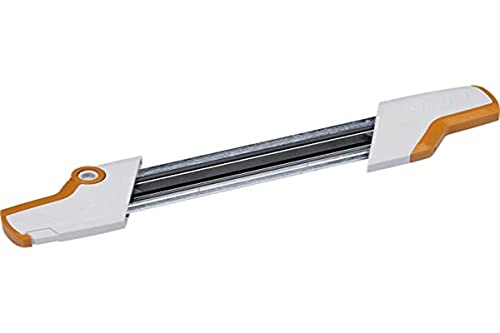
The Oregon 520-120 bench grinder is the step up: a heavier casting, a tighter vise and a dealer parts supply, for an owner who grinds chains weekly. The Stihl 2-in-1 Easy File sharpens the cutter and lowers the depth gauge in one hand stroke and is the better buy for someone with one saw and one chain. The Granberg G-106B bar-mount file guide gives hand-filing consistency without a motor or heat.
Verdict
Buy the VEVOR 230W electric chainsaw sharpener if you have several chains to keep sharp, want consistent cutters without paying for a professional grinder, and are willing to learn light passes and check the wheel size that ships. Skip it if you have one saw and sharpen occasionally, where a 2-in-1 file is cheaper, kinder to the chain and does the depth gauges too.
Full specifications
VEVOR 230W Electric Bench-Mount Chainsaw Chain Sharpener with 5.5-Inch Grinding Wheel FAQs
The listing does not state it. Bench grinders in this class typically use a 1/8-inch wheel for 1/4 and .325 pitch and a 3/16-inch wheel for 3/8 and .404; check what ships in the box and buy the second size if your chains need it.
VEVOR lists 3/8 pitch among the four it accepts and does not single out low-profile. Most bench grinders handle 3/8 low-profile with the thinner wheel; confirm the vise closes on the narrower drive link before grinding.
The listing does not mention a depth gauge function. Grind the cutters on the machine, then take the rakers down with a flat file and a depth gauge tool every second or third sharpening, as you would after hand filing.
Use light, brief passes and let the wheel do the work. A cutter that turns blue has lost its temper and will dull fast. Take the same small amount off every cutter, and dress the wheel when it glazes.