Quick verdict
A rolled canvas pouch holding three round files in 5/32, 3/16 and 7/32 inch, a 6 inch flat file, a file guide and a universal handle, which covers the common chain pitches on homeowner and farm saws. It suits anyone who owns more than one saw or a pole saw and wants to touch up chains in the field. The caveat is that a guide-and-file kit rewards practice; the first few chains will not come out as even as a bench grinder makes them.
Strengths
- Three round file sizes for the common homeowner and farm chain pitches
- Flat file and guide for depth gauge work
- One universal handle fits all the files
- Rolled canvas pouch with a pocket per tool
- Filing chart and instruction sheet included
Weaknesses
- Only one file of each size, and files are consumables
- The listing does not spell out a separate depth gauge tool beyond the guide
- Slower and less even than a bench grinder on a badly rocked chain
The overall YardToolLab Score is out of 100. Section scores are out of 10.
Who this kit is for
Most people who own a chainsaw run a chain that is duller than they think, and the usual fix is a new chain every season. A file kit is cheaper and faster once the habit sets in. Oregon’s universal field kit is built for the owner with more than one saw, or a saw and a pole saw, because it packs three round file sizes instead of one and rolls up small enough to ride in the truck or the saw case.
This review is based on the maker’s published specifications and on recurring owner feedback. We have not run this product ourselves.
What you get
Seven pieces: round files in 5/32, 3/16 and 7/32 inch, one of each; a 6 inch flat file; a file guide; a universal file handle; and a rolled canvas pouch with an inner pocket for each tool and a loop closure. Oregon includes an instruction sheet with a filing chart that matches file size and angle to the chain. The listing does not describe the guide’s angle markings in detail or name the file steel, so treat those as standard Oregon fare rather than anything exotic.
File sizes and chain coverage
The three diameters are the point of the kit. A 5/32 inch file typically fits 3/8 inch low-profile and 1/4 inch pitch chain, which is what most homeowner saws under about 45 cc and almost all pole saws and battery saws run. A 3/16 inch file typically fits .325 inch pitch chain, common on mid-size farm saws. A 7/32 inch file suits standard 3/8 inch pitch chain on larger saws. Check the pitch stamped on the drive link or printed on the chain box against Oregon’s chart before the first stroke; the wrong file diameter rounds the cutter instead of sharpening it. Owners with a single small saw sometimes note that two of the three files sit unused, which is fine; they cost little and the kit is cheaper than three separate purchases.
Guide and depth gauges
The file guide holds the round file at a consistent height in the cutter and gives you angle lines to sight against the bar, which is where a freehand filer goes wrong. Per the listing, the same guide helps set the depth gauges, the small rakers in front of each cutter that control how much wood the tooth bites. As the cutters are filed back the rakers need to come down too, a few strokes of the flat file every third or fourth sharpening, or the chain stops feeding no matter how sharp the edges look. Oregon’s sheet covers this. The result from a guide kit is good, even sharpening once your stroke is consistent; the first couple of chains tend to come out uneven, which owners report as the main learning curve.
Build and the pouch
Oregon files have a solid reputation for holding a cutting edge through several chains before they load up and go smooth, and the universal handle means one handle for all four files rather than a loose grip on a bare tang. The rolled canvas pouch is the practical upgrade over a plastic clamshell: it does not crack in the cold, each file has its own pocket so the files do not rub against each other and dull, and the loop closure keeps it shut in a toolbox. The one thing the pouch does not do is protect files from damp, so do not leave it in a wet saw case.
Living with it
Sharpen little and often: three or four strokes per cutter every tank or two of fuel keeps a chain cutting without ever needing a full rework. Count strokes so each cutter is taken back the same amount. Brush the files with a wire brush when they clog, keep them dry, and replace a file once it skates rather than bites; that is normal consumable use, not a defect. Warranty terms are not given in the listing, and files are treated as consumables by every maker.
Alternatives to Consider
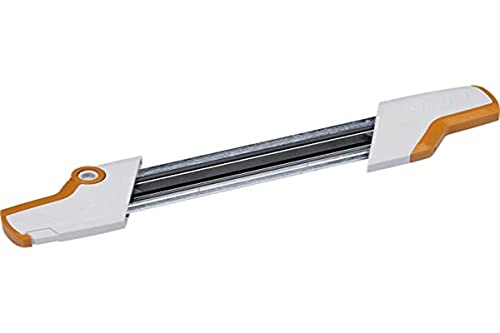
The Stihl 2-in-1 Easy File sharpens the cutter and lowers the raker in one stroke, which is faster and more foolproof, but each unit fits one chain pitch, so you buy one per saw. The Oregon 520-120 bench grinder is the choice for someone who sharpens many chains or rescues badly rocked ones, at the cost of a bench and a power outlet. The Pferd Chain Sharp CS-X works like the Stihl tool and is often cheaper.
Verdict
Buy the Oregon universal field kit if you run saws with different chain pitches, or want one kit to keep in the truck that will cover the next saw you buy. Skip it if you own one small saw and want the quickest route to a sharp chain, where a single-pitch 2-in-1 file tool is easier to learn.
Full specifications
Oregon Universal 7-Piece Chainsaw Field Sharpening Kit with Round Files, Flat File, Guide and Pouch FAQs
Match the file to the chain pitch: typically 5/32 inch for 3/8 low-profile and 1/4 pitch, 3/16 inch for .325 pitch and 7/32 inch for standard 3/8 pitch. The pitch is on the chain box or stamped on the drive links, and Oregon's filing chart in the kit lists it.
The listing says the file guide helps set the depth gauges and a 6 inch flat file is included for lowering them. A separate flat raker gauge is not listed, so buy one separately if you want it.
A few strokes per cutter every tank or two of fuel, and immediately after touching dirt or a nail. Light, frequent filing is faster than rescuing a badly dulled chain.
Yes. Oregon lists it as universal, and most battery and pole saws run 3/8 low-profile chain, which takes the 5/32 inch file.