Quick verdict
A compartmentalized hard case that packs round and flat files, a file guide, a depth gauge tool and handles for sharpening, plus a scrench, mini screwdriver, stump vise and felling wedge for working on the saw in the woods. It suits the owner who cuts firewood away from the garage and wants every small tool in one box. The caveat is that the listing does not state the round file sizes, so confirm they match your chain pitch before you rely on it.
Strengths
- Files, guide, depth gauge tool and handles in one case
- Stump vise turns any stump into a bench
- Felling wedge and scrench cover the common field jobs
- Hard case with a compartment per tool
- Oregon files and guide, not generic fillers
Weaknesses
- Round file sizes are not stated in the listing
- Wedge size and material are not given
- Heavier and bulkier than a rolled file pouch
- Case latches are a common wear point on kits of this type
The overall YardToolLab Score is out of 100. Section scores are out of 10.
Who this kit is for
Sharpening at the bench is easy; sharpening a chain on a tailgate two miles down a logging track is where kits fall apart. Oregon’s hard-case kit is built for the second situation. It carries the filing tools, the wrench and screwdriver needed to pull the bar cover and set chain tension, a stump vise to hold the bar steady, and a felling wedge, all in a case that keeps each piece in its own slot.
This review is based on the maker’s published specifications and on recurring owner feedback. We have not run this product ourselves.
What is in the case
The listing names round files, a flat file, a file guide, a depth gauge tool and file handles for the chain itself; a chainsaw wrench, the combined bar-nut socket and screwdriver that saw users call a scrench, and a mini screwdriver for the carburetor and cover screws; a stump vise; and a felling wedge. The case is described as heavy-duty, compact and compartmentalized. Oregon does not state the round file diameters, the number of files, the wedge length or the wedge material in the listing. Most kits of this type ship with the common sizes and a plastic wedge, but check the product page or the box before assuming the files fit your chain.
Files, guide and depth gauge
The sharpening half of the kit is standard Oregon practice: a round file in the guide for the cutters, a depth gauge tool and flat file for the rakers. The guide holds the file at a consistent depth and shows the angle lines to sight along the bar, which is what makes a hand-filed chain cut straight rather than pulling to one side. The depth gauge tool sits over the chain and exposes just the top of any raker that is too high, so the flat file can take it down without guessing. Owners who already file freehand rarely use the guide; owners who are learning say it is the piece that made their results consistent. Round file diameter has to match the chain pitch, which is why the missing size information in the listing matters.
Stump vise and felling wedge
The stump vise is a spiked clamp you drive into a stump or log, then tighten onto the bar so the saw is held still at working height. Anyone who has tried to file a chain while holding the saw between their knees understands the appeal; it is the single item that turns a field touch-up from a chore into a five-minute job. The felling wedge does two things per the listing: it keeps the kerf open so the bar is not pinched during a cut, and it tips the tree toward the lay when driven into the back cut. One wedge is enough for small trees and bucking; anyone felling anything of size carries two or three.
Case and build
A hard case with a slot per tool is better than a bag for exactly one reason: you can see at a glance that the depth gauge tool went back in. It also keeps the files from rubbing each other, which dulls them. The trade is bulk; this is a case that rides in the truck, not in a pocket. A recurring complaint with hard-case tool kits generally is that the hinge or latch wears before the tools do, so check the latch in the first weeks and do not overload the lid.
Living with it
Touch up the cutters every tank or two of fuel with a few strokes each, check the rakers every third or fourth sharpening, and keep the files dry and brushed clean. Files are consumables and will need replacing as they lose bite. The scrench will see more use than anything else in the case; keep it in the saw case if you split the kit up. Warranty terms are not given in the listing.
Alternatives to Consider
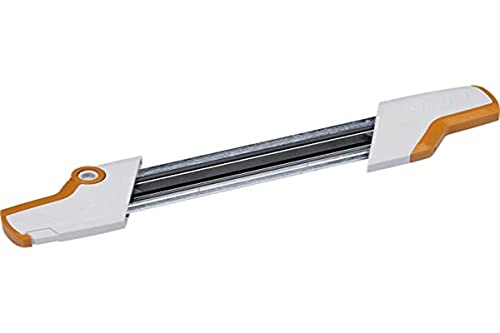
The Oregon universal 7-piece field kit in a canvas roll is the lighter option if you only need the files, guide and handle and already own a scrench. The Stihl 2-in-1 Easy File is faster for a single saw because it files the cutter and raker in one pass. For a dedicated stump vise, the Oregon or Stihl stump vises are sold separately and are a worthwhile add to any file kit.
Verdict
Buy the Oregon hard-case kit if you cut away from the shop and want files, saw tools, a vise and a wedge in one box. Skip it if you sharpen at the bench with a grinder already, or if you need to know the exact file sizes up front and the product page does not confirm them.
Full specifications
Oregon Chainsaw Sharpening Kit with Hard Case, Files, Depth Gauge Tool, Stump Vise and Felling Wedge FAQs
The listing does not state them. Kits of this type usually ship with the common sizes, but confirm against your chain pitch on the product page or the box before relying on it.
A spiked clamp you drive into a stump or log and tighten onto the bar, holding the saw steady at working height so you can file with both hands.
For bucking and small trees, yes. For felling anything of size, carry two or three; wedges are also used in pairs to lift a log off the ground.
Yes. The listing names a chainsaw wrench, the combined bar-nut socket and screwdriver, plus a mini screwdriver for small screws.