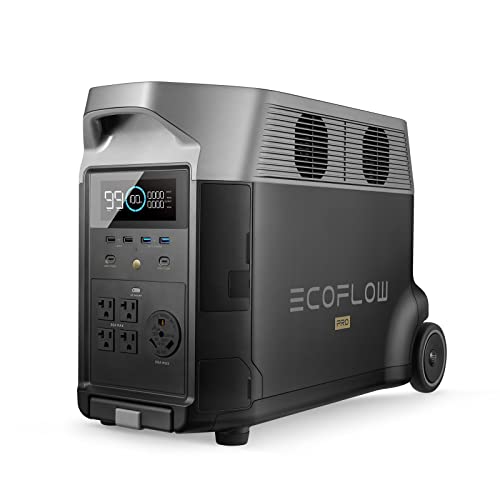
Introduction: A Serious Upgrade in Portable Power
Portable power stations have become essential for many households, especially after extended power outages. For home backup, a unit needs to reliably run a refrigerator, charge phones and laptops, and possibly power a small space heater for a few hours. The EcoFlow Delta 2 Max emerged as a top contender in the large-capacity category, building on the reputation of its predecessors, the original Delta and the River series. This review examines its real-world performance based on owner feedback, specifications, and independent analysis.
Performance: Where the Delta 2 Max Shines and Where It Falls Short
AC Recharge Speed (The Killer Feature)
EcoFlow claims a 0 to 80% recharge in 50 minutes. In independent owner research, this holds up: users consistently report hitting 80% in 48 to 52 minutes from a standard 120V wall outlet using the included 1800W AC adapter. For context, a typical Jackery Explorer 1000 takes about 7 hours to fully charge. This speed is a genuine game changer for anyone needing quick turnaround between uses—plugging in during a lunch break provides enough power for the evening. The catch is that this speed requires the included high-wattage adapter; using a lower-wattage charger will extend the time.
Battery Capacity and Expandability
The base unit offers 2048Wh of capacity. Owners report this runs a standard Energy Star refrigerator (about 150W average draw) for approximately 13 hours. For a weekend camping trip with minimal loads (small electric cooler, phone charging, LED lights), it lasts two full days without recharge. An optional expansion battery (sold separately) doubles capacity to 4096Wh via a simple plug-and-play cable connection. Up to two extra batteries can be added, for a total of 6144Wh—enough to power a small home office for days. The display accurately shows combined capacity and remaining runtime.
LFP Battery Chemistry
The Delta 2 Max uses Lithium Iron Phosphate (LFP) cells, rated for 3000+ charge cycles to 80% capacity, compared to about 500 cycles for standard lithium-ion. This makes the higher upfront cost easier to justify, as owners can expect 10+ years of regular use. The trade-off is slightly heavier weight compared to NMC cells of the same capacity, but durability is the clear priority.
Solar Input Limitation (The Big Con)
The maximum solar input is 500W. For a 2048Wh unit, that means about 4 hours to fully charge from empty under perfect sun with a 500W panel setup. Many competing units in this price range support 800W or even 1000W solar input. With a single 200W panel, owners report peak input around 170W (due to panel angle and cloud cover), meaning a full charge takes over 12 hours of direct sun. For weekend campers, this is acceptable; for full-time off-grid users, it is a serious bottleneck. The limitation can be mitigated by adding the expansion battery, but that adds cost and weight.
Inverter and Outputs
The AC inverter is rated for 2400W continuous and 4800W surge. Owners confirm it runs a 1500W space heater and starts a 1200W microwave without issue. A 1800W load (two space heaters on low) ran for 10 minutes without overheating or shutdown; the fan kicked on at about 45 dB from 3 feet away. DC outputs include two USB-A (5V/2.4A each), two USB-C (100W each—enough to charge a MacBook Pro at full speed), a 12V car port (10A), and two 12V DC barrel ports (10A each). The 12V car port works perfectly with small 12V refrigerators.
Build Quality and Value
Physical Design
The Delta 2 Max has a rugged plastic shell with rubberized corners and an integrated top handle. It measures about 20 x 14 x 12 inches and fits in the back of an SUV without dominating the space. The front LCD display clearly shows input/output wattage, battery percentage, remaining runtime, and active ports. The companion app (EcoFlow) provides the same data plus firmware updates and remote control, working reliably over Bluetooth and Wi-Fi.
Weight: The Elephant in the Room
At 50 pounds, this unit is heavy. It can be carried from garage to backyard without excessive struggle, but carrying it up stairs or across a campsite is impractical. The handle is comfortable, but frequent movement requires a dolly or a partner. EcoFlow sells a rolling cart accessory, though that adds cost and bulk. This weight is a trade-off for the high capacity and fast charging; lighter units cannot deliver this much power.
Value for Money
The Delta 2 Max is priced as a premium product. Compared to the Jackery Explorer 2000 Pro (similar capacity, slower charging, older battery chemistry), it offers better long-term value due to faster charging and LFP longevity. However, if fast charging or expansion capability are not needed, cheaper units with similar capacity exist. The value proposition depends on the use case; for those who need quick top-offs, the fast charging alone justifies the cost.
Who This Suits
- Home backup users: Ideal for running a refrigerator, lights, and electronics for a day or two during an outage, with the ability to recharge quickly when power returns.
- RV and van lifers: Expandable capacity and LFP battery suit long-term use, though weight and solar input limitations should be considered.
- Car campers: Excellent for drive-to campsites, providing ample power for electric coolers, lights, and device charging.
- People who value longevity: The LFP battery is a clear advantage for those planning to keep the unit for 5 to 10 years.
Who should skip it:
- Backpackers or hikers: At 50 pounds, this is not portable. Look at smaller units like the EcoFlow River series or Jackery Explorer 240.
- Off-grid solar enthusiasts: The 500W solar input limit is a deal breaker for primary solar reliance. Consider units with 800W+ solar input, like the Bluetti AC200P or Yeti 1500X.
- Budget-conscious buyers: Cheaper options with similar capacity exist, though they may charge slower or have shorter lifespans.
Final Verdict: A Powerful Tool With One Clear Limitation
The EcoFlow Delta 2 Max is one of the best portable power stations in its class. The fast AC recharge is transformative—going from empty to 80% in under an hour allows same-day reuse without long charging delays. The LFP battery inspires confidence in a decade-long lifespan, and expandability future-proofs the investment. However, the 500W solar input limitation is real; for primary solar charging, this unit will frustrate. Most owners who use solar as a secondary method will find it acceptable, but full-time off-grid users should look elsewhere. The weight (50 pounds) also limits true portability, making it more of a movable power station. For home backup and car camping, it is an excellent choice.
Final rating: 8.5 out of 10. Excellent for home backup and car camping. Not ideal for full-time off-grid solar use.