Quick verdict
The Fiskars 15 inch PowerTooth D-Handle Saw is the strongest pick for consistently thick branches, since its rigid D-handle gives more control and grip than a folding saw once you're pushing past what a lopper can cut. For general tree branch work, camping, or a saw that folds down to carry easily, the WEIMELTOY, REXBETI and HURRICANE folding models cover that use case at a lower price and smaller stored size.

Fiskars 15-Inch PowerTooth D-Handle Hand Saw
Fiskars builds this as a rigid, non-folding D-handle saw specifically for thick branches, with a razor-sharp triple-ground PowerTooth blade and a D-handle shape the manufacturer says gives more grip and control than a straight handle when you're bearing down on a heavier cut.
Curved and D-handle pruning saws for branches too thick for loppers, compared by cut capacity, blade steel and folding versus fixed design.
The picks at a glance
| Tool | Best for | Score /100 | |
|---|---|---|---|
| Fiskars 15-Inch PowerTooth D-Handle Hand Saw | Best for Thick Branches | Check price | |
| WEIMELTOY 10-Inch Heavy Duty Folding Pruning Saw | Best Value | Check price | |
| REXBETI 11-Inch Folding Saw | Best All-Rounder | Check price | |
| HURRICANE 10-Inch Folding Hand Saw | Best Rust Resistance | Check price | |
| VRYTOR 7-Inch Folding Pruning Saw with Hand Guard | Best Compact with Safety Guard | Check price |
The picks, reviewed
Fiskars 15-Inch PowerTooth D-Handle Hand Saw
Fiskars builds this as a rigid, non-folding D-handle saw specifically for thick branches, with a razor-sharp triple-ground PowerTooth blade and a D-handle shape the manufacturer says gives more grip and control than a straight handle when you're bearing down on a heavier cut.
Reasons to buy
- 15 inch fully hardened steel blade
- D-handle for extra grip and control
- SoftGrip touchpoints for comfort
Reasons to avoid
- The fixed D-handle design does not fold, so it takes up more storage space than the folding picks here.
- At 15 inches it is longer and less pocketable for casual carry.

WEIMELTOY 10-Inch Heavy Duty Folding Pruning Saw
WEIMELTOY states this 10 inch folding saw cuts branches up to 6 inches in diameter using an SK5 blade the listing says works on both green and dry wood, folding down with a locking button for compact storage between uses.
Reasons to buy
- Rated for up to 6 inch branches
- SK5 triple-sharpened blade
- Folding, lockable design
Reasons to avoid
- 10 inch blade length is on the shorter side of this guide's folding picks.
- Folding design has more moving parts to maintain than a fixed-blade saw.

REXBETI 11-Inch Folding Saw
REXBETI lists an 11 inch SK-5 blade with aggressive 7 TPI staggered teeth rated for 6 to 7 inch branches, marketed as suited to both yard pruning and camping or backpacking use, which makes it a reasonable single saw for general tree branch work beyond just the garden.
Reasons to buy
- Rated for 6-7 inch branches
- SK-5 steel, 7 TPI teeth
- Lightweight folding design
Reasons to avoid
- The listing emphasizes camping and survival use as much as garden pruning, so it is a generalist rather than a pruning-specific design.
- Reinforced blade structure adds some weight versus the lightest folding saws.

HURRICANE 10-Inch Folding Hand Saw
HURRICANE specifies a chrome electrophoretic coating on top of its SK5 steel blade, which the listing says reduces friction and adds corrosion protection in damp outdoor conditions, on a 10 inch triple-cut blade with a heavy-duty locking mechanism.
Reasons to buy
- Chrome electrophoretic anti-corrosion coating
- SK5 steel, HRC58 hardened teeth
- Secure heavy-duty locking mechanism
Reasons to avoid
- 10 inch blade limits maximum cut diameter compared to longer fixed-blade saws.
- The extra coating adds a manufacturing step that is not present on simpler folding saws.

VRYTOR 7-Inch Folding Pruning Saw with Hand Guard
VRYTOR uses a 65Mn steel blade rated for branches up to about 4 inches, and adds a hand guard feature the listing describes as protecting fingers during use, making it a smaller, lighter option than the 10 to 11 inch saws here for lighter branch work and easier one-hand carry.
Reasons to buy
- Rated for up to 4 inch branches
- Hand guard for added safety
- Wide, deep tooth slots resist clogging
Reasons to avoid
- 4 inch rated capacity is the lowest cutting range in this guide.
- 65Mn steel is a different alloy than the SK-5 used on most other picks, with less documented edge retention data available.
A pruning saw is the tool you reach for once a branch is too thick for loppers but doesn’t justify pulling out a chainsaw, generally somewhere in the 2 to 6 inch diameter range depending on the saw’s blade length and tooth design. Whether you’re calling it a pruning saw, a hand saw for tree branches, or a folding tree saw, you’re looking at largely the same category of tool: a curved or straight blade with aggressive, widely spaced teeth designed to cut on the pull stroke through green or dry wood.
The two biggest design differences that actually matter are folding versus fixed blade, and curved versus straight tooth geometry. A folding saw, like most of the picks in this guide, closes the blade into the handle for safe, compact storage in a bag or truck, which makes it the more practical choice for general tree work where you’re moving between multiple trees or carrying it any distance. A fixed, rigid D-handle saw sacrifices that portability for a stiffer connection between hand and blade, which translates into more control and less flex when you’re bearing down on a genuinely thick branch.
How we chose: blade length, steel type and stated cutting capacity came from each manufacturer’s listing, and we prioritized saws that specified an SK-5 or comparable high-carbon steel blade with a stated teeth-per-inch count, since that combination is what determines how aggressively the saw cuts and how long it holds an edge. We also noted where a listing specifically mentioned a locking mechanism for the folding models, since a blade that doesn’t lock firmly open is a real safety issue under load.
For most people cutting branches up to about 4 inches, a folding saw in the 10 to 11 inch blade range is the more versatile choice, since it handles both tree work and general outdoor use. If you’re regularly cutting thicker limbs, a longer fixed D-handle blade gives more sustained control through the cut, even though it takes up more room in storage.
How we research
What to look for
Folding versus fixed blade for how you actually work
A folding saw stores compactly and is safer to carry between trees or in a bag, which suits general tree branch work and moving around a property. A fixed D-handle saw gives up that portability for more rigidity and control, which matters more once you're consistently cutting near the top of what a saw can handle.
Rated cutting capacity versus blade length
Blade length and maximum branch diameter are related but not identical, since tooth design and steel quality also affect how cleanly a saw cuts through thicker wood. Check the manufacturer's stated capacity in inches rather than assuming a longer blade automatically cuts a thicker branch.
Blade steel determines edge life more than price
SK-5 high-carbon steel appears across most of the picks here because it holds a sharp edge through repeated thick cuts. A coating like chrome electrophoretic or Teflon adds rust resistance and reduces friction, but the base steel is what determines how long the saw stays sharp between sharpenings or replacements.
Locking mechanisms matter more on a folding saw than people expect
A folding saw blade that doesn't lock firmly open under load is a genuine safety concern, since the blade can fold back onto your hand mid-cut. Look for a listing that specifically describes a button, lever or reinforced locking mechanism rather than a simple friction-hinge design.
Our verdict
The Fiskars 15 inch PowerTooth D-Handle Saw is the strongest pick for consistently thick branches, since its rigid D-handle gives more control and grip than a folding saw once you're pushing past what a lopper can cut. For general tree branch work, camping, or a saw that folds down to carry easily, the WEIMELTOY, REXBETI and HURRICANE folding models cover that use case at a lower price and smaller stored size.
FAQs
In practice, yes. Both terms generally describe the same tool category, a curved or straight blade with aggressive teeth designed to cut branches on the pull stroke. Some listings emphasize pruning specifically while others market the same design toward general tree work or camping, but the underlying saws are usually built the same way.
Once a branch is thicker than roughly 1.75 to 2 inches, most loppers start to struggle or require excessive force. Pruning saws in this guide are rated for anywhere from 4 to 6 or more inches depending on blade length and design, making them the right next step before a branch is thick enough to need a chainsaw.
A folding saw is more practical for general use since it stores compactly and is safer to carry, and it covers most branches up to around 6 inches with a quality 10 to 11 inch blade. A fixed D-handle saw gives up that portability for more rigid control, which is worth it if you consistently cut at the thicker end of what a hand saw can manage.
SK-5 is a high-carbon steel commonly used on quality pruning saw blades because it holds a sharp edge through repeated hard cuts better than basic stamped steel. It will not change how thick a branch you can cut, but it does mean the teeth stay sharp longer before the saw starts to drag or tear rather than slice cleanly.
Check that the manufacturer's listing specifically describes a locking mechanism, such as a button or lever that holds the blade rigid when open, rather than relying on friction alone. Before each use, open the blade fully and confirm it locks firmly with no play, since a blade that shifts mid-cut is a real safety risk.
Related guides
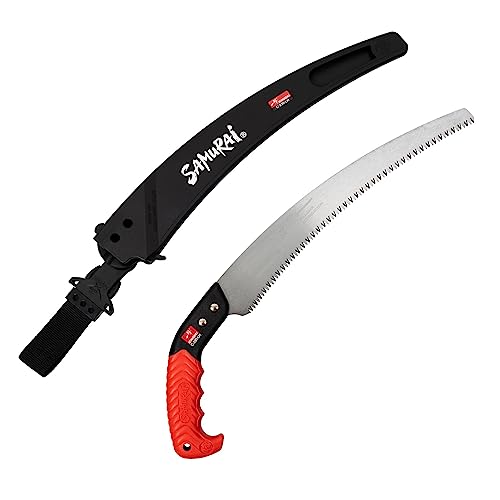
Need a Heavy Duty Pruning Saw? These Three 13-Inch Curved Blades Take Limbs of 4 to 8 Inches
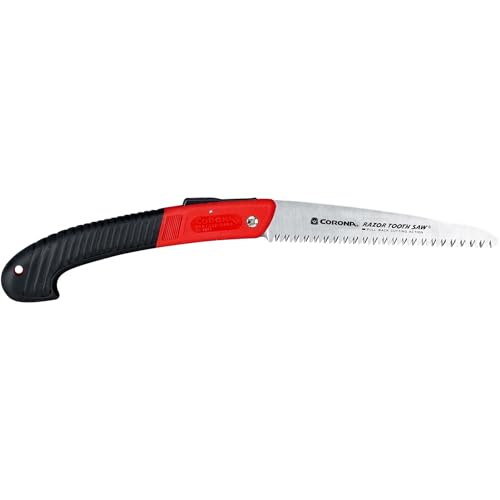
The Three Budget Pruning Saws Worth Buying: Corona, Fiskars and REXBETI Folders Compared

Best Folding Saw for Hardwood Branches: Three Pull Saws That Bite Oak, Maple and Hickory
