A chainsaw that curves in the cut after sharpening has cutters of unequal length or angle on its two sides, depth gauges set unevenly, or bar rails worn to different heights. Here is how to find which, and how to sharpen so it cuts straight.
What a crooked cut tells you
A chain has cutters that alternate left and right, and the left-hand cutters cut the left wall of the kerf while the right-hand cutters cut the right. When the two sides cut equally the bar goes straight through the log. When one side takes a bigger bite, the bar steers toward the side that is cutting harder and the cut curves. A curve that appears right after sharpening means the sharpening made the two sides unequal, and that is by far the most common cause. A curve that was there before and got worse is more likely the bar. The checks below find which.
Cause one: unequal cutter lengths
Most people file harder on one side because of how they stand and which hand holds the file, and after a few sharpenings the cutters on one side are shorter than the other. A shorter cutter sits lower and takes a smaller bite, so the side with the longer cutters cuts harder and the saw drifts. Check with a ruler or calipers: measure the top plate of a few cutters on each side from the front corner to the back. They should match within a few hundredths of an inch. If one side is longer, file that side until the lengths match, counting strokes.
Cause two: unequal angles
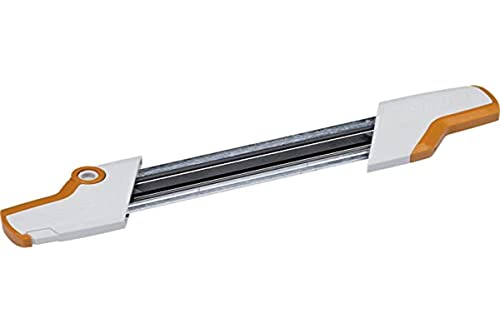
Each cutter has a top plate angle, usually 25 to 35 degrees depending on the chain, and a side plate angle. If the left cutters are filed at 30 degrees and the right at 20, they cut differently and the saw curves. A file guide or a roller guide holds the angle; freehand filing rarely keeps it the same on both sides. Set the guide to the angle stamped on the chain packaging or in the saw manual and keep the file level, with about a fifth of its diameter above the top plate.
Cause three: depth gauges
The depth gauge, or raker, is the small tooth in front of each cutter that sets how deep the cutter bites. If the gauges on one side are filed lower than the other, that side bites deeper and pulls the saw. Set every gauge with a depth gauge tool after every second or third sharpening: lay the tool over the chain, file any gauge that protrudes above its slot flat, and round the front corner. Gauges that are never filed make a chain that will not cut; gauges filed unevenly make one that cuts crooked.
Cause four: the bar
The chain rides on two rails on the edge of the bar, and they wear. If one rail wears lower than the other, the chain tilts and cuts at an angle even when it is perfectly sharp. Lay a straightedge across the bar at the rails: it should sit flat. Dress uneven rails with a flat file or a bar dressing tool until they are square, and remove the burr that forms on the outside. A groove worn wider than the drive links lets the chain lean; check by holding the bar flat and trying to rock the chain side to side. Flip the bar every time the chain comes off so both rails wear evenly, and replace a bar that is bent, blued or worn past dressing.
Cause five: tension and damage
A loose chain wanders and a chain that has hit a stone or dirt on one side is dull on that side only. Tension the chain so it pulls away from the bar a quarter inch and snaps back. Look for cutters on one side with chipped corners or rolled edges; those need filing back past the damage, and the other side filed to match.
Sharpening so it cuts straight
Clamp the bar in a stump vise or a bench vise. Mark the first cutter with a marker. File every cutter on one side with the same number of strokes at the same angle, using a guide, then turn the saw or move to the other side and file every cutter on it with the same count and angle. Measure a few cutters on each side and file the long ones to match. Set the depth gauges with the tool. Check the rails with a straightedge and dress them. Tension the chain and test on a clean log; a straight cut should produce chips of the same size from both sides of the kerf.
When to stop filing
If one side has been filed so far back that matching it means removing most of the other side, or if the cutters are near the wear marks on the top plate, a new chain costs less than the time. Buy two chains, swap them as they dull, and sharpen both evenly on a bench where the angle can be held.
How we research
We compare published manufacturer specifications, official manuals, warranty information and recurring owner feedback. Rankings are research-based unless original YardToolLab test evidence is explicitly shown on the page.
FAQs
One side of the chain is taking a bigger bite than the other, usually because its cutters are longer or sharper, or because the bar rails are worn unevenly and tilt the chain.
Use a file guide, keep the same angle on both sides, give every cutter the same number of strokes, measure cutter lengths with calipers and file the long ones to match, then set depth gauges with a gauge tool.
Yes. Rails worn to different heights tilt the chain, and a groove worn wide lets it lean. Dress the rails flat with a flat file or replace the bar.
If the cutters on one side are much shorter than the other and cannot be matched without filing most of the tooth away, a new chain is cheaper than the time.
Related guides

Stihl 2-in-1 Easy File Review: The Sharpener Every Saw Owner Should Have

Best Chainsaw Sharpeners, Ranked

Granberg Bar-Mount Chain Sharpener (Model 12) Review
Timberline Sharpener (Model 100) Review
Dremel 7300-PT Pet Nail Grinder (Modified for Chainsaw) Review
Oregon 520-120 Bench Mount Sharpener Review