A cordless pole saw is worth it for a few trees with limbs under about 6 inches and within 12 feet, especially on a battery platform you already own. It is not worth it for wooded lots, thick limbs or a one-off job. Here is the full case, with costs, runtime and safety.
The short answer
Yes, a cordless pole saw is worth it if you have a few trees that need yearly pruning, the limbs are under about 6 inches thick and within about 12 feet of the ground, you would rather not run a cord across the yard, and especially if you already own packs on a battery platform. It is not worth it if you have a wooded lot with heavy limbs, limbs higher than a pole saw safely reaches, or no battery platform yet and only one or two cuts a year to make. In the first case it replaces a yearly arborist visit within a season or two; in the second it is money spent on a tool that either cannot do the job or will sit in the garage.
When it is worth it
The cordless pole saw earns its keep on a suburban lot with fruit trees, crabapples, maples or oaks whose lower limbs creep over the roof, the driveway or the lawn every year. Those limbs are 2 to 5 inches across, 8 to 12 feet up, and there are a dozen or two of them a season. A battery saw with an 8 inch bar takes each one in a minute, with no cord to snag on branches or drag over wet grass, no pull start and no fuel. If you already own a 40V, 56V or 80V mower or trimmer, the bare tool is the smaller part of the cost and the packs you have will run it for an afternoon. Storm cleanup is the other case: a limb down in the yard or a split branch hanging over the fence, and a pole saw clears it the same day without waiting a week for a crew.
When it is not
A cordless pole saw is the wrong buy for a large, wooded property where there are hundreds of limbs and many are thick. The 8 or 10 inch bar and the motor are sized for limbs to about 6 inches, and a chain stalling in an 8 inch oak limb overhead is dangerous and slow. Those jobs want a gas pole saw, a chainsaw from the ground after the limb is dropped, or a crew. It is also the wrong buy if the limbs are 15 feet and higher; no homeowner pole saw reaches that safely, and a ladder plus a pole saw is how people get hurt. And if you have no battery platform yet, two or three cuts a year, and a manual pole saw or an arborist would do, the pack and charger double the price of the tool for a job that barely uses it.
Cost of ownership versus an arborist
An arborist visit for light pruning on a few trees typically runs a few hundred dollars, more for tall trees or anything near wires, and it repeats every year or two. A cordless pole saw bought bare on an existing platform, plus a spare chain and a bottle of bar oil, is a one-time outlay that pays back on the first or second visit it replaces. Buy the saw with a pack and charger and the payback stretches to two or three visits, which is still a good deal if the pruning is yearly. The arborist stays the better choice for big limbs, tall crowns, anything near a power line and any tree you care about enough to want it pruned by someone who knows where to cut; a pole saw does not come with that judgment.
Runtime
A cordless pole saw does not run continuously the way a mower does; the chain spins only while cutting. On a 4 Ah pack of 40V or so, expect 20 to 45 minutes of actual chain time, which is roughly 40 to 100 cuts of limbs 2 to 4 inches thick, and more on a bigger pack. That is a full afternoon of pruning on a normal lot. A 2 Ah pack lasts half that and makes a lighter saw, which overhead is a fair trade. Cold weather and a dull chain cut runtime sharply, so keep a spare chain and prune in mild weather. If you find yourself out of charge mid-job more than once a season, a second pack is cheaper than a gas saw.
Safety and the limits
A pole saw is a chainsaw on a stick held over your head, and the risks are the same as any chainsaw plus two more: the limb falling on you, and power lines. Stand to the side of the limb, never under it; undercut first so the bark does not strip; make the final cut from above and step back as it drops. Keep 10 feet from any overhead line and call the utility for anything closer. Wear a helmet with a face shield, eye protection and gloves, and never climb a ladder with a running pole saw. Within those limits a cordless pole saw is one of the safer power tools in the garage, because it starts and stops on a trigger and there is no cord to catch on a branch.
How to buy one well
Buy on the platform you already own, bare, with an 8 inch bar, a telescoping pole to about 10 feet, an automatic oiler and a total weight under 10 pounds with the pack. If you are starting fresh, pick the platform by the mower or trimmer you want next and buy the pole saw as the second tool on it. Add a spare chain and a quart of bar oil, and if the trees are few and the limbs small, consider a manual pole saw first and upgrade only if you find yourself out there every weekend.
A decision in three questions
Are the limbs under about 6 inches thick and within about 12 feet of the ground? Do you already own, or plan to buy, a battery platform? Will you prune every year, or clear storm damage more than once? Three yeses and a cordless pole saw is worth it and will pay for itself. Two yeses and it is a reasonable buy. One or none, and the money is better spent on a manual pole saw for the small jobs and an arborist for the rest.
How we research
We compare published manufacturer specifications, official manuals, warranty information and recurring owner feedback. Rankings are research-based unless original YardToolLab test evidence is explicitly shown on the page.
FAQs
With an 8 inch bar, limbs to about 6 inches in one pass; a 10 inch bar handles about 8 inches. Thicker limbs stall the chain and are better left to a chainsaw from the ground or an arborist.
About 20 to 45 minutes of actual cutting on a 4 Ah pack, which is dozens of limbs. The chain only runs while cutting, so one pack covers most afternoons of pruning.
For light yearly pruning on a few trees, a pole saw bought bare on an existing platform pays for itself in one or two visits. For tall trees, big limbs or anything near wires, hire the arborist.
Yes, with basic rules: stand to the side of the limb, undercut first, keep 10 feet from power lines, wear a helmet and face shield, and never use it from a ladder.
Related guides

Heavy Duty Pole Saws: The Three 56V and 60V Brushless 10-Inch Saws Worth Buying for Thick Limbs
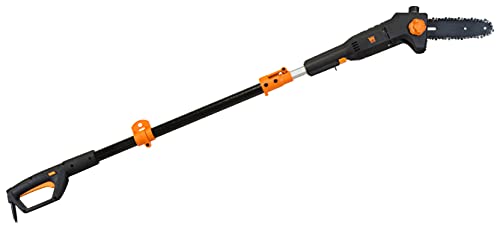
Budget Pole Saws That Plug In: Three Corded 6 to 8 Amp Saws With No Battery to Buy

Pole Saws for Beginners: Three 20V Kits That Include the Battery and Keep the Cuts Simple

Best Telescopic Pruner for High Tree Branches: Three Fiskars Pole Pruners From 8 to 16 Feet

Best Battery Pole Saw for Tall Palm Fronds: Three 10-Inch Pole Saws With the Reach and Bite for Frond Bases

Best Pole Saw for Narrow Backyard Spaces: Three Cordless Pole Saws That Reach Up Without Swinging Wide
Best Chainsaws & Tree Tools of 2026
