A pole saw is chosen by reach, bar length, power source and weight, with safety rules that decide what you should cut at all. Here is how each spec plays out, what an auto oiler and chain speed add, and what a beginner should buy.
The short answer
For most yards a cordless pole saw with an 8 inch bar, a reach of 10 to 12 feet and a weight under about 10 pounds with the pack is the right buy, and if you already own packs on a 40V or 56V platform, buy it bare. Go corded if the trees are within 100 feet of an outlet and you want the lightest tool. Go gas only for a large property or limbs over about 6 inches, and go manual if you have a couple of trees and a season of light pruning. Reach and weight matter more than power; a saw you can hold steady at full stretch is the one that cuts cleanly.
Reach
Pole saws list a reach of 8 to 15 feet, and the figure usually includes the user, so a 12 foot reach is an 8 foot pole plus the height of an average person with a raised arm. Measure the limbs you actually need to cut. Most pruning on fruit trees, ornamentals and the low crowns of shade trees is between 8 and 12 feet off the ground. Longer poles reach higher but flex, wander at the tip and put the saw at a steep angle, where it tires your shoulders in minutes and the chain cuts poorly. Anything above about 15 feet is arborist work from a bucket, not pole saw work, and the makers say so in their manuals.
Bar length
Bars run 6 to 12 inches, and 8 or 10 inches covers nearly every home. An 8 inch bar cuts limbs to about 6 inches in diameter in one pass and is lighter at the end of the pole, where weight matters most. A 10 inch bar handles limbs to about 8 inches and suits a bigger motor. Longer bars on a pole are a mistake; the extra weight at the tip makes the saw hard to control overhead and tempts people to cut limbs that should come down in sections. Check that replacement chains for the bar are easy to find, since pole saw chains are small and dull fast on dirty bark.
Corded, battery, gas or manual
A corded pole saw is the lightest and cheapest powered option, about 7 to 8 pounds, and never runs out, but the cord is a hazard overhead and limits you to the outlet. A cordless pole saw is the all-round choice: quiet, starts on a trigger, 8 to 12 pounds with the pack, and 20 to 45 minutes of actual cutting on a 4 or 5 Ah pack, which is a lot of limbs. A gas pole saw is the most powerful and longest running, at 15 to 20 pounds, with the noise, fumes and maintenance of a two-stroke; it earns its weight on acreage. A manual pole saw, a curved blade on a pole with a rope-pulled lopper, costs little, weighs 4 or 5 pounds, never needs charging and cuts limbs to about 2 inches with the lopper and bigger with the blade; it is the sensible first tool for light pruning.
Weight and balance
Every pound at the saw end feels like three at full reach. Compare weights with the pack fitted, and look at where the motor sits: a motor at the saw end gives the most power to the chain but the worst balance; a motor at the handle end with a drive shaft inside the pole balances better. A smaller pack on a lower voltage platform is often the better pole saw for the same reason. A shoulder strap and a foam grip at the balance point are worth having, and a saw under 10 pounds is where most people can still hold it steady overhead for a full cut.
Telescoping or fixed
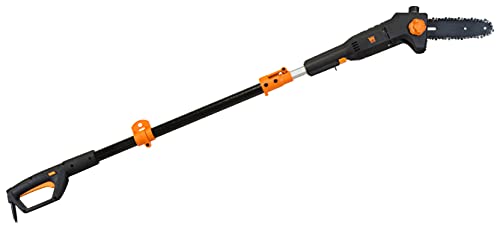
A telescoping pole extends from about 6 to 10 feet with a cam lock or twist collar, and lets you work short for control and long for height. A fixed pole in sections is stiffer and cheaper, but you choose its length when you assemble it. Telescoping is the better buy for mixed trees. Check the lock: a cam lever that stays tight when the pole is twisted and does not slip under load is the part that fails first on cheap saws.
Auto oiler and chain speed
A pole saw chain needs bar oil constantly; an automatic oiler with a visible reservoir and an adjustable flow is standard on good saws and missing on the cheapest. A saw without one needs the chain oiled by hand every few cuts, which overhead is a chore people skip until the chain burns. Chain speed, listed in meters or feet per second, decides how cleanly the saw cuts; about 6 to 8 meters a second is typical on battery pole saws and plenty for limbs to 6 inches. Higher speed with a sharp chain cuts faster and binds less, but sharpness matters more than the number.
Safety
A pole saw puts a running chain 10 feet over your head, and three rules keep it safe. First, power lines: never use any pole saw, including a fiberglass manual one, within 10 feet of an overhead line, and treat every line as live. Second, kickback: cut with the bottom of the bar, keep the tip clear of the limb and nearby branches, and bring the saw down into the cut at a modest angle rather than straight up. Third, stand to one side of the limb, never under it, with a clear path to step back; make a shallow undercut first so the limb does not strip bark down the trunk, then cut from above. Wear a helmet with a face shield, gloves and eye protection, keep bystanders two limb-lengths away, and never work from a ladder with a powered pole saw.
What a beginner should buy
A cordless pole saw with an 8 inch bar, a telescoping pole to about 10 feet, an auto oiler, a tool-free chain tensioner and a total weight under 10 pounds with a 2.5 to 4 Ah pack. Buy it on a battery platform you already own or plan to build. If the trees are few and small, a manual pole saw with a lopper does the same job for a fraction of the price and weight, and it is the one to start with before deciding whether a powered saw is worth it.
How we research
We compare published manufacturer specifications, official manuals, warranty information and recurring owner feedback. Rankings are research-based unless original YardToolLab test evidence is explicitly shown on the page.
FAQs
Most list 8 to 15 feet, counting the user. Practical control runs out at about 12 feet; beyond that the pole flexes and the steep angle makes clean cuts hard.
8 inches for most homes, cutting limbs to about 6 inches across. A 10 inch bar handles limbs to about 8 inches but adds weight at the tip, where it is felt most.
Cordless is more convenient and safer overhead because there is no cord to snag. Corded is lighter, cheaper and never runs out if the trees are within reach of an outlet.
No. Stay at least 10 feet from any overhead line with any pole saw, including manual fiberglass ones, and call the utility for limbs near lines.
Related guides

Heavy Duty Pole Saws: The Three 56V and 60V Brushless 10-Inch Saws Worth Buying for Thick Limbs
Budget Pole Saws That Plug In: Three Corded 6 to 8 Amp Saws With No Battery to Buy

Pole Saws for Beginners: Three 20V Kits That Include the Battery and Keep the Cuts Simple

Best Telescopic Pruner for High Tree Branches: Three Fiskars Pole Pruners From 8 to 16 Feet

Best Battery Pole Saw for Tall Palm Fronds: Three 10-Inch Pole Saws With the Reach and Bite for Frond Bases

Best Pole Saw for Narrow Backyard Spaces: Three Cordless Pole Saws That Reach Up Without Swinging Wide
Best Chainsaws & Tree Tools of 2026
