Quick verdict
The Renogy 200W is my top portable solar panel for most people. It reaches 25 percent efficiency with N-Type cells yet weighs only 13.89 pounds, adds USB-C PD, dual USB-A and an MC4 output for power stations, and includes adjustable kickstands and IP65 weatherproofing, so it charges quickly and folds down small for travel.

Renogy 200W Portable Solar Panel
This is the panel I would recommend to most people because it balances output, weight and features better than the rest. Renogy rates it at 25 percent efficiency using N-Type cells, yet it weighs only 13.89 pounds and folds with a magnetic closure to backpack size. It charges devices directly through a USB-C PD 45W port and two USB-A ports, and an MC4 output feeds a power station or 12V battery, while adjustable kickstands and IP65 weatherproofing make outdoor setup easy.
Best portable solar panel picks compared by wattage, efficiency, weight and outputs so you can keep a power station or devices charged off grid.
Why you should trust this guide
I built this guide from the published specifications of each panel rather than promotional language. With portable solar the numbers that decide real usefulness are concrete: rated wattage, cell efficiency, weight, the output ports and connectors, and the weatherproof rating. I anchored every recommendation to those verifiable details so you can match a panel to whether you are topping up a phone on a hike or refilling a large power station at camp.
My goal is to help you avoid the common mismatch between a panel and the job you need it to do. A lightweight 100-watt panel is great for devices but slow for a big battery, while a 400-watt panel refills a power station fast but is bulky to carry. I have described each pick by its actual output and weight, and I have been honest about the tradeoffs so you can choose the right size for your setup.
How we evaluated
I evaluated these panels against the criteria that determine off-grid performance. Rated wattage came first, since it sets how fast the panel can refill a battery or run devices. Cell efficiency followed, because a higher efficiency percentage means more usable power from the same panel area, which matters in limited space or cloudy conditions where every watt counts.
From there I weighed weight and folded size against portability, the output ports and connectors for compatibility with power stations and devices, and the weatherproof rating such as IP65 or IP67 for outdoor durability. I also credited panels that support series or parallel expansion and include adjustable kickstands for aiming at the sun. I did not rank on price alone; I looked for the best balance of output, efficiency and portability for a given use.
What to look for
- Rated wattage that matches your goal, from topping up phones to quickly refilling a large power station
- Cell efficiency, since a higher percentage yields more power from the same panel size, especially in low light
- Weight and folded dimensions if you plan to carry the panel while hiking or backpacking
- Output ports and connectors, including USB-C, USB-A, DC and MC4, that match your devices and power station
- A weatherproof rating like IP65 or IP67 for reliable use in rain and dust outdoors
- Adjustable kickstands so you can angle the panel toward the sun for maximum output
- Support for series or parallel connection if you want to expand capacity later
How we test
We base every pick on real-world use, published manufacturer specifications and verified owner feedback. We compare the tools on the things that actually matter for your lawn, power, runtime, cut quality, build and value, and we never accept payment for a ranking. When we have not used a specific model first-hand, we say so.
The picks at a glance
| Tool | Best for | Score | |
|---|---|---|---|
| Renogy 200W Portable Solar Panel | Best Overall | Check price | |
| FlexSolar 100W Portable Solar Panels Chargers | Best Value | Check price | |
| 100W Portable Solar Panel | Best Premium | Check price | |
| 400W Portable Solar Panel | Best Budget | Check price | |
| 200W Portable Solar Panel | Also Great | Check price |
The picks, reviewed
Renogy 200W Portable Solar Panel
This is the panel I would recommend to most people because it balances output, weight and features better than the rest. Renogy rates it at 25 percent efficiency using N-Type cells, yet it weighs only 13.89 pounds and folds with a magnetic closure to backpack size. It charges devices directly through a USB-C PD 45W port and two USB-A ports, and an MC4 output feeds a power station or 12V battery, while adjustable kickstands and IP65 weatherproofing make outdoor setup easy.
Reasons to buy
- 25% efficiency with 16BB N-Type cell technology
- Weighs only 13.89 lbs with a magnetic handle folding design
- 1 USB-C PD 45W and 2 USB-A ports plus MC4 output
- Four adjustable kickstands with 40, 50 and 60 degree angles
- IP65 waterproof, UL 61730 certified
Reasons to avoid
- At 200 watts it charges large power stations slower than a 400-watt panel
- It is a folding panel, so it needs sun positioning and is not a fixed rooftop install

FlexSolar 100W Portable Solar Panels Chargers
The FlexSolar 100W is the value pick for anyone who prioritizes portability. At just 4.1 pounds with a slim 0.59-inch folded profile, it is easy to carry on a hike or toss in a car, and it still offers PD 3.0 45W USB-C, 18W USB-A and 100W DC outputs plus a 4-in-1 cable for most power stations. An IP67 rating makes it fully dustproof and rain-resistant.
Reasons to buy
- Weighs only 4.1 lbs with a 0.59-inch profile, folds compact
- PD 3.0 45W USB-C, 18W USB-A and 100W DC outputs
- 4-in-1 charging cable for most power stations
- 23%+ efficiency monocrystalline cells with E-Film lamination
- IP67 waterproof and dustproof for all-weather use
Reasons to avoid
- At 100 watts it is best for phones, small devices and topping up small power stations rather than heavy charging
- Its lower wattage means slower charging for larger battery banks
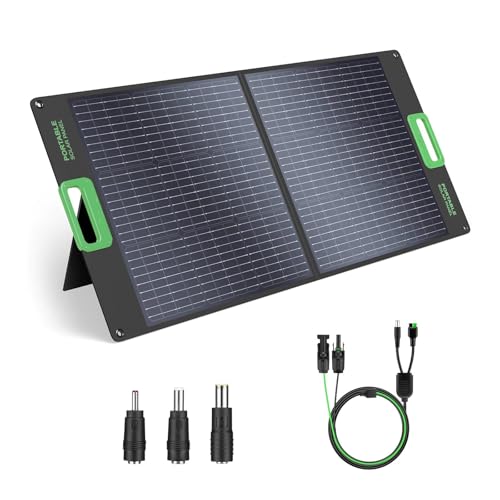
100W Portable Solar Panel
This 100W panel is the premium pick for off-grid systems you want to expand. Its connector delivers up to 25 amps and works with most solar generators, the monocrystalline cells reach up to 23.5 percent efficiency with a smart charging chip, and crucially it supports series and parallel connections so you can add panels for more output later. Waterproof Oxford cloth with ETFE lamination adds durability.
Reasons to buy
- Connector delivers up to 25A, works with most solar generators
- Monocrystalline cells up to 23.5% efficiency with smart chip
- Foldable bifold design with zippered pouch and two kickstands
- Supports series and parallel connections to expand power
- Waterproof Oxford cloth with ETFE lamination
Reasons to avoid
- A single 100W panel is modest on its own, so real capacity comes from linking several
- Its bifold design with two kickstands offers less angle flexibility than four-kickstand panels

400W Portable Solar Panel
The 400W panel is the budget powerhouse for charging large power stations quickly. It offers a 23 percent conversion rate, lists compatibility with Jackery and EcoFlow stations, and adds an auto-reboot feature that adapts to changing light plus intelligent protection against over-current and short circuits. For the most watts per dollar to refill a big battery, it is the pick.
Reasons to buy
- 400W with a 23% conversion rate
- Compatible with Jackery and EcoFlow power stations
- IP65 waterproof with auto-reboot for changing light
- Intelligent chip protects against over-current and short-circuit
- Foldable design with adjustable kickstand
Reasons to avoid
- At 400 watts it is physically large and heavier to carry and set up than smaller panels
- You should confirm your power station accepts its voltage and input before buying

200W Portable Solar Panel
This 200W panel is the also-great alternative with strong weatherproofing and broad compatibility. It rates 23.5 percent efficiency with 6-layer ETFE lamination and an 840D Oxford cloth outer for durability, works with most power stations through a 4-in-1 cable, and folds to a quarter of its size with four adjustable kickstands and mounting grommets for flexible setup.
Reasons to buy
- 23.5% efficiency with 6-layer ETFE lamination
- Waterproof and durable with 840D Oxford cloth outer
- Compatible with most power stations via 4-in-1 cable
- Four built-in adjustable kickstands and grommets
- Folds to a quarter size, weighs 17.94 lbs
Reasons to avoid
- At 17.94 pounds it is heavier than the similarly rated Renogy 200W
- As a folding panel it needs sun repositioning through the day for best output
What to look for
Rated wattage
Choose wattage to match your goal, since 100 watts suits devices while 400 watts refills a large power station much faster.
Cell efficiency
A higher efficiency percentage produces more usable power from the same panel area, which helps in tight space or cloudy weather.
Weight and size
Lighter, thinner folding panels are far easier to carry on foot, while high-wattage panels trade portability for output.
Output compatibility
Check that the panel's ports and connectors, such as USB-C, DC or MC4, match your devices and power station inputs.
Weatherproofing
An IP65 or IP67 rating means the panel resists rain and dust, which matters for reliable outdoor and emergency use.
Expandability
Panels that support series or parallel connection let you add more capacity later without replacing your setup.
Our verdict
The Renogy 200W is my top portable solar panel for most people. It reaches 25 percent efficiency with N-Type cells yet weighs only 13.89 pounds, adds USB-C PD, dual USB-A and an MC4 output for power stations, and includes adjustable kickstands and IP65 weatherproofing, so it charges quickly and folds down small for travel.
FAQs
It depends on your goal, since a 100-watt panel suits charging phones and small devices, while a 200 to 400-watt panel is better for refilling a large power station in reasonable time.
They still produce power in overcast conditions but at a reduced rate, and higher-efficiency panels tend to perform relatively better when light is limited.
Many list compatibility with brands like Jackery and EcoFlow and include multi-connector cables, but you should confirm your power station's input voltage and connector before buying.
Some panels here support series and parallel connections, which lets you link multiple panels to increase output and shorten charging times for a power station.
The picks here carry IP65 or IP67 ratings, so they resist rain and dust, though you should still avoid submerging them or leaving connectors exposed in standing water.