Quick verdict
The Generac 26kW is the standby generator I would point most larger homes toward. It is sized to cover a whole house including central air, adds built-in cellular monitoring through the Mobile Link app, and includes oil-level sensors and cold-start features that keep it ready for the outage you did not plan for.

Generac 26kW Home Standby Generator
The Generac 26kW is the pick for a larger home because it is sized to carry a whole house, including refrigeration, heating and cooling, without shedding major loads. It adds built-in cellular connectivity so you can watch status and maintenance alerts in the Mobile Link app, and Generac includes oil-level sensors plus improved cold-start and a sloped roof to shed ice. Every unit ships with a five-year limited warranty and 24/7 support, which matters for something wired into your house.
Check price on Amazon →The best standby generator for whole-house backup. Compared Generac 10kW to 26kW units plus a portable dual-fuel option by coverage, fuel, monitoring and
Why you should trust this guide
A standby generator is a permanent fixture that sits beside the house, watches the utility line, and starts on its own within seconds of an outage using an automatic transfer switch. That automation and whole-home capability are what separate it from a portable unit, and they are also what make sizing the single most important decision. The kilowatt rating on the label tells you how much of your home the generator can carry at once, and getting that wrong means either shedding major appliances or overpaying for capacity you never use.
I have not installed these specific units, and I will not claim to have. What this guide does is compare the manufacturer specifications, the kilowatt output, the transfer switch amperage, the fuel type, the monitoring features and the warranty, and translate them into which size fits which home. Because these products are wired into your electrical panel, I also flag the install realities that a spec sheet leaves out, like the need for a licensed electrician and a gas hookup.
How we evaluated
Sizing came first. A 10kW unit is built to cover essential circuits, while stepping up through 14kW, 22kW and 26kW brings progressively more of the home online, including central air conditioning on the larger models. I looked at the paired transfer switch amperage for each, since a 100 Amp switch handles a subset of circuits while a 200 Amp switch is aimed at whole-home coverage, and matched those to typical house sizes.
From there I weighed the features that affect living with the generator for years. Remote monitoring through an app tells you the unit is healthy between outages, clean power with low harmonic distortion protects sensitive electronics, and fuel flexibility between natural gas and propane decides how it is supplied. I also noted warranty length and cold-weather features, since a standby generator only earns its cost if it actually starts when the storm arrives.
What to look for
- Kilowatt rating matched to your home size, since it sets how many circuits run at once during an outage.
- Transfer switch amperage, where a 100 Amp switch covers essentials and a 200 Amp switch targets whole-home coverage.
- Fuel type, natural gas for a continuous supply or liquid propane for homes without a gas line.
- Remote monitoring, which lets you confirm the unit is healthy and get maintenance alerts between outages.
- Clean power output, measured as low total harmonic distortion, to safely run computers and electronics.
- Warranty length and support, because a permanently installed unit is a long-term investment.
- Installation requirements, including a licensed electrician and a fuel hookup, which add real cost beyond the generator.
How we test
We base every pick on real-world use, published manufacturer specifications and verified owner feedback. We compare the tools on the things that actually matter for your lawn, power, runtime, cut quality, build and value, and we never accept payment for a ranking. When we have not used a specific model first-hand, we say so.
The picks at a glance
| Tool | Best for | Score | |
|---|---|---|---|
| Generac 26kW Home Standby Generator | Best Overall | Check price | |
| Generac Guardian 10kW Home Standby Generator | Best Value | Check price | |
| Generac Guardian 22kW Home Standby Generator | Best Premium | Check price | |
| Generac 14kW Home Standby Generator | Best Budget | Check price | |
| Westinghouse 12500 Watt Dual Fuel Home Backup Portable Generator | Also Great | Check price |
The picks, reviewed
Generac 26kW Home Standby Generator
The Generac 26kW is the pick for a larger home because it is sized to carry a whole house, including refrigeration, heating and cooling, without shedding major loads. It adds built-in cellular connectivity so you can watch status and maintenance alerts in the Mobile Link app, and Generac includes oil-level sensors plus improved cold-start and a sloped roof to shed ice. Every unit ships with a five-year limited warranty and 24/7 support, which matters for something wired into your house.
Reasons to buy
- Whole House Protection: Keep your family comfortable and connected during power outages. A
- Lowest Total Cost Of Ownership: Electronic fuel & ignition control optimizes fuel use for
- Remote Monitoring & Control: Built-in Cellular Connectivity allows you to monitor performa
- Superior Reliability: Oil level sensors monitor oil level to help ensure generator readine
- Long Term Assurance: Every Generac Standby Generator comes with a 5-year limited warranty
Reasons to avoid
- Standby generators require professional installation and a gas hookup, which adds significant cost beyond the unit
- Remote monitoring features rely on a Mobile Link premium subscription

Generac Guardian 10kW Home Standby Generator
The 10kW Guardian is the value entry because it pairs a whole-home-ready generator with a 100 Amp 16-circuit transfer switch, so it covers the essential circuits most families care about during an outage. Generac lists Wi-Fi Mobile Link monitoring, True Power Technology with under 5 percent harmonic distortion for clean output, and a five-year limited warranty. It runs on natural gas or liquid propane, which keeps you off the gas-can routine.
Reasons to buy
- Remote Monitoring Anywhere: With Generac 7172 10kW Mobile Link Wi-Fi connectivity, effortl
- Whole House Protection: Keep your home powered during outages with Generac’s 100 Amp 16-ci
- Long-Term Assurance: Backed by a 5-Year Limited Warranty, this automatic transfer switch d
- High-Quality 10kW Power: True Power Technology delivers clean, stable 10,000 watts with un
- Crafted for Excellence: Proudly engineered and assembled in the USA, our generators stand
Reasons to avoid
- At 10kW it covers essential circuits rather than a large home with central air
- Generac recommends installation by a licensed electrician, adding to the total cost
Generac Guardian 22kW Home Standby Generator
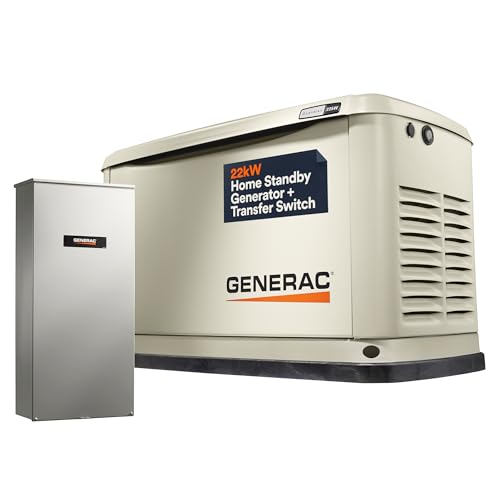
The 22kW Guardian is the premium residential choice, with a 200 Amp NEMA 3R smart transfer switch designed for whole-home coverage in an outdoor aluminum enclosure. It delivers clean 22,000-watt output with under 5 percent THD, adds Wi-Fi Mobile Link monitoring, and carries the same five-year limited warranty as the rest of the line. It slots in for buyers who want near-top-tier coverage without going to the 26kW.
Reasons to buy
- Remote Monitoring Anywhere: With Generac 7043 22kW Mobile Link Wi-Fi connectivity, effortl
- Whole House Protection: Enjoy comprehensive coverage with Generac's 200 Amp NEMA 3R smart
- Long-Term Assurance: Backed by a 5-Year Limited Warranty, this automatic transfer switch d
- High-Quality 22kW Power: True Power Technology delivers clean, stable 22,000 watts with un
- Crafted for Excellence: Proudly engineered and assembled in the USA, our generators stand
Reasons to avoid
- It still needs a licensed electrician and a fuel hookup to install
- For very large homes the 26kW may be a better fit despite the higher price
Generac 14kW Home Standby Generator
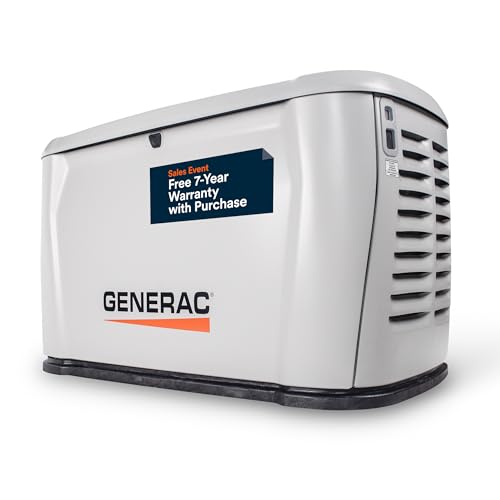
The Generac 14kW is the budget whole-home step because it brings the same built-in cellular monitoring, electronic fuel and ignition control and oil-level sensors as the 26kW in a smaller, less expensive package. It is compatible with the Generac Home Energy ecosystem, including ecobee thermostats and PWRcell batteries, if you want to expand later. It suits a mid-size home that does not need the full 26kW capacity.
Reasons to buy
- Whole House Protection: Keep your family comfortable and connected during power outages. A
- Lowest Total Cost Of Ownership: Electronic fuel & ignition control optimizes fuel use for
- Remote Monitoring & Control: Built-in Cellular Connectivity allows you to monitor performa
- Superior Reliability: Oil level sensors monitor oil level to help ensure generator readine
- Compatible with the Generac Home Energy Ecosystem: Compatible with ecobee by Generac therm
Reasons to avoid
- 14kW may require shedding some large loads in a bigger house
- Cellular monitoring depends on a Mobile Link premium subscription

Westinghouse 12500 Watt Dual Fuel Home Backup Portable Generator
The Westinghouse 12500 is the portable alternative for buyers who want backup without a permanent install. It runs on gas or propane, delivers 9,500 running and 12,500 peak watts, and is transfer-switch ready with an L14-30R and a 50A RV outlet so an electrician can tie it to a manual switch. Remote electric start, a key fob and a digital hour meter make it practical to bring out only when a storm hits.
Reasons to buy
- 9500 Running Watts and 12500 Peak Watts (Gasoline); 8500 Running Watts, 11200 Peak Watts (
- Features Two GFCI 120V 5–20R 20A Standard Household Receptacle, One Transfer Switch Ready
- Powered by a Heavy Duty 457cc Westinghouse 4-Stroke OHV Engine Featuring a Long-Lasting Ca
- Plug-and-Play: Comes with a Remote Start Key Fob, 12V Battery Charger, Oil, an Oil Funnel,
- All Westinghouse Portable Generators are Functionally Tested in the Factory and May Contai
Reasons to avoid
- A portable unit must be started and refueled manually and cannot auto-start like a standby
- It has to run outdoors well away from the home for safe carbon monoxide venting
What to look for
Kilowatt sizing
The kilowatt rating sets how much of your home runs at once, so match it to house size and whether you need central air.
Transfer switch amperage
A 100 Amp switch covers essential circuits while a 200 Amp switch aims at whole-home coverage.
Fuel type
Natural gas gives a continuous supply where a line exists, while propane suits homes without gas service.
Remote monitoring
App-based monitoring confirms the unit is healthy and sends maintenance alerts between outages.
Power quality
Low total harmonic distortion means the output is clean enough to run computers and sensitive electronics.
Installation cost
A standby unit needs a licensed electrician and a fuel hookup, so budget for install beyond the generator price.
Our verdict
The Generac 26kW is the standby generator I would point most larger homes toward. It is sized to cover a whole house including central air, adds built-in cellular monitoring through the Mobile Link app, and includes oil-level sensors and cold-start features that keep it ready for the outage you did not plan for.
FAQs
It depends on your home. A 10kW unit covers essential circuits, while 22kW to 26kW models are sized for whole-home coverage including central air, so match the kilowatts to your house and the loads you must keep running.
Yes. A standby generator uses an automatic transfer switch to detect an outage and start within seconds, which is the main advantage over a portable unit you must start by hand.
No. These units wire into your electrical panel and connect to a gas supply, so Generac and other makers require installation by a licensed electrician for safety and warranty.
Natural gas offers a continuous supply if your home has a line, while propane works for homes without gas service. These Generac units run on either fuel.
A standby is permanently installed, auto-starts and can cover a whole house, while a portable like the Westinghouse must be started and refueled manually and run outdoors.