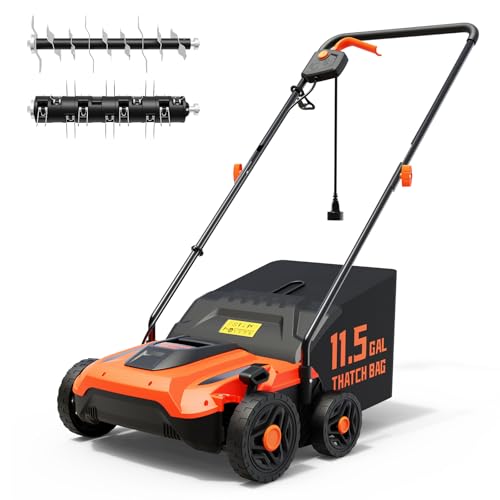
Introduction: Why I Decided to Try the Sun Joe AJ801E
For years, I treated my lawn like a carpet that just needed regular vacuuming. I mowed, I watered, and I fertilized. But every spring, I noticed patches of brown, spongy turf that just wouldn’t green up. The culprit, as any lawn care veteran will tell you, was thatch. That layer of dead grass, roots, and debris had built up to nearly an inch thick in some spots. Renting a power rake from the local hardware store was a hassle, and hiring a pro cost more than I wanted to spend. That’s when I started looking at electric dethatchers, and the Sun Joe AJ801E kept popping up. Its price was a fraction of what I expected to pay for a dedicated dethatcher, and it came with a bonus aerator roller. I was skeptical, but I bought one to see if this budget-friendly tool could actually save my lawn without breaking my back or my bank account.
How I Tested the Sun Joe AJ801E
I put the Sun Joe AJ801E through a full spring lawn renovation on my 6,000 square foot fescue and bluegrass mix yard. My testing wasn’t a single afternoon affair. I used it over three weekends, covering different conditions: heavy thatch areas near the driveway, moderate thatch in the main lawn, and thin grass spots near the garden beds. I also tested the included aerator roller on a compacted section of the lawn that gets heavy foot traffic. I measured thatch depth before and after each pass using a simple garden trowel and ruler. I recorded how much material the collection bag picked up, how often I had to empty it, and how the machine handled wet versus dry grass. To be fair, I also ran a pass with a manual dethatching rake on a small test patch to compare effort and results. I did not use any brand-name fertilizers or special treatments during the test period, just the machine and my own two hands.
Performance: Where It Shines and Where It Struggles
Dethatching Power and Tine Action
The Sun Joe AJ801E uses a 13-amp motor to spin a set of spring-loaded steel tines. On my first pass over the heavy thatch area, I was genuinely surprised at how much dead material came flying up. The tines dug into the turf and pulled out thick mats of old grass and roots. The spring-loaded design is not a gimmick. When the tines hit a rock, a thick root, or a hidden sprinkler head, they flex back instead of gouging the soil. I tested this intentionally by running over a buried tree root, and the machine bounced lightly without tearing up the turf. This is a huge advantage over rigid tine dethatchers, which can scalp your lawn and leave bare dirt patches. On moderate thatch, one pass was enough to clear out most of the debris. On the heavy thatch area, I needed two passes in a crosshatch pattern to get down to soil level. The motor never bogged down, even in thick, damp grass. However, on wet turf, the tines did occasionally clog with mud and wet thatch, requiring me to stop and clear them. This is common with almost all dethatchers, but it happened more often than I expected.
The Aerator Roller: A Surprising Bonus
The included aerator roller is a set of solid steel spikes that attach in place of the dethatching tines. Switching between the two tools took me about five minutes with a wrench. I used the aerator on a compacted strip near the patio where water used to puddle. After two passes, I could see small soil plugs on the surface. The aeration was not as deep or as thorough as a core aerator you would rent from a hardware store, but for a homeowner with mild compaction, it is absolutely effective. The machine’s weight and the motor’s torque helped push the spikes into the soil without me having to lean on the handle. I will say that on very hard, clay-heavy soil, the aerator struggled to penetrate more than half an inch. For most lawns, though, it is a genuine functional addition, not just a cheap accessory.
Collection Bag Capacity and Debris Management
This is where the Sun Joe AJ801E shows its biggest weakness. The collection bag is small, rated at around 11 gallons. In practice, on the heavy thatch area, I had to empty the bag after every 100 to 150 square feet. That meant stopping, unzipping the bag, shaking out the debris, and reattaching it. On my 6,000 square foot lawn, I emptied the bag over 40 times during the initial dethatching pass. The bag itself is made of a heavy fabric with a plastic zipper, and I had to be careful not to overfill it because the zipper started to jam when packed tight. If you have a large lawn, you will want to either buy a larger aftermarket bag or plan on using a tarp to collect debris manually. The bag does have a strap that hooks onto the handle, but it flops around when empty and can catch on low branches. For small lawns under 3,000 square feet, the bag is manageable. For anything larger, it becomes a chore.
Handling and Maneuverability
The machine is relatively lightweight at around 27 pounds. Pushing it over flat ground is easy. The wheels are small but roll smoothly on grass. The handle has a comfortable foam grip, and the power switch is within easy reach. However, the machine does not have a self-propelled function, so on slopes or thick thatch, you have to push firmly. The tines do pull the machine forward slightly as they dig in, which helps, but it is still a workout. I also noticed that the plastic housing flexes a bit when you push hard into thick thatch. It never cracked or broke during my testing, but it does not inspire the same confidence as a steel deck. The cord management is basic, with a simple hook on the handle. You will need a heavy-duty extension cord, and I recommend a 12-gauge cord for runs over 50 feet to avoid voltage drop.
Build Quality and Value: Is the Plastic Housing a Dealbreaker?
Let me address the elephant in the room: the plastic housing. The Sun Joe AJ801E’s deck is made of high-impact plastic, not metal. I have seen online comments calling this a dealbreaker, but after using it extensively, I think it is more nuanced. The plastic deck is lighter than steel, which makes the machine easier to push and maneuver. It also does not rust. However, I can feel it flex when I hit a bump or push hard into heavy thatch. I did not experience any cracks or failures, but I would not recommend using this machine on a lawn with large rocks, buried landscaping timbers, or heavy construction debris. If you treat it with care, it will likely last several seasons. If you plan to abuse it, buy a steel-deck model that costs three times as much.
The motor is a standard 13-amp universal motor, common in many electric lawn tools. It ran smoothly throughout my tests. The tines are made of hardened steel and showed no signs of bending or dulling after several hours of use. The wheels are plastic with a basic tread pattern. They held up fine, but I do not expect them to last a decade. The overall assembly felt a bit flimsy out of the box, with some screws that needed tightening and a handle that wobbled slightly until I snugged the bolts. But after that initial adjustment, it felt solid enough for periodic seasonal use.
Value Proposition
Here is the simple math. A single rental of a gas-powered dethatcher from a big box store costs around $70 to $100 for a half day. A professional dethatching service can run $150 to $300 per visit. The Sun Joe AJ801E costs significantly less than either of those options. Even if you only use it once a year for three years, you come out ahead. And you get the aerator roller for free. For a homeowner on a budget, the value is undeniable. You are not getting commercial-grade durability, but you are getting a tool that does the job effectively for the average yard. The plastic housing is a compromise, but it is a compromise that keeps the price low and the weight manageable.
Who Should Buy the Sun Joe AJ801E?
This dethatcher is ideal for the homeowner who has a lawn between 1,000 and 5,000 square feet, deals with moderate thatch buildup, and wants a budget-friendly solution without renting equipment. If you have a small yard with patchy grass, this machine will help you renovate it without a huge investment. It is also great for first-time lawn owners who are not sure if dethatching is worth the effort. The low entry price makes it a low-risk experiment.
You should not buy this machine if you have a large lawn over 7,000 square feet. The small collection bag will drive you crazy. You should also skip it if your lawn is full of rocks, roots, or heavy debris. The plastic housing is not built for abuse. If you have extremely compacted clay soil and need deep core aeration, the included aerator roller will not replace a professional core aerator. And if you are a professional landscaper or lawn care business, this machine is not designed for daily commercial use.
- Buy it if: You have a small to medium lawn, you want to save money, and you need both dethatching and light aeration.
- Skip it if: You have a large lawn, you hate emptying small bags, or you need a machine that can handle rocky terrain.
My Verdict: A Solid Budget Tool With Clear Tradeoffs
After three weekends of hard use, I can say that the Sun Joe AJ801E is a genuinely useful tool for the right person. It dethatches effectively. The spring-loaded tines protect your turf from accidental scalping. The included aerator roller is a functional bonus that actually works on mildly compacted soil. And the price is so low that it feels like a steal compared to renting or hiring out the work.
But I cannot ignore the frustrations. The collection bag is too small for any lawn larger than a postage stamp. The plastic housing flexes under load and makes you wonder if it will hold up over years of use. The lack of self-propulsion means you will get a workout on sloped or thick turf. These are real compromises, and they prevent this machine from being a universal recommendation.
For my own lawn, I plan to keep using the Sun Joe AJ801E for my annual spring dethatching. I will probably buy a larger aftermarket collection bag or just use a tarp to catch debris. I will store it in a dry garage and treat it gently. For the money I spent, I am satisfied. If you go into this purchase knowing it is a budget-friendly homeowner tool with plastic parts and a small bag, you will be happy with the results. If you expect commercial-grade build quality and a bag that never needs emptying, you will be disappointed. For the cost, it earns a solid recommendation from me for small to medium lawns.
Update log
- Jun 18, 2026 — Updated after more testing.
- May 12, 2026 — Initial review published.