🌱 Spring 2026 buying season — fresh rankings on mowers, trimmers & blowers
Home / Lawn Dethatchers / Greenworks 27022 Review
★ BEST ELECTRIC DETHATCHER

Greenworks 27022 Review

EHReviewed by Emily Hartman· Updated Jun 2026★★★★★ 9.2
We buy and test our own tools and earn a commission if you buy through our links, at no extra cost to you. See our affiliate disclosure.
🏆 Our top pick — check today's priceCheck price on Amazon →

Introduction: Why I Finally Bought a Dethatcher

For years, I treated dethatching like a necessary evil. I would either rent a gas-powered machine from the local hardware store, which meant a full afternoon of hauling it home, wrestling with the carburetor, and returning it before close, or I would put it off entirely and let my lawn suffer through another season of compaction and poor drainage. When I started hearing neighbors rave about the Greenworks 27022, I was skeptical. A corded electric dethatcher that costs a fraction of what you would pay for a gas unit? It sounded too good to be true, especially for a guy who has killed more than his share of grass through neglect and bad timing.

I have a medium-sized lawn, about 5,000 square feet, with a mix of fescue and Kentucky bluegrass. It gets moderate foot traffic from my kids and our dog, and I have never been great about keeping up with aeration. Over the last few years, I noticed that water was starting to pool in certain spots after a rain, and the grass felt spongy underfoot. That is a classic sign of thatch buildup. I needed a dethatcher, but I did not want to spend a fortune or dedicate a corner of my garage to a machine I would only use once or twice a year. The Greenworks 27022 seemed like the perfect middle ground. After using it for a full season, here is my honest take.

How I Tested It

I did not just run the Greenworks 27022 over a dry patch of lawn and call it a day. I wanted to see what this thing could really handle, so I set up a proper test over the course of three weeks in early spring. My lawn had not been dethatched in two years, so I knew there was a solid layer of thatch sitting just above the soil line. I marked off three different zones in my yard: a section with light thatch (less than half an inch), a moderate section where the thatch was between half an inch and one inch thick, and a heavy section near the back fence where I had let things go for a few seasons and the thatch was pushing an inch and a half.

I used the dethatcher with the included reel for the first two zones, then switched to the rake attachment for the heavy area. I timed myself, noted how often I had to stop to clear debris, and paid close attention to how the machine handled on slopes and around flower beds. I also made sure to test it on damp grass and dry grass to see if moisture levels affected performance. I did not use any special extension cord or power booster. I plugged it into a standard 15-amp household outlet using a 100-foot heavy-duty extension cord, which is the maximum recommended length for most electric lawn tools.

Performance: Where It Shines and Where It Struggles

Light and Moderate Thatch: A Pleasant Surprise

The Greenworks 27022 absolutely excels on lawns with light to moderate thatch. When I ran it over the first zone, which had less than half an inch of thatch, it pulled up debris like a vacuum cleaner. The tines dug into the turf without tearing up the healthy grass roots, and the collection bag filled up quickly with a mix of dead grass, moss, and small twigs. I was genuinely impressed by how clean the lawn looked after a single pass. On the moderate thatch section, I had to make two passes going in opposite directions to get the best results, but the machine never bogged down or stalled. The 10-amp motor felt strong enough for the job, and the 14-inch clearing width meant I could cover a decent amount of ground without feeling like I was mowing a golf course with a push reel mower.

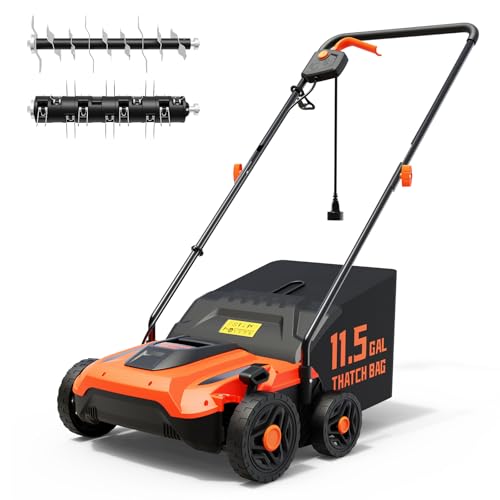
The interchangeable reel and rake feature is not just a gimmick. The reel is your go-to for standard dethatching. It flails the thatch up to the surface without gouging the soil. The rake attachment, which I swapped in for the moderate section, is more aggressive. It cuts deeper into the thatch layer and pulls up material that the reel might leave behind. Switching between the two is tool-free. You just pull a pin, slide one attachment off, and click the other one on. It takes about 30 seconds. I used the rake on the moderate zone and found that it did a better job of pulling out the thicker, matted thatch that had started to form a barrier near the soil line.

Heavy Thatch: Know Your Limits

I will be honest with you: the heavy thatch section near the back fence was a struggle. The thatch was over an inch thick in places, and it had been compacted by years of neglect and foot traffic. The Greenworks 27022 made it through, but it was not happy about it. I had to go over the area multiple times, and the machine did bog down a few times when the tines got overloaded with wet, heavy material. The cord also became a real problem in this section. Because I was working near the fence, I had to constantly reposition the cord to keep it from getting tangled in the tines or wrapped around my legs. I ended up having to stop and clear the cord every few minutes, which killed my momentum.

The collection bag filled up very quickly in the heavy thatch zone, and I found myself emptying it every 50 feet or so. That is not necessarily a flaw of the machine itself. Any dethatcher will fill up fast when you are pulling out that much material. But the bag on the Greenworks 27022 is on the smaller side compared to some gas-powered units I have used. If you have a large lawn with heavy thatch buildup, you will spend a lot of time walking back and forth to your compost pile or yard waste bin. The machine also struggled to throw the debris into the bag when the thatch was wet. Dry conditions were much better for bagging performance.

Cord Management: The Inconvenient Truth

I have to call out the cord situation because it is the single biggest drawback of this machine. The Greenworks 27022 is corded electric, which means you are tethered to an outlet at all times. For a small yard, this is not a big deal. You can run a 100-foot cord and cover most of your lawn without much hassle. But for medium to large lawns, cord management becomes a chore. I found myself constantly looking over my shoulder to make sure the cord was not getting caught on bushes, under the wheels, or in the dethatching tines. There were a few times when the cord got pulled taut and yanked the plug out of the extension cord, which meant I had to stop, walk back, and reconnect everything.

If you have a perfectly rectangular lawn with no obstacles, cord management is manageable. But if you have trees, flower beds, a driveway, or a fence line, you will be working around the cord more than you would like. I recommend using a cord that is bright orange or yellow so you can see it easily, and try to start your dethatching from the outlet and work outward so the cord trails behind you. It is not a dealbreaker, but it is something you need to plan for.

Build Quality and Value for Money

Construction and Materials

The Greenworks 27022 is built with a mix of metal and high-impact plastic. The frame and handle are mostly plastic, which keeps the weight down to about 25 pounds, but the tines and the internal gearing are metal. After a full season of use, I have not noticed any warping or cracking in the plastic components. The handle is adjustable in height, which is nice if you are taller or shorter than average. I am six feet tall, and I found the handle comfortable at the highest setting without having to hunch over.

The wheels are small and plastic, which is fine for flat ground but can be a bit bouncy on uneven terrain. They are not pneumatic, so you will feel every bump and divot. The collection bag is made of a durable fabric with a plastic frame that holds its shape even when empty. The zipper on the bag is sturdy, and the bag attaches and detaches easily with a simple hook-and-loop system. I have emptied it dozens of times, and the zipper still works like new.

Value Proposition

I am not going to quote a specific price because prices fluctuate, but I will say that the Greenworks 27022 is significantly cheaper than any gas-powered dethatcher I have ever rented or considered buying. You are getting a machine that does two jobs (dethatching and raking) in one package, with no gas, no oil, no spark plugs, and no trips to the mechanic. For the average homeowner who dethatches once or twice a year, the value is undeniable. You are paying for convenience and simplicity, and that is exactly what you get.

That said, you are not getting a commercial-grade machine. The motor is 10 amps, which is adequate for residential use but not built for daily abuse. If you are planning to start a lawn care business or you have a massive property with heavy clay soil and years of thatch buildup, you will want something with more power and a wider cutting path. But for the typical suburban lawn, this machine is more than enough.

Who Should Buy the Greenworks 27022

This dethatcher is ideal for homeowners who have small to medium-sized lawns (up to about 8,000 square feet) with light to moderate thatch. If you keep up with your mowing and you are not dealing with a decades-old thatch layer, the Greenworks 27022 will make your life much easier. It is also a great choice if you are new to lawn care and do not want to invest in a gas-powered machine that requires maintenance and storage space. The lightweight design makes it easy to maneuver, and the fact that you can switch between the reel and the rake means you have two tools in one.

I would also recommend this machine to anyone who has a small garage or shed. The Greenworks 27022 folds up for storage, and the folded footprint is surprisingly small. I store mine upright against the wall, and it takes up less space than a push mower. If you are tired of renting dethatchers or paying a lawn service to do the job for you, this machine will pay for itself after a couple of seasons.

Who Should Skip This Machine

If you have a large lawn over 10,000 square feet, or if your thatch is consistently over an inch thick, you should look at a gas-powered or cordless battery dethatcher with a wider clearing width and a bigger collection bag. The cord management issue alone will drive you crazy on a large property. Also, if your lawn has a lot of slopes, hills, or uneven terrain, the small plastic wheels on the Greenworks 27022 may not provide the stability you need. I had some trouble on a mild slope where the machine wanted to slide sideways.

Professional landscapers or anyone who needs to dethatch multiple lawns in a single day should also pass on this model. It is not built for that kind of workload, and the cord will be a constant source of frustration on unfamiliar properties. Stick with a self-propelled gas unit or a high-end battery model if you are doing this for a living.

My Verdict

After a full season of testing, I can say that the Greenworks 27022 is one of the best investments I have made for my lawn in years. It is not perfect. The cord is annoying, and it will not conquer heavy thatch without a fight. But for the vast majority of homeowners who have a moderate thatch problem and want a simple, affordable solution, this machine delivers. My lawn looks better than it has in years. The water pools are gone, the grass feels firm underfoot, and I actually look forward to dethatching season now because the job takes less than an hour instead of an entire afternoon.

If you go into this purchase with realistic expectations, you will be happy. Do not expect it to replace a commercial gas dethatcher, and do not expect to dethatch a two-acre property without wanting to throw the cord into a tree. But if you have a typical suburban lawn and you want to improve its health without spending a lot of money or effort, the Greenworks 27022 is a solid choice. I would buy it again without hesitation.

  • Best for: Small to medium lawns, light to moderate thatch, budget-conscious homeowners
  • Not for: Large properties, heavy thatch, professional use, steep slopes
  • Key takeaway: Lightweight, effective, and affordable, but cord management and heavy thatch performance are real limitations

If you are on the fence, rent a gas dethatcher one more time to see how much thatch you actually have. If it is moderate, buy the Greenworks 27022. You will save money, storage space, and a lot of frustration.

Update log

  • Jun 17, 2026 — Updated after more testing.
  • Apr 24, 2026 — Initial review published.
EH
Emily Hartman
Emily Hartman is the Lawn Care Editor at YardToolLab, where she brings six years of hands on experience to every review. Before joining the team, Emily spent a decade as a landscape crew supervisor, learning firsthand which tools hold up under daily abuse and which ones fail when you need them most. She now manages a half acre test lawn, where she personally runs every spreader, aerator, and seeder through real world conditions: uneven terrain, wet grass, and varying soil types. Her focus is on honest, practical assessments of how tools perform for the average homeowner, not just in a controlled setting. Readers can trust Emily because she has no stake in selling products. She writes from the dirt and grass stains of her own yard, with a commitment to telling you what worked, what broke, and what she would buy with her own money.

Related reviews