Quick verdict
For most people the Husqvarna 455 Rancher is the professional-grade pick to start with. Its 56cc, 3.5-HP X-Torq engine and 20-inch bar handle felling, bucking, and land clearing, while Smart Start, an inertia chain brake, and LowVib damping make a demanding saw easier to control all day.

Husqvarna 455 Rancher Gas Chainsaw
The 455 Rancher runs a 56cc, 3.5-HP X-Torq engine on a 20-inch bar and supports bars from 13 to 24 inches, giving it the muscle for felling and bucking. Smart Start, an inertia-activated chain brake, Air Injection cleaning, and LowVib damping are the features that make a saw this powerful manageable over a full workday, which is why it is the top pick.
Check price on Amazon →The best professional chainsaw for felling and land clearing: gas saws compared on engine size, bar length, anti-vibration, and starting features.
Why you should trust this guide
I build these guides by reading the full manufacturer listing for each saw, then comparing the specs that actually determine how it performs on a demanding job. For professional-class chainsaws that means engine displacement and horsepower, bar length, anti-vibration systems, starting features, and air filtration. I only repeat numbers the maker states, and I flag where a saw is a generic brand or where a feature is marketing language rather than a measurable spec.
I also stay honest about what professional means here. These are gas saws built for felling, bucking, and land clearing, and they demand fuel mixing, more maintenance, and proper safety gear. Where a saw is more capacity than a homeowner needs, or comes from a brand without a dealer network, I say so, because matching the saw to the work matters more than chasing the biggest engine number.
How we evaluated
My comparison focused on the criteria that separate a true working saw from a homeowner tool. Engine displacement and horsepower came first, since power is what lets a saw cut large-diameter wood without bogging, and these span 38cc up to 62cc. Bar length was next, ranging from 16 to 24 inches, which sets the size of tree you can fell and how the saw balances.
From there I weighed the features that make a powerful saw usable all day: anti-vibration systems that reduce hand fatigue, inertia-activated chain brakes for kickback safety, and easy-start systems that cut down on pull-cord struggle. I also considered air filtration, which affects engine life in dusty work, and brand support, since an established dealer network for parts and service is a real advantage on a saw you rely on.
What to look for
- Engine displacement: More cc and horsepower let a saw cut large-diameter wood without bogging; 50cc and up suits serious work.
- Bar length: A 20-inch bar is a versatile professional standard; go to 24 inches for larger trees, or 16 inches for lighter work.
- Anti-vibration: A real damping system like LowVib reduces hand and arm fatigue over long cutting sessions.
- Chain brake: An inertia-activated brake is a key safety feature that helps stop the chain during kickback.
- Easy starting: Systems like Smart Start and air purge reduce pull-cord effort and the risk of flooding.
- Air filtration: Centrifugal Air Injection keeps debris out of the filter, which extends engine life in dusty conditions.
- Brand and support: An established dealer network for parts and service matters on a saw you depend on for work.
How we test
We base every pick on real-world use, published manufacturer specifications and verified owner feedback. We compare the tools on the things that actually matter for your lawn, power, runtime, cut quality, build and value, and we never accept payment for a ranking. When we have not used a specific model first-hand, we say so.
The picks at a glance
| Tool | Best for | Score | |
|---|---|---|---|
| Husqvarna 455 Rancher Gas Chainsaw | Best Overall | Check price | |
| Husqvarna 460 Rancher Gas Powered Chainsaw | Best Value | Check price | |
| VEVOR 20inch 62CC Gas Powered Chainsaw | Best Premium | Check price | |
| Husqvarna 450 Rancher 20 Inch Gas Chainsaw | Best Budget | Check price | |
| Husqvarna 120 Mark III Gas Chainsaw | Also Great | Check price |
The picks, reviewed
Husqvarna 455 Rancher Gas Chainsaw
The 455 Rancher runs a 56cc, 3.5-HP X-Torq engine on a 20-inch bar and supports bars from 13 to 24 inches, giving it the muscle for felling and bucking. Smart Start, an inertia-activated chain brake, Air Injection cleaning, and LowVib damping are the features that make a saw this powerful manageable over a full workday, which is why it is the top pick.
Reasons to buy
- 20 inch bar, ergonomic gas chainsaw
- Smart Start with inertia-activated chain brake
- 56-cc 3.5-HP X-TORQUE Engine
- Air Injection centrifugal cleaning
- 7 degree offset handle with LowVib
Reasons to avoid
- Gas two-stroke means fuel mixing and more maintenance than a battery saw
- Heavier and louder than a homeowner-grade saw, so hearing protection is a must

Husqvarna 460 Rancher Gas Powered Chainsaw
The 460 Rancher steps up to a 60.3cc, 3.6-HP engine and ships with a 24-inch bar, so it cuts larger diameter trees with more margin than the 455. It shares the same Smart Start, chain brake, Air Injection, and LowVib features, making it the value pick for anyone who needs more capacity from a trusted platform.
Reasons to buy
- 24-inch gas chainsaw, ergonomic
- Smart Start, inertia-activated chain brake
- 60.3-cc 3.6-HP X-TORQUE Engine
- Air Injection technology
- 7 degree offset handle with LowVib
Reasons to avoid
- The bigger engine and longer bar add weight and fatigue
- More saw than needed for smaller trees and firewood
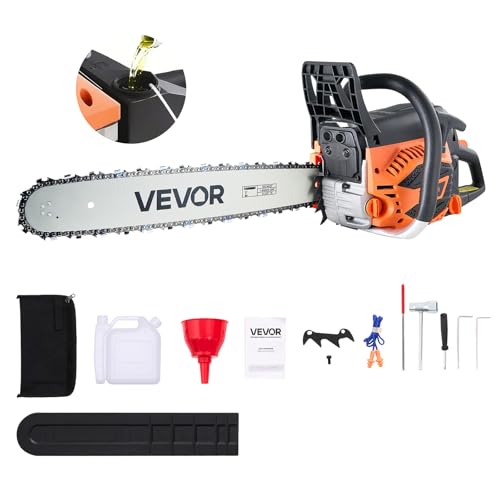
VEVOR 20inch 62CC Gas Powered Chainsaw
The VEVOR 62cc has the highest displacement here at a listed 3.8 HP with a 20-inch bar that cuts up to 18 inches in diameter, plus cold and hot start options and a large 550ml fuel tank. Its impact-resistant composite body and emergency stop make it a lot of raw capacity for the price.
Reasons to buy
- 62cc 3.8 HP engine, 12,000 rpm
- Cold and hot start options
- Emergency stop function
- PA6 composite body, impact resistant
- 550 ml fuel tank and 260 ml oil tank
Reasons to avoid
- Generic brand without the dealer network and parts support of Husqvarna
- Big-bore two-stroke engines demand careful fuel mixing and break-in

Husqvarna 450 Rancher 20 Inch Gas Chainsaw
The 450 Rancher is the entry point into Husqvarna's Rancher line with a 50.2cc, 3.2-HP engine and a 20-inch bar. It keeps the Smart Start, chain brake, Air Injection, and LowVib features while costing less, making it the budget pick for buyers who want the brand at a lower engine tier.
Reasons to buy
- 20 inch bar, ergonomic gas chainsaw
- Smart Start, inertia-activated chain brake
- 50.2-cc 3.2-HP X-Torq engine
- Air Injection technology
- Soft inlay ergonomic trigger, LowVib
Reasons to avoid
- Less power than the 455 and 460 for heavy repeated cutting
- Still a full gas saw with the usual fuel and upkeep demands

Husqvarna 120 Mark III Gas Chainsaw
The 120 Mark III is a lighter 38cc, 1.8-HP saw with a 16-inch bar aimed at home and garden work rather than heavy felling. Its air purge system, easy starting, and LowVib damping make it approachable and portable, which is why it earns a spot as a lighter alternative.
Reasons to buy
- 16 inch portable chainsaw
- Air purge system and combined choke/stop control
- 38-cc 1.8-HP X-Torq engine
- Air Injection technology
- LowVib technology
Reasons to avoid
- Underpowered for true professional felling and land clearing
- 16-inch bar limits the diameter of wood you can cut in one pass
What to look for
Power for the job
Professional cutting demands engine power. Saws from 50cc up handle felling and bucking large trees, while a 38cc saw like the 120 Mark III is better for lighter home tasks. Match displacement to the wood you cut most.
Bar length and balance
A 20-inch bar is a versatile standard that most Rancher saws support. A 24-inch bar cuts larger trees but adds weight and can feel unbalanced, so buy the longest bar you genuinely need, not the longest available.
All-day comfort
Power is only useful if you can run the saw for hours. Anti-vibration damping, ergonomic handles, and easy-start systems reduce fatigue and are worth prioritizing on a saw you use for real work.
Safety features
An inertia-activated chain brake helps stop the chain during kickback, and a proper guard reduces flying debris. On a powerful gas saw these features, along with your own protective gear, are non-negotiable.
Brand and serviceability
Husqvarna's dealer network means parts and service are easy to find, which matters when downtime costs you. A generic saw like the VEVOR offers more displacement per dollar but leaves you more on your own for repairs.
Our verdict
For most people the Husqvarna 455 Rancher is the professional-grade pick to start with. Its 56cc, 3.5-HP X-Torq engine and 20-inch bar handle felling, bucking, and land clearing, while Smart Start, an inertia chain brake, and LowVib damping make a demanding saw easier to control all day.
FAQs
It comes down to engine power, durability, and features built for long workdays: more displacement for cutting large wood, anti-vibration damping, an inertia chain brake, good air filtration, and a bar long enough to fell and buck full-size trees.
For serious felling and bucking, look at 50cc and up, like the 455 or 460 Rancher. Smaller 38cc saws handle pruning and firewood but bog down in large-diameter wood.
No. A longer bar cuts larger trees but adds weight, uses more power, and can feel unbalanced. A 20-inch bar is a versatile standard; go longer only if you regularly cut trees that need it.
Gas saws deliver sustained high power and untethered run time without waiting on charges, which is why they dominate felling and land clearing. The tradeoff is fuel mixing, more maintenance, and more noise and vibration.
Yes, on a saw you rely on. An established brand like Husqvarna has a dealer network for parts and service, so downtime is shorter. A generic saw may cost less up front but can be harder to repair.