Quick verdict
Under 1000, the 1000W Portable Power Station with a 999Wh LiFePO4 battery is my top pick. It delivers 1000W continuous and 2000W peak, charges ten devices at once, weighs only 17 pounds, and recharges by wall, solar, or car, making it a capable silent backup for a wide range of loads.

Portable Power Station 1000W
This 999Wh LiFePO4 station delivers a stable 1000W continuous and 2000W peak, enough for many household essentials, and charges up to ten devices at once through AC, USB-C PD, USB-A, and wireless. It recharges three ways including MPPT solar, and its automotive-grade battery is rated for 2000-plus cycles at a portable 17 pounds.
The best generator under 1000: 1000W LiFePO4 battery stations with high capacity, solar recharging, and honest notes on output, weight, and real loads.
Why you should trust this guide
Under 1000, you can get a genuinely capable battery power station, and I evaluate this range on the specifications that determine real-world usefulness: watt-hour capacity, continuous and surge output, battery chemistry, and recharge options. All figures come from the manufacturer listings, and where a claim is vague or a spec is missing, I say so rather than invent a number.
These are silent, fume-free stations you can use indoors, which sets them apart from engine generators. My aim is to help you buy enough capacity and output for your actual loads without overpaying, and to be clear about what a 1000W inverter can and cannot run.
How we evaluated
My criteria begin with capacity in watt-hours and continuous output in watts, since together they decide how much you can run and for how long. In this class, a 999 to 1024Wh battery with 1000W continuous output is common, so I weigh your likely loads and runtime needs against those figures.
I also looked at battery chemistry and cycle life, favoring LiFePO4 units rated for thousands of cycles, along with port variety, fast USB-C PD charging, and recharge flexibility including MPPT solar. Weight matters because these units get carried, and I noted where a bundle includes a solar panel versus selling it separately.
What to look for
- Capacity and output together: Watt-hours set runtime and continuous watts set what you can run, so weigh both against your loads.
- LiFePO4 chemistry: A LiFePO4 battery rated for thousands of cycles lasts far longer than lower-cycle chemistries.
- Surge headroom: A 2000W or higher peak lets the station handle brief startup spikes from motors.
- Fast USB-C PD: A 60W or higher USB-C port charges laptops quickly and reduces reliance on AC.
- Recharge options: Wall, car, and MPPT solar add flexibility, but panels are frequently sold separately.
- Weight: Capacity adds weight, so balance how much power you need against how easily you can carry it.
- What is in the box: Some bundles include a solar panel and longer coverage, which affects real value.
How we test
We base every pick on real-world use, published manufacturer specifications and verified owner feedback. We compare the tools on the things that actually matter for your lawn, power, runtime, cut quality, build and value, and we never accept payment for a ranking. When we have not used a specific model first-hand, we say so.
The picks at a glance
| Tool | Best for | Score | |
|---|---|---|---|
| Portable Power Station 1000W | Best Overall | Check price | |
| EBL Portable Power Station 500w | Best Value | Check price | |
| Portable Power Station 1000W | Best Premium | Check price | |
| 1000W Portable Power Station 1024Wh LiFePO4 | Best Budget | Check price | |
| Jackery Solar Generator 1000 v2 | Also Great | Check price |
The picks, reviewed
Portable Power Station 1000W
This 999Wh LiFePO4 station delivers a stable 1000W continuous and 2000W peak, enough for many household essentials, and charges up to ten devices at once through AC, USB-C PD, USB-A, and wireless. It recharges three ways including MPPT solar, and its automotive-grade battery is rated for 2000-plus cycles at a portable 17 pounds.
Reasons to buy
- [999Wh Power Station
- [10 Devices Simultaneous Charging
- [Triple MPPT Charging Technology
- [Advanced Battery & Upgraded BMS Protection] Automotive-grade battery delivers 2000+ charg
- [Ultra-Portable 17-Lb Design for Emergency Adventures] Compact 17-pound frame with ergonom
Reasons to avoid
- Even at 1000W it cannot run large appliances with heavy heating elements or motors
- The solar panels that enable off-grid MPPT charging are sold separately
EBL Portable Power Station 500w
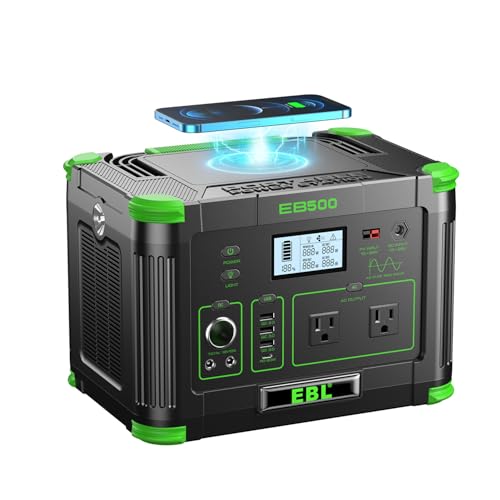
The EBL 500W is the lighter, lower-output option here at 519.48Wh and 14.1 pounds, ideal if your needs center on phones, laptops, and small essentials. It uses pure sine wave AC outlets, offers multiple output types, and recharges by solar, car, or wall for flexibility.
Reasons to buy
- 【500W High Capacity to Power Your Life】This compact powerhouse packs a massive 519.48Wh (1
- 【Multiple Outputs Provide More Options】 Run your essential gear all at once with versatile
- 【Easily Rechargeable With 3 Ways】(1)Solar: Fully charge in 6-9 hours with a compatible 100
- 【Safe & Stable】Worry no more about power outages because the power station with a reliable
- 【Pro Maintenance & Safety Guidelines】 Please do not use this power station to power device
Reasons to avoid
- Its 500W ceiling and smaller capacity limit it compared with the 1000W stations here
- The manufacturer advises against powering devices over 500 watts
Portable Power Station 1000W
This 999Wh station mirrors the top pick's 1000W continuous and 2000W surge output in a compact 17.8 pound frame, with ten-device charging and a USB-C PD 60W port for fast laptop charging. An upgraded BMS auto-shuts off when devices are full, and MPPT enables solar recharging.
Reasons to buy
- 【999Wh Powerhouse,1000W】 Packs massive 999Wh capacity into a surprisingly compact 17.8-pou
- 【Charge 10 Devices Simultaneously】 Turns one into a complete charging command center: 2 AC
- 【Upgraded BMS Battery Protection】 Features an upgraded Battery Management System that auto
- 【Triple Recharge with MPPT Technology】 Recharge anywhere via AC wall outlet, solar panels,
- 【60W PD Fast Charging Revolution】 The USB-C PD 60W port charges MacBook Pros and flagship
Reasons to avoid
- Like the others it tops out at loads a 1000W inverter can handle, so no large appliances
- Solar panels for the MPPT input are sold separately

1000W Portable Power Station 1024Wh LiFePO4
This 1024Wh LiFePO4 station offers slightly more capacity and a 1000W continuous output, with a 60W USB-C PD port that can charge a laptop to 50 percent in about 30 minutes. Its six-layer BMS is rated for 3000-plus cycles, and it supports up to 300W solar input for off-grid recharging.
Reasons to buy
- 1000W POWER 1024Wh CAPACITY — END POWER ANXIETY 1000W continuous output & 1024Wh LiFePO4 b
- MULTI-PORT FAST CHARGING — POWER 5 DEVICES AT ONCE 2×110V AC, 1×60W PD USB-C (30mins charg
- 6-LAYER SAFETY 3000+ CYCLES — LONG-LASTING & SECURE Automotive-grade LiFePO4 battery bank
- 200W SOLAR COMPATIBLE — OFF-GRID POWER FREEDOM This solar power bank supports max 300W sol
- 27.73LBS LIGHTWEIGHT 3 COLORS — EASY TO CARRY ANYWHERE Integrated non-slip handle, 27.73lb
Reasons to avoid
- At 27.73 pounds it is heavier than the other 1000W stations here
- It charges five devices rather than the ten some competitors support, and solar panels are extra

Jackery Solar Generator 1000 v2
The Jackery Solar Generator 1000 v2 bundle stands out by including a 200W solar panel and five years of coverage, giving you off-grid recharging out of the box. It delivers 1500W AC output with a 3000W surge, three pure sine wave AC ports, and a durable LFP battery, plus one-hour emergency charging.
Reasons to buy
- Powerful yet Compact: Boasting a 1,500W AC output and a 3,000W surge peak, the Solar Gener
- One Hour Fast Charging: Charge your Explorer 1000 v2 Portable Power Station from 0% to 100
- 10 Year Lifespan: The Explorer 1000 v2 portable power station is equipped with a durable L
- Tailored for Versatility: Featuring two USB-C ports, one USB-A port, one DC car port, and
- Smart App Control: Effortlessly switch between different charging modes with Jackery’s App
Reasons to avoid
- The bundle is the priciest option here, which may push the top of an under-1000 budget
- Its higher output and included panel add weight and bulk versus the compact stations
What to look for
Capacity and output together
A 1000W station is defined by two numbers: watt-hours for runtime and continuous watts for what it can run. A 999Wh, 1000W unit powers a broad set of essentials for a meaningful stretch, but sustained high-draw loads still drain it quickly.
Battery chemistry and lifespan
LiFePO4 batteries rated for 2000 to 3000-plus cycles, common in this class, hold up to frequent use for years. This chemistry is a key reason these stations are worth the step up from smaller, lower-cycle units.
Surge headroom for motors
Appliances with motors or compressors spike well above their running watts on startup. A 2000W or higher surge rating lets a 1000W station absorb those brief spikes without shutting down.
Recharge speed and solar
Look at how fast the unit refills from the wall and whether it supports MPPT solar for off-grid use. Solar panels are often sold separately, so factor that into the total cost if you want to recharge off-grid.
Weight versus capacity
More capacity means more weight, ranging here from around 17 to nearly 28 pounds. If you carry the station often, favor the lighter units, and if it mostly stays put, the heavier high-capacity options are fine.
Our verdict
Under 1000, the 1000W Portable Power Station with a 999Wh LiFePO4 battery is my top pick. It delivers 1000W continuous and 2000W peak, charges ten devices at once, weighs only 17 pounds, and recharges by wall, solar, or car, making it a capable silent backup for a wide range of loads.
FAQs
A 1000W continuous station can run a wide range of essentials such as a mini fridge, lights, routers, laptops, fans, and phone charging, and can handle brief startup surges up to its peak rating. It cannot run large appliances with heavy heating elements like electric heaters or full-size kitchen appliances.
Divide the capacity by your load and reduce slightly for losses. A 999 to 1024Wh unit runs a small fridge intermittently for many hours or a continuous few-hundred-watt load for a few hours, so runtime depends heavily on what you plug in.
LiFePO4 chemistry offers a much longer cycle life, often 2000 to 3000-plus cycles, along with stable, safe performance. That makes these stations well suited to regular use over many years, which is why it is common in this price range.
Not for everyday use where you charge from the wall. For off-grid or long-outage recharging, a compatible solar panel helps, but most units sell the panel separately. A few bundles, like the Jackery Solar Generator 1000 v2, include one, which affects the overall value.
It depends on your loads. A 500W unit is lighter and cheaper and fine for phones, laptops, and small essentials. A 1000W unit costs more and weighs more but runs a broader set of devices, including a mini fridge, and offers more runtime, which many buyers find worth the step up.