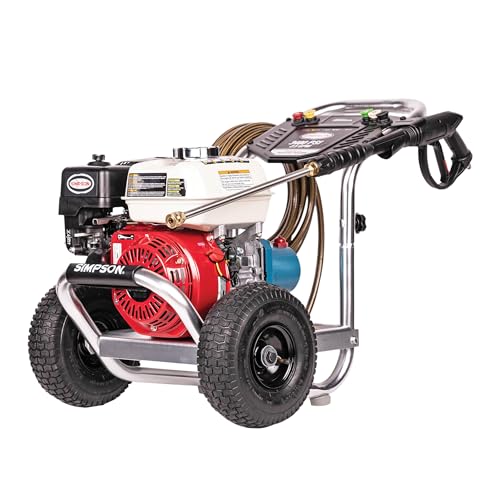
Quick verdict
A 3200 PSI, 2.5 GPM gas washer built around a 212cc Westinghouse OHV engine and a maintenance-free axial cam pump, with a half-gallon soap tank, 12 inch never-flat wheels and three years of limited coverage. It suits a homeowner with a driveway, a fence line and a deck to clean a few times a year. The axial pump is the limit: it is not built for daily paid work.
Strengths
- Maker-rated 3200 PSI and 2.5 GPM, about 8,000 cleaning units
- 3-year limited service, labor and parts coverage
- Engine oil, tools and quick-start guide in the box
- Five quick-connect nozzles including 25 degree
- 12 inch never-flat wheels on a steel frame
- Half-gallon onboard soap tank
Weaknesses
- Axial cam pump is not rebuildable and has a shorter life than a triplex
- Manual choke and recoil start take a little practice
- Weight is not stated in the listing
- Units may arrive with a faint oil or fuel smell from factory checks
The overall YardToolLab Score is out of 100. Section scores are out of 10.
Who this washer is for
A 3200 PSI, 2.5 GPM gas washer is the sweet spot for a homeowner with a concrete driveway, a fence line and a deck that all need cleaning once or twice a year. The Westinghouse WPX3200 fills that slot with a 212cc Westinghouse OHV engine, an axial cam pump, a half-gallon soap tank and a steel frame on 12 inch never-flat wheels, backed by three years of limited coverage. It is the step most people take after an electric washer proves too slow on concrete.
This review is based on the maker’s published specifications and on recurring owner feedback. We have not run this product ourselves.
What you get
In the box: the washer, a 25-foot abrasion-resistant Super-Flex hose, a lightweight spray gun and wand, five quick-connect nozzles (0, 15, 25, 40 degree and soap), engine oil, tools and a quick-start guide. The fuel tank holds 0.9 gallon and the onboard soap tank half a gallon. The choke is manual and the start is recoil. Westinghouse notes that every unit is function-checked at the factory and may arrive with a trace of oil or fuel smell, which is normal for this brand and not a sign of a used return.
Pressure, flow and cleaning power
At the maker’s 3200 PSI and 2.5 GPM, the WPX3200 claims about 8,000 cleaning units, roughly three to four times a typical electric washer. Pressure figures on gas washers are peak ratings and the working number is lower, but the 2.5 GPM flow is what shortens a driveway job; it carries dirt off the surface rather than just loosening it. The 25 degree tip handles most concrete and siding, the 15 degree tip is for oil stains and gum, and the 40 degree tip is for cars, windows and softwood decking, where the 15 can leave lines. Owners in this class generally report that stripping a deck for restaining is realistic, and that siding needs the longest reach and the lightest tip.
Engine and pump
The 212cc horizontal-shaft OHV engine is the displacement used across most consumer gas washers in this bracket, which keeps parts and know-how easy to find. The pump is an axial cam design described as maintenance-free, meaning the pump oil is sealed and never changed; the tradeoff against a triplex pump is a shorter expected life under heavy weekly use, which is fine for a homeowner running it a dozen times a year. The engine ships with its oil in the box rather than in the crankcase; fill it before the first pull.
Hose, nozzles and detergent
Twenty-five feet of hose is standard and enough for a driveway with the washer rolled to the middle; a 50-foot replacement is the common upgrade for two-story siding. The gun is described as lightweight, which matters over an hour of holding it against pump pressure. The half-gallon soap tank feeds only through the black soap nozzle at low pressure; for serious degreasing most owners switch to a downstream injector or pre-treat by hand before rinsing.
Build, wheels and handling
The frame is steel and the 12 inch wheels are never-flat, so there is no tire to lose air over winter. Owner complaints for this class usually center on assembly fit and the hose hook rather than the engine, and on the first start taking several pulls; set the choke, pull steadily and open the choke once it fires. Weight is not stated in the listing; gas washers of this size are typically a two-handed roll up a ramp into a truck rather than a lift.
Living with it
Gas washers reward routine: fresh fuel with stabilizer, an oil change after the first few hours and once a season after that, and pump protector before storage so the seals do not freeze. Never let it idle for more than a minute or two with the trigger closed; the pump heats the trapped water and the thermal relief valve dumps it. The three-year limited coverage for service, labor and parts is longer than most rivals at this price, and Westinghouse runs a US support network.
Alternatives to Consider
The Simpson MegaShot MSH3125 is the long-standing benchmark at this output, with a Honda GC190 engine and a deep parts network. The Westinghouse WPX3400 is a step up in pressure for a little more money if the same frame and warranty appeal to you. For a small lot with no driveway, the Westinghouse ePX3100 electric washer avoids fuel entirely.
Verdict
Buy the WPX3200 if you have concrete, a fence and a deck, want gas output with a three-year warranty and are comfortable with basic small-engine care. Skip it if your jobs are cars and furniture, where an electric washer is quieter and simpler, or if you expect to run it weekly for pay, where a triplex pump is the better investment.
Full specifications
Westinghouse WPX3200 Gas Pressure Washer, 3200 PSI 2.5 GPM, 212cc OHV Engine, Onboard Soap Tank, 5 Nozzles FAQs
Yes, the listing includes engine oil, tools and a quick-start guide. Fill the crankcase before the first pull; running the engine dry is the quickest way to void the three-year coverage.
Westinghouse function-checks every unit at the factory and says a trace of residual oil or fuel odor is normal. It does not mean the unit is a return.
The onboard tank feeds at low pressure through the soap nozzle. For heavy driveway degreasing most owners pre-treat by hand or use a downstream injector that pulls stronger concentrate.
Not for a homeowner. It is sealed and needs no oil change. A triplex pump lasts longer under daily paid use, which is why contractors pay more for one.