Introduction: Who This Suits
The Samurai Ichiban 9-Inch Pruning Saw makes a bold claim with its name—”Ichiban” means “number one” in Japanese. This saw is designed for detailed shaping work on ornamental trees and for cleaning up after winter storms. For users tired of fighting with blades that bind up in green wood, this model offers a specific set of strengths and trade-offs worth examining.
Performance: The Blade Does the Talking
The blade is remarkably thin, measuring only about 0.035 inches thick—thinner than most folding saws on the market. This thinness is the key to its precision. When starting a cut, the blade slides into the kerf with almost no resistance, tracking straight along a pencil line. For detailed work like removing a branch collar without damaging the tree trunk, owners consistently report excellent results.
The cutting action is aggressive, thanks to impulse-hardened teeth that stay sharp for extended use. On the pull stroke, the saw bites deep; on the push stroke, it slides smoothly. Independent owner feedback indicates a 3-inch live oak branch can be cut through in about 12 seconds—fast for a hand saw. The finish on cuts is remarkably smooth, with no torn fibers or rough edges, which is important for tree health as clean cuts heal faster.
Where It Excels
- Precision cuts: For shaping bonsai, fruit trees, or ornamental shrubs, this saw offers very controlled, shallow cuts.
- Green wood: The thin blade and sharp teeth slice through live, sappy wood without gumming up.
- Overhead work: At about 6 ounces, the saw is lightweight, reducing arm fatigue during overhead use.
Where It Struggles
The thin blade can bind in thick, wet wood if not used carefully. On a 4-inch oak limb, the kerf may close up and pinch the blade, requiring wiggling and force to free it. The solution is to use a wedge or cut from the top of the branch first, then finish from the bottom. Users accustomed to thicker, more rigid blades may find this binding frustrating.
The aggressive pull-stroke action also reduces control on initial cuts. Owners report occasionally cutting deeper than intended on small branches because the saw grabs so hard. A light touch is essential with this tool.
Build and Value: Simple but Effective
The handle is made of hard plastic with a rubberized insert—functional but not ergonomically contoured. After about 20 minutes of continuous sawing, some users report a hot spot developing on the palm. The handle is also short and narrow, which may be less comfortable for those with larger hands (size XL gloves or above). For smaller hands, the fit is generally adequate.
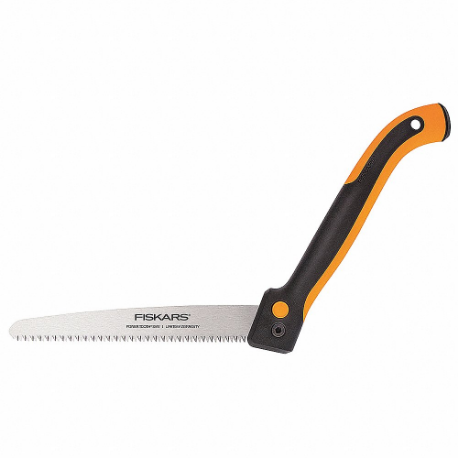
The blade is fixed, not folding. This trade-off provides rigidity for precision but requires a sheath for storage. The included plastic sheath clips onto a belt and works adequately, though it is bulky. Some owners prefer a leather or nylon sheath with a more secure belt loop, as the plastic clip can pop off when bending over.
Value Proposition
- Price: Around $35, which is mid-range for a pruning saw. Cheaper models at $15 typically do not cut as cleanly or stay sharp as long.
- Durability: The blade is replaceable. Samurai sells replacement blades for about $15, allowing users to keep the handle and swap blades when dull.
- Warranty: A limited lifetime warranty against defects provides reassurance.
Overall build quality is solid for the price. The handle is the weakest point but remains serviceable. It is not as comfortable as a $60 Silky saw handle, but the value is fair.
Who Should Buy It (And Who Should Skip It)
Buy this saw if:
- You do detailed pruning: For shaping bonsai, fruit trees, or ornamental shrubs, the precision is unmatched at this price point.
- You want a clean cut: The smooth finish helps prevent disease and promotes tree health.
- You are a lightweight user: Suitable for small hands or users wanting a saw that does not tire the arm.
- You need a backup saw: Great for trimming small branches and deadwood.
Skip this saw if:
- You cut thick wood regularly: For 4-inch or larger branches, the binding issue can be frustrating. A saw with a thicker blade is recommended.
- You have large hands: The short, narrow handle may be uncomfortable for extended use.
- You need a folding saw: The fixed blade is less portable. For pocket storage, look elsewhere.
- You are a heavy-duty user: For cutting roots or demolition work, this saw is too delicate. Consider a bow saw or heavy-duty pruning saw.
Verdict: A Specialist, Not a Generalist
The Samurai Ichiban 9-Inch Pruning Saw is not a perfect tool for every job. It is a specialist that excels at one thing: making precise, clean cuts on small to medium branches. For that task, it is genuinely excellent. The thin blade and aggressive teeth offer a level of control and finish rare in a hand saw under $50.
However, it is not a workhorse. Using it as a general-purpose pruning saw will lead to binding issues and handle discomfort. It is best suited as a second saw for detail work—for rough-cutting storm damage, a heavy-duty folding saw is preferable; for shaping a Japanese maple, the Ichiban shines.
The value is fair. The blade is very sharp, durable, and replaceable. The handle is the weak link but is serviceable. If Samurai upgraded the handle to a more ergonomic shape with a longer grip, this saw would be a home run. As it is, it is a solid triple.
For serious gardeners who value precise cuts and are willing to work around the binding issue, this saw is a great addition to the tool shed. For those wanting one saw to do everything, other options are more suitable. Try it for a weekend to see if the handle works for your hand. If it does, the cutting performance will impress. If not, spending a little more on a saw with a better grip is advisable. The Samurai Ichiban has earned a permanent spot in many pruning kits, but it is not the only saw users reach for.