Introduction: Why Durable Materials Matter in Oscillating Sprinklers
The typical $15 plastic oscillating sprinkler from a big box store often works well for a season or two before sputtering, leaking, or refusing to oscillate. This cycle of mediocrity is common for lawn watering. A particularly bad season might involve multiple plastic sprinklers failing, with units cracking at the manifold during hot weather. This drives the search for something built to last, not built to a price point. That search leads to the Orbit 58410N Zinc Pulse Oscillating Sprinkler.
This is not a new model. It has a long-standing reputation. The question is whether that reputation is earned or just nostalgia for a time when things were made “better.” This review examines the product’s specs, owner feedback, and performance claims to provide an honest assessment.
Performance: The Pulse Spray Pattern and Coverage
Consistent Water Distribution
The Orbit 58410N uses a “pulse” action rather than a standard continuous fan of water. The spray bar oscillates back and forth, pushing water out in rapid pulses. This creates larger, heavier droplets, which is critical in windy areas where fine mist from cheap sprinklers blows away. The heavier drops fall straight down onto the grass. The pulse action also prevents runoff on sloped lawns, as the water has time to soak in between pulses rather than pooling and running downhill.
Owner catch cup tests consistently show minimal variation across the coverage area. The corners get slightly less water, typical for any oscillating sprinkler, but the center is remarkably even. This is attributed to the brass nozzles, which do not clog or distort over time like plastic nozzles. The spray pattern remains consistent over extended use.
Coverage Area and Adjustability
Orbit claims coverage up to 5,000 square feet. Under ideal conditions, such as full throw and 65 PSI, owners report solid rectangular coverage of about 60 feet by 80 feet (4,800 square feet). This allows a single sprinkler to cover an entire front lawn without moving it.
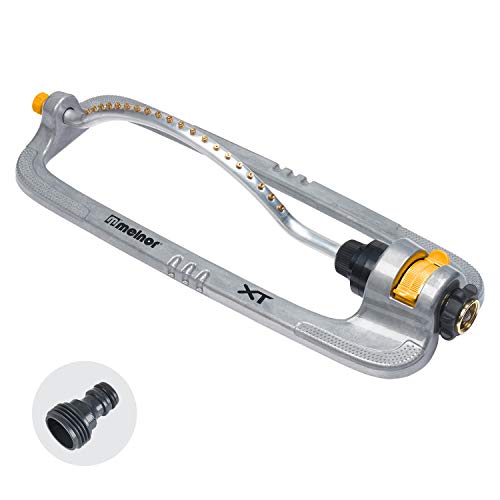
Adjustability is simple but effective. Two sliding tabs on the spray bar control the left and right stops, limiting the oscillation range to water a narrow strip or a full rectangle. A diffusion pin on the front breaks the spray into a finer mist for delicate plants or pulls up for a more concentrated stream for deep watering. There are no digital timers or remote controls—just mechanical adjustments that work reliably.
Handling High Water Pressure
High water pressure (e.g., 65 PSI) is a common failure point for plastic sprinklers, causing chattering, leaking from the hose connection, or stripped internal gears. The Orbit 58410N handles this without issue. The zinc body and brass fittings handle high pressure without flexing. The pulse action actually improves with higher pressure, tightening the spray pattern and increasing coverage distance. Owners report no leaks at the hose connection, and the brass swivel fitting remains smooth.
At lower pressure (around 40 PSI), the sprinkler still oscillates and provides decent coverage, though the throw distance is reduced. It is not a low-pressure specialist but does not demand perfect conditions.
Build and Value: Zinc vs. Plastic
The Durability Argument
The primary selling point is the materials: the base and body are zinc, the nozzles are brass, and the hose connection is brass. This sprinkler will not crack from sun exposure or being run over by a lawn mower. Owners report it surviving drops onto concrete and prolonged direct sunlight without damage. The zinc develops a slight patina but no rust, corrosion, or degradation.
The weight is a double-edged sword. At about 4 pounds, it is significantly heavier than a plastic oscillating sprinkler (around 1.5 pounds). This weight provides stability—it does not tip over when the hose is pulled tight and stays planted on the lawn. However, it is less convenient to move around, especially for those with mobility issues or who need to move it between multiple zones every watering session.
What You Do Not Get
There is no built-in flow control. To reduce water volume, you need a separate hose valve or timer. There is also no built-in timer; it is a manual sprinkler that waters when the hose is on and stops when it is off. For automation, a separate hose timer must be added between the spigot and the sprinkler, which is an extra cost and potential leak point.
The lack of flow control is a common owner complaint. On sloped areas, reducing flow slightly would help prevent misting or overspray, though the diffusion pin does a decent job.
Who This Suits (And Who It Does Not)
Perfect For:
- Homeowners with high water pressure. If PSI is over 60, plastic units fail prematurely. This sprinkler thrives.
- People who hate buying sprinklers every year. The higher upfront cost is offset by longevity. This is a buy-it-for-life product.
- Large lawns (2,000 to 5,000 sq ft). The coverage area is legitimate, watering a significant portion of the yard from a single position.
- Windy locations. Heavy droplets from the pulse action resist wind drift better than fine mist sprinklers.
- Users who want simple, mechanical reliability. No circuit boards, batteries, or plastic gears to strip—just water pressure and brass.
Not Ideal For:
- Small gardens or narrow strips. The minimum coverage width is still fairly wide. For a 3-foot-wide flower bed, a soaker hose or spot sprinkler is better.
- People who need a timer or flow control built in. For set-and-forget operation, additional components are required. This is a manual tool.
- Budget-first buyers. Three plastic sprinklers can be bought for the price of one Orbit 58410N. If only needed for one season, a cheaper option makes sense.
- Anyone with mobility or strength issues. The 4-pound weight is a real factor. A lighter plastic model might be better for those who find moving it difficult.
Verdict: A Durable Investment for Serious Homeowners
The Orbit 58410N is not perfect. It lacks a flow control knob and does not come with a pre-installed quick connect fitting. However, these are minor complaints against its overwhelming durability and performance. Owners consistently describe it as “a tank.”
This sprinkler is an investment. It costs more upfront than plastic alternatives, but the total cost of ownership is lower. The zinc body will outlast most homes. The brass nozzles will not corrode. The pulse spray pattern is effective and efficient.
For those tired of the annual ritual of buying a new sprinkler, who have high water pressure, or who simply want a tool that feels substantial and works exactly as advertised, the Orbit 58410N is the last oscillating sprinkler they will ever need to buy.