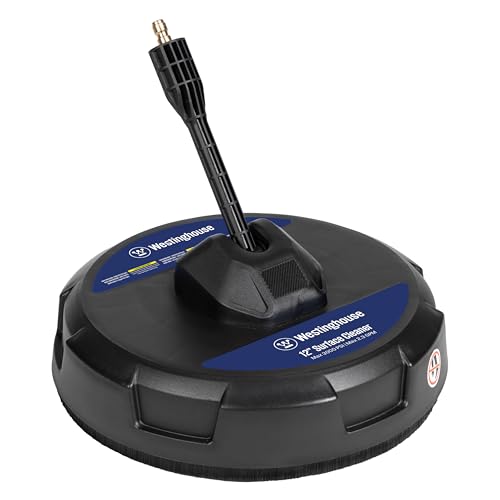
Quick verdict
A 15 inch surface cleaner with two spinning nozzles under a shroud and splash skirt that fits any wand with a standard 1/4 inch quick connect and is rated by Karcher for washers from 2600 to 3200 PSI and up to 2.7 GPM. It suits the homeowner with a gas or strong electric washer and a driveway, patio or sidewalk that streaks under a wand. The limit is flow: pair it with a 4 GPM commercial machine and you have outgrown it.
Strengths
- Fits any brand with a 1/4 inch quick-connect wand
- Two spinning nozzles at a fixed height stop zebra striping
- Shroud and splash skirt keep overspray off your legs
- 15 inch path cuts driveway time sharply versus a fan tip
- Rated for the common 2600 to 3200 PSI homeowner washer
Weaknesses
- Ceiling of 3200 PSI and 2.7 GPM rules out contractor washers
- No wheels are mentioned; it glides on the skirt
- Needs the washer at full output to spin well
- Nozzle size for a given washer is not stated in the listing
The overall YardToolLab Score is out of 100. Section scores are out of 10.
Who this surface cleaner is for
Anyone who has washed a driveway with a fan tip knows the result: a clean slab striped with lighter and darker arcs where each pass overlapped. A surface cleaner fixes that by holding two spinning nozzles at a fixed height under a shroud, so every square inch gets the same pressure from the same distance. Karcher’s 15 inch model is built for the homeowner washer, rated for 2600 to 3200 PSI and up to 2.7 GPM, and it connects to any brand’s wand through a standard 1/4 inch quick-connect fitting.
This review is based on the maker’s published specifications and on recurring owner feedback. We have not run this product ourselves.
What you get
The listing describes the 15 inch cleaner with two spinning nozzles, a shroud with a splash-free skirt, and a 1/4 inch quick-connect plug on the inlet that fits the end of a standard wand. Karcher lists concrete, driveways, patios, decks and sidewalks as its surfaces, plus hard vertical surfaces such as brick and stucco. The listing does not mention wheels, a wand extension or spare nozzles, and it does not state which nozzle orifice is fitted, so confirm that detail if your washer sits at the top or bottom of the range.
Fit and compatibility
The 1/4 inch quick connect is the same coupler that accepts the colored tips on nearly every US consumer washer, gas or electric, which is why Karcher calls it multi-brand. The working range is 2600 to 3200 PSI and up to 2.7 GPM, and both limits matter. Below the range the nozzles spin lazily and the cleaner leaves swirls; above it, especially on flow, the unit is over-driven and the bar and swivel wear quickly. That makes it a precise match for the 3000 to 3200 PSI, 2.5 GPM gas washers from Simpson, Westinghouse and Ryobi and the strongest 2.0 GPM electrics, and a poor match for a 4 GPM contractor machine.
Coverage and cleaning action
A 15 inch path is the size that balances speed against the flow a homeowner washer can supply; two nozzles share the water, so a wider deck on the same washer would simply clean less well. The fixed nozzle height is what removes streaks, and the spinning bar means each spot is hit from several angles rather than one. Owners of 15 inch cleaners on 3200 PSI washers generally describe a two-car driveway as a one-hour job instead of an afternoon, with edges and stair risers finished by hand with the 25 degree tip. Heavy oil stains and gum still need a pre-treatment or a turbo nozzle; the cleaner evens out a surface, it does not replace chemistry.
Shroud, skirt and splash
The shroud keeps the spray and the loosened grit under the unit, and the skirt seals it to the ground, so you are not standing in a fine mist of driveway dirt. On vertical brick or stucco the skirt matters more, because without it the rebound comes straight back. The listing does not mention wheels; cleaners this size usually float on their own spray and glide on the skirt, which works on smooth concrete and drags a little on rough aggregate.
Build and handling
Karcher does not state the housing material or weight. Owners of this class report that the swivel is the wear part: it should spin freely by hand before every use, and a drop of light oil on the swivel extends it. Clogged nozzles from grit in the supply water are the usual cause of a cleaner that will not spin; an inline filter on the garden hose inlet is cheap insurance for any washer feeding a surface cleaner.
Living with it
Rinse the underside after use so sand does not sit in the nozzles, check that the bar spins freely, and hang it rather than stacking tools on the skirt. Store it indoors in winter. Keep the washer at full throttle while the cleaner is on the ground, since a surface cleaner needs the whole output to work, and lift it when you stop moving so it does not etch a ring into the slab. Warranty terms are not in the listing; check the product page.
Alternatives to Consider
The Ryobi 15 inch surface cleaner is the Home Depot equivalent for the same washer class and is also rated for standard quick-connect wands. The Simpson 15 inch surface cleaner with casters suits owners who want wheels under it. If your washer runs 3.5 GPM or more, a 20 inch cleaner from BE Power Equipment or Mi-T-M uses that flow properly.
Verdict
Buy the Karcher 15 inch surface cleaner if you own a 2600 to 3200 PSI washer with a standard quick-connect wand and a driveway, patio or walkway that streaks under a fan tip. Skip it if your washer is a small electric under 2600 PSI, where it will spin poorly, or a contractor machine over 2.7 GPM, which calls for a larger and heavier cleaner.
Full specifications
Karcher 15 Inch Pressure Washer Surface Cleaner for 2600 to 3200 PSI, 1/4 Inch Quick Connect FAQs
If your wand ends in a standard 1/4 inch quick-connect coupler, yes. Karcher lists it as multi-brand compatible for washers from 2600 to 3200 PSI and up to 2.7 GPM.
Below 2600 PSI the nozzles may spin slowly and clean unevenly. Karcher rates it from 2600 PSI; a small electric washer is better served by a smaller 11 or 12 inch cleaner made for that output.
Karcher lists decks among the surfaces. Keep the washer at the low end of the range, move steadily and test a hidden board; softwood furs if the cleaner dwells.
The listing does not mention wheels. Cleaners of this size usually glide on the skirt and float on the spray; wheels appear on larger and heavier models.