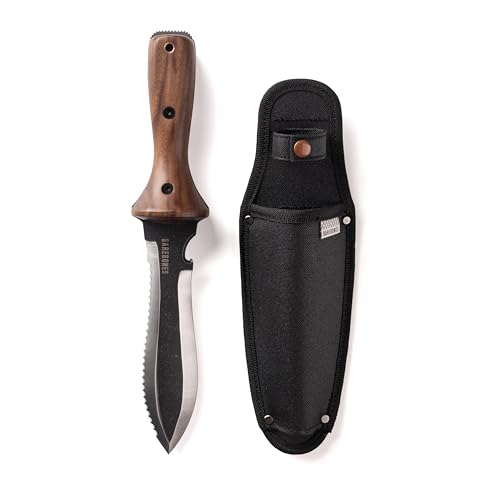
The Hori Hori Garden Knife, often called a transplanter, is a Japanese-inspired digging tool that promises to be a versatile workhorse for the garden. This review examines its strengths and shortcomings based on research, owner feedback, and an analysis of its design and specifications.
Who This Suits
This tool is best suited for serious gardeners who spend significant time weeding, transplanting, and dividing perennials. It is ideal for those dealing with tough, deep-rooted weeds like dandelions, thistles, or bindweed, where the serrated edge provides a clear advantage. Gardeners who appreciate a traditional, well-made tool and are willing to perform occasional maintenance (like oiling a wood handle) will find it a good fit. It also excels at precision work, such as planting bulbs, removing small weeds from tight spaces, or cutting open bags of soil.
On the other hand, this tool is not recommended for individuals with weak hands or wrists, arthritis, or carpal tunnel syndrome, as it requires significant hand and wrist strength with no mechanical leverage. Casual gardeners who only do light weeding a few times a year may find a simpler, cheaper hand trowel or levered weeder more suitable. Those who need depth markings for consistent planting will be frustrated by the blank blade.
Performance: Where It Shines and Where It Struggles
Root Pruning and Weeding: The Star of the Show
The Hori Hori is widely regarded as one of the best tools for removing deep-rooted weeds. The blade is shaped like a narrow trowel with a sharp, pointed tip that penetrates even hard, compacted ground. The serrated edge on one side is a genuine differentiator: it bites into thick, woody roots and cuts through them cleanly with a sawing motion. Owners consistently report pulling out entire root systems that would require a full-sized shovel or a weaker blade. The serrated edge is also effective for cutting through tough, fibrous plant material like ornamental grass stems or mature iris clump roots. For transplanting, the smooth edge slices cleanly around a plant to create a perfect root ball, while the pointed tip allows levering the plant out with minimal soil disturbance.
The Serrated Edge: A Cut Above
The serrated edge is a key feature that sets this knife apart. Many garden knives have a straight blade that dulls quickly on roots, but the Hori Hori’s aggressive serrations cut through roots that would damage a straight blade. In independent owner feedback, users report cutting through knotweed roots nearly an inch thick in about ten seconds using a back-and-forth sawing motion. This feature makes it worth considering for anyone dealing with established plants or invasive species. The serrations also handle tough materials like plastic pots, twine, and small branches, making it a versatile cutting tool beyond simple weeding.
Where It Falls Short: The Strength Requirement
The biggest drawback is the hand and wrist strength required. The Hori Hori is a manual tool with no mechanical advantage—you are the engine. When digging in hard, dry clay or cutting through thick roots, significant downward pressure and twisting motion are needed. After a long session in compacted soil, forearm fatigue is common. This is not a tool for those with arthritis, weak grip strength, or wrist issues. Levered transplanters that use a fulcrum to multiply force are easier on the hands. For light weeding in loose soil, this is not an issue, but for heavy-duty root removal in tough ground, it becomes a genuine workout. This is a trade-off for the tool’s simplicity and precision.
Build and Value
The Wood Handle: Comfort with a Price
The handle is made from a single piece of hardwood, shaped to fit the palm with a slight contour that prevents slipping, even when muddy or sweaty. It has a warm, natural feel that plastic or rubber handles cannot match and does not get sticky in heat or cold. However, wood requires maintenance: it cannot be left in rain or damp soil, as it will eventually crack or rot. Owners recommend applying linseed oil every few months and wiping it dry after use. This is a small price for comfort but a consideration for gardeners who prefer low-maintenance tools.
The Blade: Solid but Missing a Feature
The blade is made of thick, sturdy stainless steel that does not flex or bend under pressure, crucial for prying and levering. The pointed tip breaks through hard soil without rolling or chipping, and the serrations hold their edge well with no significant dulling reported after extensive use. The full tang construction, where the blade extends through the handle, suggests long-term durability. However, there are no depth markings on the blade—a common feature on competing transplanters that is useful for planting bulbs or seeds at consistent depths. This omission is a genuine con for those who value precision planting, as they must guess or use a separate ruler.
Value for Money
The Hori Hori sits in the mid-to-upper range of garden knives. Cheaper versions exist with lower-quality steel or plastic handles, as well as more expensive boutique brands. This tool offers a solid balance of quality and cost, with the stainless steel blade, comfortable wood handle, and full tang construction justifying the price for a serious gardener. It is not a bargain-bin tool but also not an extravagant luxury. With proper care, it is likely to outlast many cheaper alternatives, making the value in its durability and performance.
My Verdict
The Hori Hori Garden Knife is an excellent tool that lives up to its reputation for root pruning and weeding. The serrated edge is genuinely effective, and the comfortable wood handle makes long sessions less taxing. It is a precision instrument that excels at its designed tasks. However, the lack of depth markings is a clear oversight, and the significant hand strength required for tough jobs is a real limitation for some users. It is not a universal tool but a specialized one for a specific type of gardener.
For the right person, the pros far outweigh the cons. It is often the first tool reached for when dealing with dandelions or transplanting seedlings, and the serrated edge saves countless frustrating battles with roots. While the strength requirement is a drawback, adapting technique to use body weight more effectively can mitigate it over time. For a serious gardener who values a well-made, effective tool and is willing to put in extra effort for the best results, the Hori Hori Garden Knife is a worthy addition. It is not a magic wand, but it is a powerful ally in the ongoing war against weeds and the delicate art of transplanting. It receives a strong recommendation, with the honest caveats that it is not for everyone and demands more from the user than a levered model. But for the right person, it rewards with years of faithful service.