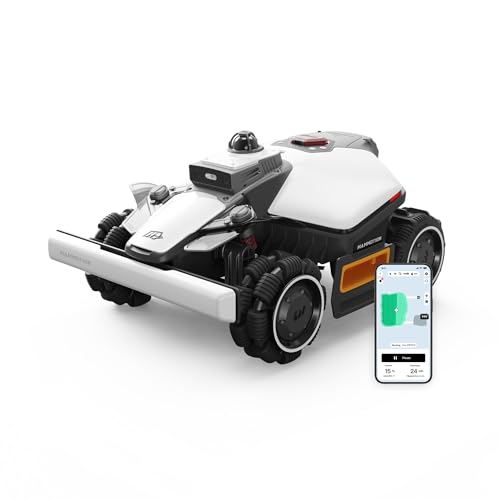
Quick verdict
A quarter-acre robot mower that maps and positions itself with dual 360° LiDAR, needs no wire or RTK antenna, carries a built-in TruEdge trimmer for borders, and is slim enough to pass a 0.8-meter gap. It suits a compact or oddly shaped yard with trees, fences and a narrow side passage. The caveat is that ECOVACS itself says initial setup may take a few adjustments on unusual layouts.
Strengths
- Dual 360° LiDAR positioning, about 2 cm, no wire or antenna
- Works under trees and along fences where GPS mowers drop out
- Built-in TruEdge trimmer cuts along paths and beds
- AI Vision and 3D ToF LiDAR recognize 200+ obstacle types
- Narrow body fits passages as slim as 0.8 m, about 31 in
- Zones, schedules and no-go areas in the app
Weaknesses
- Quarter-acre rating limits it to smaller lots
- Cutting width, height range and slope rating are not stated
- Setup may need fine-tuning on unusual layouts, per the maker
- Tight corners and raised edges still need manual trimming
The overall YardToolLab Score is out of 100. Section scores are out of 10.
Who this robot mower is for
The yard that frustrates most robot mowers is not big. It is the quarter-acre lot with mature trees, a fence line close to the house, a 3-foot side passage and beds with curved edges, where satellite mowers lose their fix and wide-bodied robots cannot get through to the back. The ECOVACS Goat O1000 LiDAR PRO is built for that lot: LiDAR positioning that does not care about the sky, a slim body for the side passage and a built-in trimmer for the edges.
This review is based on the maker’s published specifications and on recurring owner feedback. We have not run this product ourselves.
What you get
The mower is rated for lawns up to a quarter acre. It maps and positions with what ECOVACS calls HoloScope, a dual 360° LiDAR system, with no perimeter wire and no RTK antenna, and claims about 2 cm positioning accuracy. Obstacle detection combines AI Vision cameras with 3D time-of-flight LiDAR. A TruEdge trimmer is integrated into the body. The listing does not state cutting width, cutting height range, slope rating, battery capacity or noise, so those need to come from the product page.
Navigation and mapping
LiDAR positioning is the reason to pick this mower over an RTK one. A satellite-corrected robot needs sky; under a maple canopy or against a north wall it drifts, stops or wanders, and owners of RTK mowers report that shaded yards are where the technology struggles most. LiDAR measures the yard directly, so tree cover and fences become landmarks rather than problems. Mapping is done from the ECOVACS app, with mowing zones, schedules and no-go areas drawn for difficult sections. ECOVACS is honest in the listing that initial setup and fine-tuning may take a few adjustments on unique layouts, which matches what owners of LiDAR mowers in general describe: a couple of evenings of tweaking, then it settles.
Edging and cut
The TruEdge trimmer is the feature that separates this model from the standard robot. Most robots leave a strip of uncut grass along every hard edge because the cutting disc sits inboard of the body; here a dedicated trimmer runs the border along driveways, sidewalks, flower beds and irregular edges, so the Saturday string-trimmer lap gets shorter. ECOVACS qualifies the claim sensibly: tight corners, narrow gaps and raised edges may still need manual work, and that is accurate for every edge-cutting robot sold.
Obstacles and the narrow body
The AI Vision and 3D ToF LiDAR combination is said to identify more than 200 obstacle types, from toys and patio furniture to pets and small wildlife, with detection precision down to 5 cm, so the mower mows close around an object rather than giving it a wide berth. The body is built narrow enough to pass corridors as slim as 0.8 meters, roughly 31 inches, which is the width of many side yards between a house wall and a fence. If your back lawn is only reachable through such a gap, measure it; this may be the only robot that fits.
Living with it
Keep the LiDAR windows and camera lenses clean, since dirt on the sensors is the first cause of hesitant behavior on any vision or LiDAR mower. Rinse the underside, check the blades and the trimmer every few weeks, and store the mower indoors over winter. The app handles schedules and zone edits remotely. ECOVACS does not state a warranty term in this listing.
Alternatives to Consider
The Mammotion LUBA mini 2 AWD 1500H adds all-wheel drive and more coverage for a hillier yard up to 0.37 acres. The Dreame A3 AWD 1000 is another LiDAR mower with AWD and an optional trimmer module for sloped quarter-acre lots. The WORX Landroid Vision Cloud WR320 covers half an acre with no antenna, better for a flatter, more open yard that does not need a slim body.
Verdict
Buy the ECOVACS Goat O1000 LiDAR PRO if your lawn is a quarter acre or less, has tree cover, fences or a narrow side passage, and you want edges handled without a wire or a mast. Skip it if the lawn is larger than a quarter acre, if it has steep banks, since no slope rating is given, or if you want every cutting figure stated before you buy.
Full specifications
ECOVACS Goat O1000 LiDAR PRO Wire-Free Robot Lawn Mower for Lawns Up to 1/4 Acre FAQs
That is its strength. It positions by LiDAR rather than by satellite, and ECOVACS states about 2 cm accuracy even under trees, near fences and in shade, where RTK and GPS mowers lose their fix.
Mostly. The built-in TruEdge trimmer runs along driveways, sidewalks and beds, and ECOVACS says it reduces manual trimming. The maker also notes that complex corners, narrow gaps and raised edges may still need an occasional pass by hand.
ECOVACS rates the body for corridors as slim as 0.8 meters, about 31 inches, which covers most side yards between a house and a fence that stop wider robots.
Just the mowed grass. A quarter acre is about 10,900 square feet of lawn, which is most suburban lots once the house, drive and beds are taken out. Measure the turf, not the plot.