Editorial disclosure: This is a research-based review, not a YardToolLab in-depth test. We checked Ames’ exact model 2917400 page, current retailer specifications, university turf guidance and exact-product owner reports. Home Depot labels many reports as verified purchases and identifies some Seed or Reviewer Program submissions; the other owner sources do not establish verified purchase. Those limits are stated below.
Bottom line
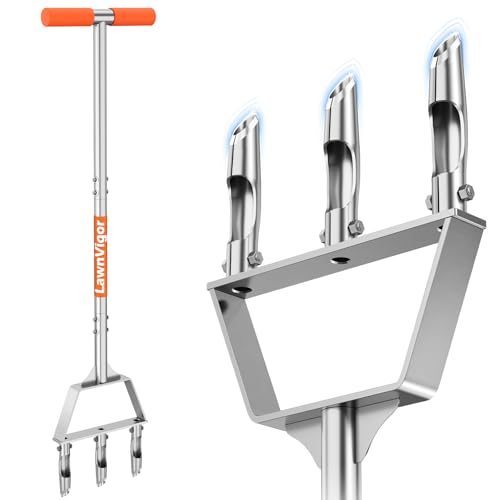
The Ames 2917400 Steel Spike Aerator is a simple, one-piece tool with four solid steel spikes. It can make localized holes without fuel, assembly or a rental trip, and exact-model owners repeatedly find it manageable for small patches when the soil is moist. It does not remove soil cores, so it should not be presented as a substitute for core aeration on a broadly compacted lawn.
Iowa State University Extension specifically advises avoiding spike devices for relieving compaction because they push soil aside, while Utah State says solid-tine aeration is less effective at loosening soil and can increase compaction if used improperly. That evidence changes the recommendation: choose the Ames for occasional, targeted hole-making in a small area—not as the main treatment for heavy clay, deep compaction, thatch or a full-size lawn.
The product itself is current: Ames lists model 2917400 in stock on its official site. The most defensible reasons to buy it are low storage needs, simple spot use and precise placement around known obstacles. The strongest reasons to skip it are labor, limited coverage, three-inch solid spikes and the risk of mistaking visible holes for meaningful compaction relief.
Exact model and verified specifications
Ames’ official product page identifies model 2917400 and describes a sturdy one-piece spike aerator with a stirrup-style handle. Its published assembled dimensions are 36.020 inches high, 7.756 inches deep and 1.252 inches wide. Home Depot’s exact-model specification adds a 32.5-inch handle, 7.76-inch head width, four steel tines and a three-inch tine length.
| Model | Ames 2917400 |
|---|---|
| Tool type | Manual solid-tine spike aerator; not a hollow-tine/core aerator |
| Construction | One-piece steel design |
| Number of tines | Four solid steel spikes |
| Published tine length | 3 in |
| Published assembled height | 36.020 in |
| Published head/depth dimension | About 7.76 in |
| Retailer-listed warranty | Limited 15 years; confirm current terms and proof-of-purchase requirements with Ames |
Retailer pages conflict about country of origin and even list inconsistent weights, so this review does not repeat those claims as settled facts. The current Ames page should control for product identity and dimensions; warranty service should be confirmed directly rather than inferred from a retailer label.
What the four spikes actually do
Placing a foot on the lower bar drives four solid points into the turf. The tool then has to be pulled out, moved and pressed again. This produces narrow channels but removes no soil. A hollow-tine aerator instead lifts plugs, creating space and reducing bulk density across the treated area.
Penn State describes lawn aeration as removing plugs with hollow tines, usually three to four inches long, and warns that solid spikes should not be mistaken for core equipment. Utah State gives the more nuanced view: solid-tine work can avoid the surface mess of plugs, but it is less effective at loosening soil and can worsen compaction if poorly used.
That makes the Ames most plausible for a tiny, selected patch where the goal is temporary surface channels or access without maneuvering a machine. It is a poor choice when the job is to correct widespread construction compaction, dense clay, a thick thatch layer or thousands of square feet.
Owner-reported positives
- Simple for small areas: multiple Home Depot verified purchasers describe setting it down, stepping and moving forward. One exact-model owner said a 100-square-foot lawn was an appropriate scale; another reported completing about 1,000 square feet in roughly an hour but still viewed a plug-aerator rental as the stronger periodic treatment.
- Light and easy to store: the absence of moving parts, wheels or loose hardware is a recurring positive in the exact-product pool. Owners mention short five- or ten-minute sessions instead of committing to the whole lawn at once.
- Precise placement: one verified owner valued being able to work around shallow tree roots. The same precision can help avoid marked sprinkler heads, though the three-inch spikes can still damage shallow irrigation or cable lines.
- Moist soil improves penetration: several verified reports say the tool enters more readily after rain or irrigation. This aligns with Extension guidance that aeration equipment needs moisture for penetration, while saturated soil is also undesirable.
Owner-reported negatives and disagreements
- Coverage is slow: some owners call the manual process useful exercise; others say it takes too much energy or is unsuitable beyond small areas. A Home Depot Q&A respondent reported leg cramping and advised switching feet.
- Dry or rocky soil is a problem: one verified buyer said the tool would not work well in dry, compacted earth. Other owners report success after watering, showing that soil moisture and stone content materially change the experience.
- Tines may bend: a detailed exact-product report describes one spike bending in a stony clay mix. That report was recommended but not visibly marked verified purchase, so it is a durability warning rather than a measured defect rate.
- Holes can be short-lived: one verified buyer said the holes filled after the first rain and wished they had chosen a plug tool. Others were satisfied simply because the product made the holes they expected.
- Comfort is basic: a 2022 exact-model video reported good balance and penetration but wanted a padded top grip. The video includes an Amazon affiliate disclosure and had a very small audience, so it is an individual, commercially linked account—not independent performance research.
Review provenance and evidence limits
Home Depot currently displays roughly 300 exact-model ratings, a 4.3/5 aggregate and 91% recommendation rate. Many text reviews are marked verified purchase, but the pool also includes star-only entries, at least one Seed Program review and a recent Home Depot Reviewer Program entry. Aggregate scores do not separate soil type, lawn size or long-term durability, so YardToolLab does not convert them into its own numerical rating.
The detailed reviews that best describe use conditions are mostly from 2016–2020, although shorter verified ratings continue through 2026. The Alee Wal Reviews video is dated 2022 and explicitly affiliate-supported. Ubuy’s exact-product page summarizes mixed reports about welding, spike size and usability, but shows only one rating and does not disclose the original review provenance; we treat it as low-confidence corroboration only.
No source found provides controlled before/after soil-density measurements for the 2917400. Owner claims that a lawn became greener may reflect weather, watering, fertilizer or other care and should not be attributed to this tool alone.
How to use it without overclaiming the result
- Identify the problem first. Check whether the lawn has true compaction, excess thatch, poor grading, irrigation problems or only a small worn patch. A screwdriver that is difficult to insert can be a screening clue, not a full soil diagnosis.
- Mark hazards. Locate sprinkler heads, shallow irrigation lines, landscape lighting wire and pet fencing before pressing three-inch spikes into the ground.
- Aim for moist, not saturated soil. Water beforehand if the ground is hard and dry, then allow it to drain. Stop if stones or resistance are bending the tines.
- Use controlled steps. Keep the tool vertical, alternate feet and work in short sessions. Do not jump on the bar or lever aggressively against buried rock.
- Judge the right outcome. The immediate result is four holes per placement. Do not treat that as proof that deep compaction has been relieved.
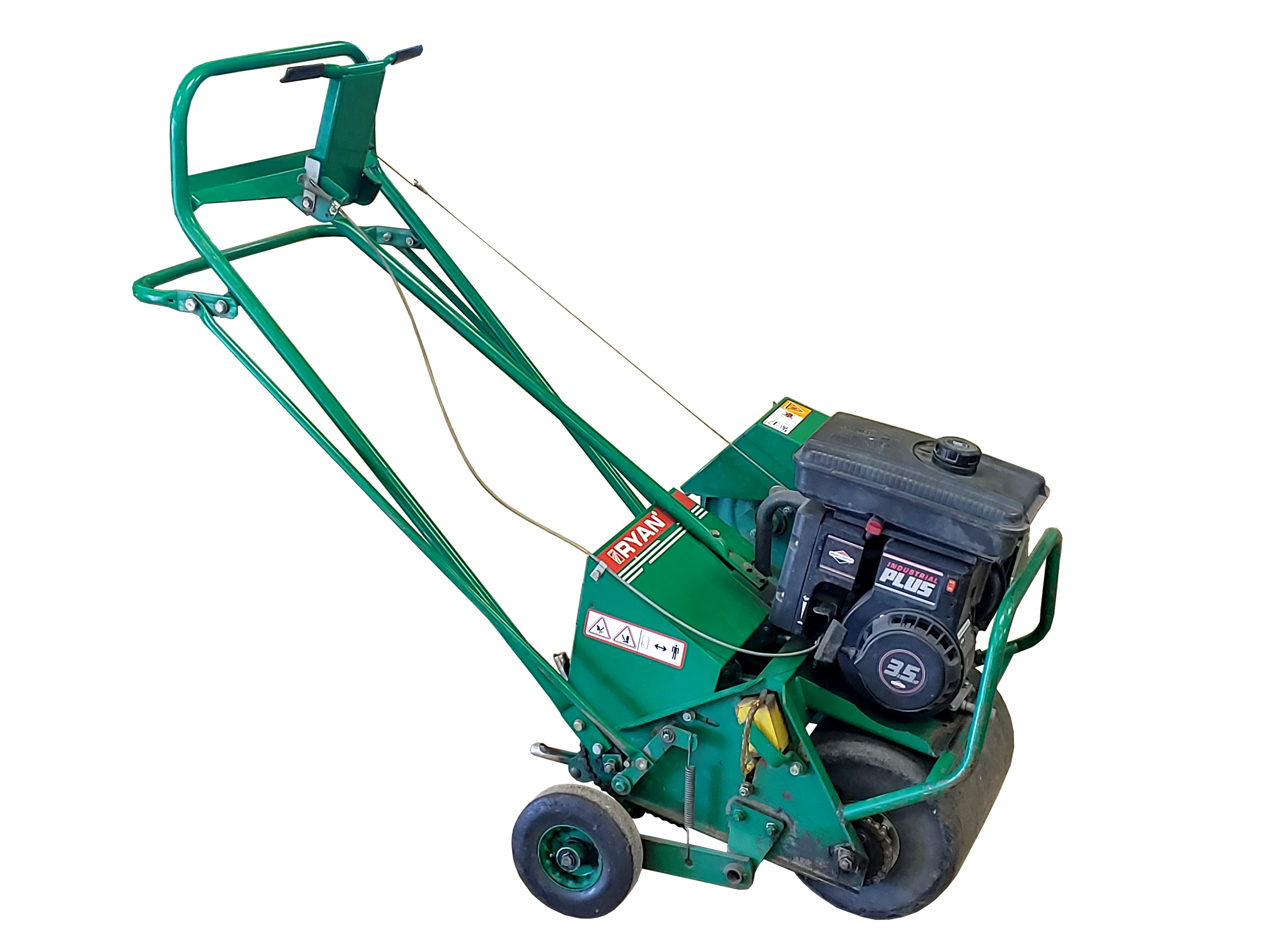
For broader options, compare our manual lawn-aerator guide. If the goal is genuine compaction relief, start with the core-aerator guide. Our research-based Ryan Lawnaire IV model guide shows how powered hollow-tine equipment differs from this four-spike tool.
Who should buy it?
Consider the Ames 2917400 for a very small patch, occasional targeted holes, limited storage and users who understand that the work is repetitive. Its one-piece design is simpler than multi-part manual tools, and it can be placed more precisely than a rolling or powered unit.
Choose a hollow-tine tool or service for widespread compaction, dense clay, larger lawns or a goal of reducing soil density. Rental or professional service can be more efficient than hundreds of manual placements. If mobility, balance, knee, hip or back issues make repeated stepping unsafe, skip this style altogether.
Sources and research method
Product identity, one-piece construction and assembled dimensions came from the official Ames 2917400 product page. Tine count and length, handle/head dimensions and the retailer-listed warranty were cross-checked on the exact Home Depot listing and Acme Tools page.
Owner evidence came from Home Depot’s exact-product review pool, the disclosed-affiliate Alee Wal Reviews video and the low-confidence Ubuy summary. The difference between solid and hollow tines was checked against Iowa State University Extension, Utah State University Extension and Penn State Extension. Sources were rechecked September 2, 2026.