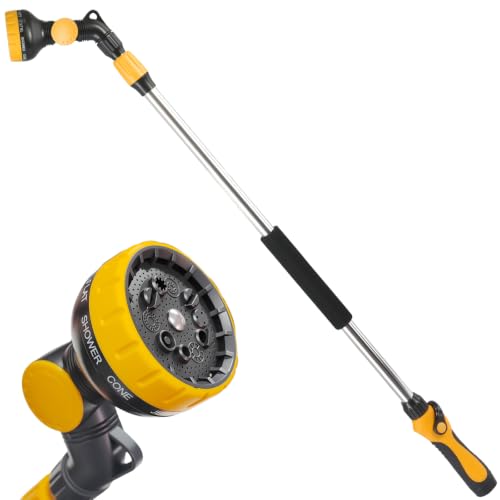
Quick verdict
The Dramm RainSelect is the strongest overall pick for raised beds thanks to its purpose-built 16 inch length, adjustable 9-pattern head and simple one-touch valve. Gardeners who want the gentlest possible spray for seedlings should consider the 400-hole soft rain wand instead, since its breaker head is built specifically around diffusing water rather than offering multiple patterns.

Dramm RainSelect Rain Wand 16 Inch
Dramm builds this wand at a compact 16 inches specifically, the manufacturer notes, for containers, raised beds and small garden spaces where a long wand is more awkward than helpful. Its 9-pattern adjustable head switches between mist, shower and jet to match seedlings versus more established plants, and a one-touch thumb valve starts and stops flow without squeezing a trigger through a whole bed.
Best watering wands for raised garden beds, picked for compact length, downward-angled heads and gentle spray at soil level.
The picks at a glance
| Tool | Best for | Score /100 | |
|---|---|---|---|
| Dramm RainSelect Rain Wand 16 Inch | Best Overall | — | Check price |
| Dramm One Touch Rain Wand 30 Inch | Best for Gentle Shower | — | Check price |
| Orbit 14 Inch 10-Pattern Front Trigger Wand | Best Value | — | Check price |
| RESTMO Heavy Duty Metal Watering Wand 16 Inch | Best Budget | — | Check price |
| 18 Inch Soft Rain Watering Wand with Shut-Off Valve | Also Great | — | Check price |
The picks, reviewed
Dramm RainSelect Rain Wand 16 Inch
Dramm builds this wand at a compact 16 inches specifically, the manufacturer notes, for containers, raised beds and small garden spaces where a long wand is more awkward than helpful. Its 9-pattern adjustable head switches between mist, shower and jet to match seedlings versus more established plants, and a one-touch thumb valve starts and stops flow without squeezing a trigger through a whole bed.
Reasons to buy
- Compact 16 inch length
- 9 adjustable spray patterns
- One-touch thumb control valve
- Lightweight aluminum construction
- Built for containers and raised beds
Reasons to avoid
- 16 inches is too short to be useful for anything mounted overhead, so it is not a dual-purpose tool for hanging baskets.
- Aluminum construction, while durable, is lighter duty than a stainless steel wand.

Dramm One Touch Rain Wand 30 Inch
This wand delivers what Dramm describes as a soft, full-flow shower built to water plants thoroughly without damaging delicate flowers or seedlings, which suits the tightly packed plantings common in a raised bed. At 30 inches it is longer than the RainSelect, letting you water across a wide bed from one side without stepping into the soil, while the same one-touch thumb valve keeps operation simple.
Reasons to buy
- Soft, full-flow shower spray
- One-touch thumb valve
- 30 inch reach across wide beds
- Durable aluminum construction
- Reduces bending and straining
Reasons to avoid
- At 30 inches it is longer than strictly necessary for a narrow raised bed, though the reach can help avoid stepping in soil.
- Single shower-style spray, without the multi-pattern dial some other Dramm and Orbit wands include.

Orbit 14 Inch 10-Pattern Front Trigger Wand
At just 14 inches, this Orbit wand is built for close, controlled work at bed height, with a front trigger and flow control knob giving you precise water control right where you are aiming it. Its ratcheting head angles the spray up or down, useful for directing a gentle shower down onto soil around the base of plants in a raised bed rather than across the leaves. 10 spray patterns cover everything from a fine mist for seedlings to a firmer flat spray for compacted soil.
Reasons to buy
- Compact 14 inch length
- 10 spray patterns
- Front trigger with flow control knob
- Ratcheting head angles up or down
- Lightweight metal construction
Reasons to avoid
- The shortest wand in this group, so it offers no benefit for anything beyond arm's reach.
- Metal construction with a rubber grip is lighter duty than the heavier-gauge wands on this list.

RESTMO Heavy Duty Metal Watering Wand 16 Inch
This 16 inch wand uses a zinc alloy body the manufacturer positions as solid and shock resistant, with a 180-degree ratcheting head that angles the spray down into a raised bed's soil without repositioning your whole arm. Its 7 spray patterns are adjustable through a separate flow control knob, and the TPU-coated pistol grip is built for repeated squeezing during a full watering pass down a row of beds.
Reasons to buy
- Zinc alloy body
- 180 degree ratcheting head
- 7 watering patterns
- Flow control knob
- TPU-coated pistol grip
Reasons to avoid
- 180-degree swivel head is useful for angle adjustment but adds a moving joint that is one more spot to eventually wear.
- 16 inches keeps you closer to the bed than a longer wand, so you may brush against plants while working close in.

18 Inch Soft Rain Watering Wand with Shut-Off Valve
Built around a 400-hole breaker head, this wand produces what the manufacturer calls a full-flow shower gentle enough for delicate soil, tender plants and seedlings, which matches the closely spaced, easily disturbed plantings typical of a raised bed. The head is fully removable for cleaning if the fine holes clog, and the aluminum body with a stainless steel disc is built for outdoor durability at a modest 18 inch length that suits bed-height watering.
Reasons to buy
- 400-hole breaker head
- Aluminum body with stainless disc
- Removable head for cleaning
- Built-in shut-off valve
- Suited to delicate soil and seedlings
Reasons to avoid
- 400 holes is a coarser mist than the 1000 or 2000-hole nozzles built for the most delicate seedlings, so it is a middle ground rather than the gentlest option available.
- Fixed spray style rather than a multi-pattern adjustable head.
Raised garden beds sit at a very different height and scale than hanging baskets: you are usually standing right next to the bed, working close range across tightly spaced seedlings, transplants and vegetables rather than reaching upward. That calls for a shorter, more precisely controlled wand with a head that can angle down toward the soil, not the long-reach, upward-angled wands built for elevated baskets. This guide is built specifically around that shorter, downward-focused use case, and the picks below are chosen to differ meaningfully from a hanging-basket wand rather than duplicate it.
I compared overall length, favoring compact 14 to 18 inch wands over long or telescoping ones, whether the head can tilt or ratchet downward toward soil level, and spray gentleness since raised beds commonly hold closely spaced seedlings and transplants that a hard stream could dislodge. A one-touch thumb valve or front trigger also matters more here than on a basket wand, since you are typically making several stops along a row of plants rather than one continuous upward spray.
A breaker-style head with several hundred tiny holes will generally produce the gentlest spray for delicate transplants, while an adjustable multi-pattern wand trades a bit of that gentleness for the flexibility to switch to a firmer setting for compacted soil or established plants. Aiming water down at soil level around the base of plants rather than across their leaves is also worth prioritizing regardless of which wand you choose, since wet foliage left standing can encourage fungal problems in a densely planted bed. A shorter wand also tends to be lighter in the hand, which matters if you are watering several beds in a row and stopping and starting the flow repeatedly at each one. The details below reflect each manufacturer’s published length, pattern and material specifications rather than a season of our own research, since we did not personally run each wand through a growing season.
How we research
What to look for
Compact length for bed height
Raised beds typically sit at waist height or lower, so a 14 to 18 inch wand gives precise, close-range control without the extra length a hanging basket or tall shrub would need.
Downward-angled or ratcheting head
A head that tilts down lets you aim water at soil level around plant bases instead of across leaves, reducing the risk of fungal issues from wet foliage.
Gentle breaker or shower pattern
Raised beds often hold closely spaced seedlings and transplants, so a fine multi-hole shower head reduces soil displacement compared with a hard jet.
Thumb valve or trigger control
A one-touch thumb valve or front trigger lets you start and stop water precisely as you move along a row without walking back to the spigot.
Build material at a shorter length
Aluminum or zinc alloy bodies keep a compact wand lightweight for repeated close-range work while still resisting rust better than plastic.
Our verdict
The Dramm RainSelect is the strongest overall pick for raised beds thanks to its purpose-built 16 inch length, adjustable 9-pattern head and simple one-touch valve. Gardeners who want the gentlest possible spray for seedlings should consider the 400-hole soft rain wand instead, since its breaker head is built specifically around diffusing water rather than offering multiple patterns.
FAQs
Raised beds sit closer to you than hanging baskets or tall shrubs, so a 14 to 18 inch wand gives more precise control over exactly where water lands without the extra length getting in the way or brushing against nearby plants.
A downward-angled or ratcheting head that lets you tilt the spray toward soil level is helpful, since watering at the base of plants rather than across their leaves reduces splashing and can lower the risk of fungal problems on foliage.
A breaker head uses many small holes to split a hose stream into a soft, wide shower instead of one hard jet. Raised beds often hold seedlings and transplants that a concentrated stream could dislodge or expose the roots of, so a breaker head is gentler.
You can, but the two tasks want different lengths. A short 14 to 18 inch wand suits close, controlled watering at bed height, while a 24 inch or longer, often curved or telescoping wand suits reaching up into an elevated basket, so many gardeners keep one of each.
A wand works well for daily or every-other-day hand watering, giving you visual control over each area, while a soaker hose is better suited to unattended, deeper watering over a longer bed. Many gardeners use a wand for spot watering and seedlings and a soaker hose for established rows.
Related guides

Melnor 65146AMZ RelaxGrip 33-Inch Shower Wand Reviewed: Thumb Control and Quick Connects for Tired Wrists

Review: Orbit 56044 10-Pattern Turret Wand, a 30-Inch Metal Wand with a Ratcheting Head
Orbit 56625 36-Inch Front Trigger Shower Wand Review: Gentle Reach for Baskets and Seedbeds

Best Watering Wand for Hanging Flower Baskets: Three Wands That Reach, Shower Gently and Shut Off at the Thumb

Dramm One Touch 16 Inch Rain Wand Review: Gentle Water for Containers