Quick verdict
The Honda HSS928 sets the standard here with a track-drive, hydrostatic two-stage system rated for 1,900 lbs of snow per minute. For most driveways, the Husqvarna ST124 or PowerSmart 26-Inch deliver similar two-stage performance at a lower price, and the EGO two-stage models offer a gas-free alternative.
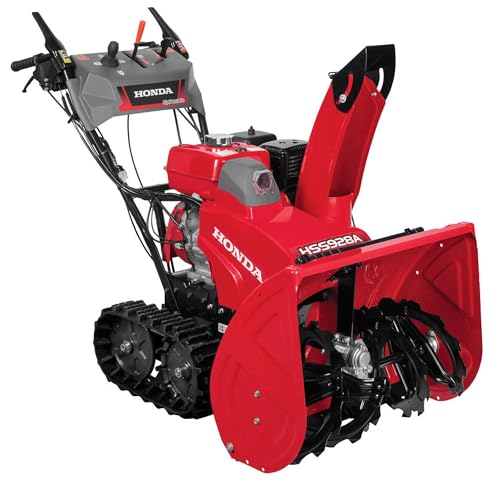
Honda HSS928 28-Inch Track-Drive
Honda's commercial-grade GX270 engine and dual rubber tracks with hydrostatic drive give the HSS928 both raw clearing power, up to 1,900 lbs of snow per minute, and traction advantages on inclines or rough ground that wheeled machines don't match. A 28-inch clearing width and 21.7-inch intake height handle deep, plowed piles in fewer passes.
Check price on Amazon →A two-stage auger and impeller move snow single-stage machines can't. See how the top gas and electric two-stage blowers compare.
The picks at a glance
| Tool | Best for | Score /100 | |
|---|---|---|---|
| Honda HSS928 28-Inch Track-Drive | Premium Pick | Check price | |
| Husqvarna ST124 212cc | Best Value Gas | Check price | |
| PowerSmart 26-Inch Self-Propelled | Best Budget Gas | Check price | |
| EGO Power+ SNT2420 24-Inch | Best Battery Two-Stage | Check price | |
| EGO Power+ 28-Inch Self-Propelled | Best Premium Electric | Check price |
The picks, reviewed
Honda HSS928 28-Inch Track-Drive
Honda's commercial-grade GX270 engine and dual rubber tracks with hydrostatic drive give the HSS928 both raw clearing power, up to 1,900 lbs of snow per minute, and traction advantages on inclines or rough ground that wheeled machines don't match. A 28-inch clearing width and 21.7-inch intake height handle deep, plowed piles in fewer passes.
Reasons to buy
- Powerful, Electric Start Honda GX Engine: This Honda snow blower uses a commercial grade G
- Exceptional Snow Thrower: With a throwing distance of up to 52 feet, this gas snow blower
- Dual Track Drive: This gas powered snow blower features pliable, low temperature rubber tr
- Self-Propelled, Hydrostatic Drive: This snow blower's hydrostatic transmission lets you mo
Reasons to avoid
- Track-drive construction adds significant cost over the wheeled two-stage machines in this comparison.
- The added weight of the track system makes it a slower, more deliberate machine to maneuver in tight spaces.

Husqvarna ST124 212cc
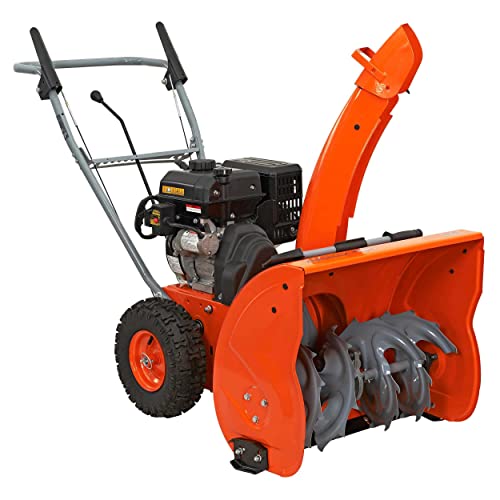
Husqvarna's ribbon auger design is described by the manufacturer as mixing air into the snow for easier clearing, backed by a 212cc engine, 21-inch intake height, and a 3-year bumper-to-bumper warranty plus a 5-year engine warranty that beats the coverage on several competitors.
Reasons to buy
- Ribbon auger mixes air into the snow, which makes the snow easy to handle and thereby ensu
- 13-in snow tires grip the terrain for exceptional control and maneuverability
- 21-in intake height maximizes snow clearing performance
- 3 year bumper-to-bumper warranty, plus a 5 year warranty on the engine only
Reasons to avoid
- Husqvarna's dealer and parts network is smaller in some regions than Honda's.
- 24-inch clearing width is a step narrower than the widest gas option here.
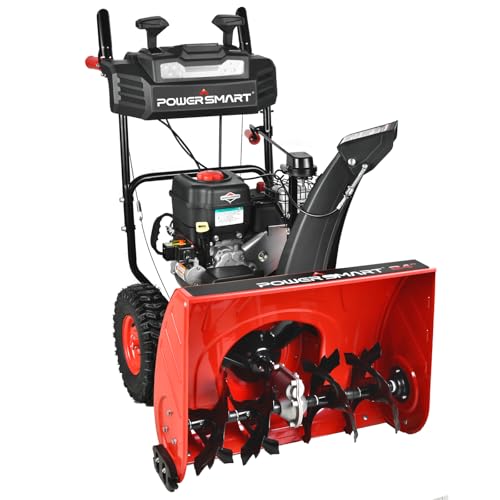
PowerSmart 26-Inch Self-Propelled
PowerSmart's 26-inch two-stage undercuts the Honda and Husqvarna on price while still offering a 208cc engine, 2,700 lb/min plowing capacity, and self-propelled drive with 13-inch snow terrain tires for traction.
Reasons to buy
- Tackle Heavy Snow: This PowerSmart gas snow blower adds handle warmer that keeps your hand
- Power Up: Powerful 208cc Briggs & Stratton 950 snow series engine delivers 2700 lbs/min sn
- Self-Propelled Drive System: Quickly and easily cut through icy snow with variable speed c
- Built to Last: Tackle heavy snow with steel construction in the housing, frame, deflector
Reasons to avoid
- Build quality and long-term reliability feedback is more limited than for the longer-established Honda and Husqvarna brands.
- It's the widest and heaviest wheeled machine here, which makes tight-space maneuvering slower.

EGO Power+ SNT2420 24-Inch
EGO markets the SNT2420 specifically for deep, wet, and packed snow, combining dual 56V batteries for what the company calls gas-like performance in a self-propelled, two-stage electric machine that throws snow up to 50 feet.
Reasons to buy
- EXCEEDS THE POWER OF GAS – Peak Power technology combines two EGO POWER+ 56V ARC Lithium b
- THROWS SNOW UP TO 50 FEET – High-performance two-stage snow clearing system helps move lar
- IDEAL SNOW BLOWER FOR LARGE DRIVEWAYS – Clears up to an 18-car driveway with 8 inches of s
- HANDLES SNOWPLOW PILES WITH EASE – 24-inch clearing width and 20-inch intake height help p
Reasons to avoid
- Battery and charger are sold separately, and EGO recommends its larger 7.5Ah packs for full-rated performance.
- Cold weather can reduce real-world battery runtime below the manufacturer's stated figures.

EGO Power+ 28-Inch Self-Propelled
The widest EGO two-stage model, rated by the manufacturer for coverage up to a 32-car driveway on a single charge with its larger 12.0Ah batteries, adds trigger-controlled steering and a 60-foot throw distance, the longest of any electric model in this comparison.
Reasons to buy
- THROWS SNOW UP TO 60 FEET – Peak Power technology combines the power of any two EGO ARC Li
- 28-INCH CLEARING WIDTH AND 21-INCH INTAKE HEIGHT – This electric snow blower can handle th
- CLEARS UP TO A 32-CAR DRIVEWAY – Clear up to a 32-car driveway with 8 inches of snow on a
- SELF-PROPELLED WITH TRIGGER-CONTROLLED STEERING – This variable speed self-propelled EGO s
Reasons to avoid
- The larger recommended battery packs needed for its full-coverage rating add substantially to the total cost beyond the base unit.
- It's the heaviest electric two-stage model here, a tradeoff for its wider clearing path.
A two-stage snow blower splits the clearing job into two separate mechanical steps: a first-stage auger breaks up and gathers the snow, then a separate high-speed impeller throws it through the chute. That separation is what lets these machines handle deep, packed, and wet snow without clogging the way a single-stage machine, which uses one part to do both jobs, tends to when conditions get tough. It’s also why two-stage machines are generally the better choice for anyone dealing with more than a few inches of snow at a time.
Engine or motor power is the next variable that separates two-stage machines from each other. The gas models compared below run 208cc to 212cc engines with plowing capacities in the 2,400 to 2,700 lb per minute range according to their manufacturer listings, while the battery two-stage options from EGO combine dual 56V batteries for what the company describes as gas-like power aimed specifically at deep, wet, and packed snow. Neither engine size nor battery voltage alone tells the whole story, since clearing width, intake height, and auger design all factor into how much snow a machine actually moves per pass.
Drive systems vary meaningfully within the two-stage category too. Honda’s HSS928 uses dual rubber tracks and hydrostatic drive built for traction on inclines and uneven ground, while the PowerSmart and Husqvarna machines use wheeled self-propelled drive with aggressive snow tires. Both approaches work well on a standard driveway; the track system is the stronger choice specifically where icy slopes or rough terrain are a regular factor.
The comparison below draws on the engine or battery specification, clearing width, intake height, and throw distance published by each manufacturer, along with self-propel and chute control features listed on the Amazon product pages. As with any two-stage machine, buyers should confirm chute clearing and safety procedures in the owner’s manual, since the auger and impeller in a two-stage design are more powerful than a single-stage machine’s.
How we research
What to look for
How the two-stage system works
A separate auger and impeller mean the machine doesn't rely on one part to both gather and throw snow, which is the core reason two-stage machines clog less on deep, wet, or packed snow than single-stage ones.
Engine size or battery power
Gas two-stage engines here run 208cc to 212cc with plowing capacities around 2,400 to 2,700 lb/min. Battery two-stage machines use dual 56V packs and are specifically marketed by EGO for deep, wet, and packed snow conditions.
Track drive vs wheeled self-propel
Honda's track-drive hydrostatic system is built for traction on inclines and rough ground. Wheeled self-propelled machines with aggressive snow tires handle a standard flat-to-moderate driveway well at a lower price point.
Clearing width and intake height
24 to 28 inch clearing widths and 20 to 21 inch intake heights across these picks let a two-stage machine take a real bite out of deep or plow-piled snow in fewer passes than a narrower machine.
Gas maintenance vs battery cost
Gas two-stage machines need fuel, oil changes, and off-season storage prep. Battery two-stage machines skip that but typically require purchasing larger battery packs separately to match the gas machines' working time.
Our verdict
The Honda HSS928 sets the standard here with a track-drive, hydrostatic two-stage system rated for 1,900 lbs of snow per minute. For most driveways, the Husqvarna ST124 or PowerSmart 26-Inch deliver similar two-stage performance at a lower price, and the EGO two-stage models offer a gas-free alternative.
FAQs
A two-stage machine uses a separate auger to break up and gather snow and a high-speed impeller to throw it, while a single-stage machine relies on one rotating part to do both. That separation is what lets two-stage machines handle deeper, wetter, and more packed snow without clogging as easily.
Not necessarily. If snowfall is generally light and infrequent, a single-stage electric machine is lighter, cheaper, and easier to store. Two-stage machines earn their cost on driveways that regularly see deep, wet, or heavy snow.
It depends on your terrain. Honda's track-drive HSS928 is specifically built for traction on inclines, rough ground, and icy conditions, which is a real advantage if your driveway has a slope or uneven surface. On flat, paved ground, a wheeled self-propelled two-stage machine performs comparably for less money.
The gas two-stage machines here throw snow 45 to 56 feet according to their manufacturer specs, while the EGO battery two-stage models are rated at 50 to 60 feet. Throw distance depends partly on snow density, with wetter snow generally traveling a shorter distance than dry powder.
For a standard residential driveway, yes, EGO's two-stage models are built with output the company compares directly to gas performance. For a very long driveway or back-to-back heavy storms, a gas engine's unlimited fuel-based runtime still gives it an edge over battery capacity.