Quick verdict
The Spear & Jackson 8290RS extends to 40.5 inches and adds a ratcheting mechanism on top of its telescoping handles, making it the strongest pick here for tall, tough, hard-to-reach branches. Anyone who wants a smaller adjustment range with slightly more compact storage should look at the STEELHEAD or TABOR TOOLS models instead, both extending from a shorter 27 inch starting length.

Spear & Jackson 8290RS Razorsharp Telescopic Ratchet Loppers
Spear & Jackson combines telescoping handles that extend to a stated 40.5 inches with a ratcheting mechanism, giving both maximum reach and a stepped cutting action for the toughest branches, backed by an SK5 carbon steel blade with a PTFE coating for rust resistance.
Telescoping loppers with extendable handles for reaching higher branches, compared by extended length, cut capacity and compound-action leverage.
The picks at a glance
| Tool | Best for | Score /100 | |
|---|---|---|---|
| Spear & Jackson 8290RS Razorsharp Telescopic Ratchet Loppers | Best Overall | Check price | |
| STEELHEAD Heavy-Duty Telescoping Bypass Lopper | Best Bypass for Live Wood | Check price | |
| TABOR TOOLS GG22A Extendable Anvil Lopper | Best for Dry, Dead Branches | Check price | |
| AIRAJ 27-41 Inch Anvil Loppers | Best Cut Capacity | Check price | |
| YRTSH Telescoping Compound Action Lopper | Best Budget Pick | Check price |
The picks, reviewed
Spear & Jackson 8290RS Razorsharp Telescopic Ratchet Loppers
Spear & Jackson combines telescoping handles that extend to a stated 40.5 inches with a ratcheting mechanism, giving both maximum reach and a stepped cutting action for the toughest branches, backed by an SK5 carbon steel blade with a PTFE coating for rust resistance.
Reasons to buy
- Extends to 40.5 inches
- Ratchet action for tough branches
- SK5 steel blade with rust-resistant coating
Reasons to avoid
- At full 40.5 inch extension the tool is longer and less maneuverable in tight garden beds.
- Ratchet cutting takes more total hand motions per branch than a straight compound-action lopper.
STEELHEAD Heavy-Duty Telescoping Bypass Lopper
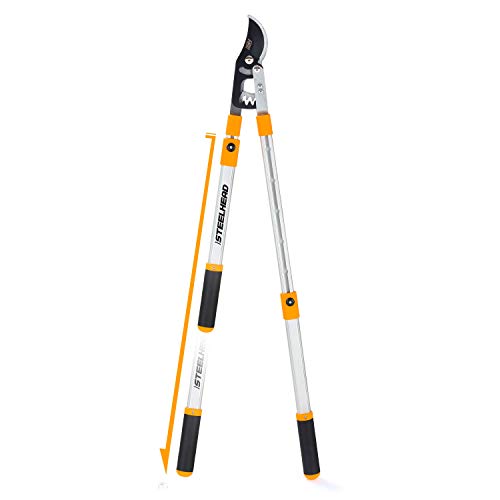
STEELHEAD uses a bypass blade rather than anvil, which the manufacturer pairs with a compound-ratcheting gear system rated up to 3 times the cutting force, and telescoping handles from 27 to 40 inches, making it a better fit than the anvil picks here for live, green branches you want cut cleanly.
Reasons to buy
- Bypass blade for clean live-wood cuts
- Compound-ratcheting gear, up to 3x force
- Tool-less telescoping adjustment
Reasons to avoid
- Bypass blades are generally less effective than anvil designs on dry, dead wood.
- 1-3/4 inch capacity is on par with the group rather than the largest available.

TABOR TOOLS GG22A Extendable Anvil Lopper
TABOR TOOLS pairs an anvil-style cutting head, better suited to dry and dead wood, with a compound-action mechanism the listing says triples cutting power, extending from 27 to 40 inches with a stated 1-3/4 inch capacity.
Reasons to buy
- 1-3/4 inch cut capacity
- Compound-action, 3x force
- Anti-shock rubberized grips
Reasons to avoid
- Anvil-style cutting is less ideal for live, green branches than a bypass design.
- Compound action alone, without a ratchet, means the full force is still applied in one continuous squeeze.

AIRAJ 27-41 Inch Anvil Loppers
AIRAJ lists a 2 inch cut capacity, the largest stated capacity in this guide, combined with a 6-speed adjustable handle extending to 41 inches and a 4-pivot compound-action design, plus an included spare replacement blade.
Reasons to buy
- 2 inch cut capacity
- Extends to 41 inches
- Includes spare replacement blade
Reasons to avoid
- Anvil head suits dead or dry branches better than delicate live growth.
- 6-step adjustment is less precise than a continuously variable telescoping slide.
YRTSH Telescoping Compound Action Lopper
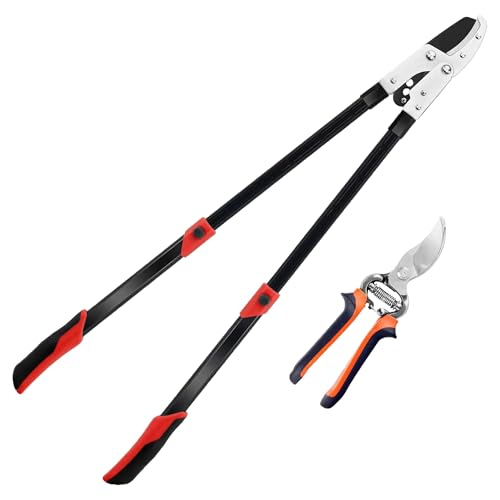
YRTSH offers the same core features as the pricier picks here, a compound-action mechanism and a 28 to 41 inch adjustable aluminum handle, at a lower typical price point, with a Teflon-coated blade the listing says handles both green and dry branches.
Reasons to buy
- 28-41 inch adjustable handle
- Compound-action technology
- Teflon-coated alloy steel blade
Reasons to avoid
- The listing does not specify a maximum cut capacity as precisely as the other picks in this guide.
- Aluminum handle construction is lighter but generally less rigid than steel-reinforced designs at full extension.
Telescoping loppers solve a specific problem that fixed-length loppers don’t: reaching a branch that’s a few feet above where you can comfortably cut with a standard 25 to 28 inch tool, without pulling out a pole saw or a ladder. The handles slide out and lock at a chosen length, usually somewhere between 27 and 41 inches depending on the model, adding real reach without adding a second tool to your shed.
That extra reach comes with a mechanical trade-off worth understanding before buying. Extending the handles increases the leverage arm, but it also increases the torque on your wrists and shoulders at full extension, which is why every lopper in this guide pairs its telescoping handle with a compound-action or ratcheting gear system. That mechanism multiplies your hand force through a system of pivot points or ratchet clicks, which is what actually makes cutting at arm’s length manageable rather than the extended length alone.
How we chose: extended length, cut capacity and mechanism type came from each manufacturer’s stated specifications on their listing. We prioritized loppers that clearly stated both a minimum and maximum handle length, since some listings only advertise the maximum extended length without mentioning how compact the tool collapses down for storage or transport. We also checked whether each model was described as compound-action, ratcheting or both, since a ratchet adds intermediate locking clicks on top of the pivot-based force multiplication a compound-action design already provides.
Cut capacity on telescoping loppers generally runs 1.75 to 2 inches, similar to a quality fixed-length lopper, since the extending handle mechanism does not typically reduce how much cutting force reaches the blade. If your main need is cutting the thickest branches rather than reaching high ones, a shorter fixed-length compound lopper may give more stable leverage at the base; these telescoping picks are for situations where reach, not raw cutting force, is the limiting factor.
How we research
What to look for
Extended length versus collapsed length
A lopper's maximum reach is only half the picture. Check the minimum, collapsed length too, since that determines how the tool stores in a shed and how maneuverable it feels on branches that don't actually need full extension.
Compound action versus ratcheting
Compound action multiplies force through a system of pivot points in a single continuous squeeze. A ratchet mechanism, like the Spear & Jackson pick here, adds intermediate locking clicks on top of that, trading cutting speed for even less peak force per motion, which matters more on the toughest branches.
Bypass versus anvil at full extension
The same live-wood-versus-deadwood distinction that applies to hand pruners applies here. A bypass blade gives a cleaner cut on green, growing branches, while an anvil blade generates more crushing force for dry or dead wood, and most telescoping loppers commit to one design or the other rather than offering both.
Weight distribution changes at full extension
A lopper that feels balanced collapsed can feel considerably more front-heavy or awkward once extended to 40 inches, since the head and blade weight is now further from your hands. Aluminum handles help keep this manageable, but expect some added strain versus a fixed-length lopper regardless of material.
Our verdict
The Spear & Jackson 8290RS extends to 40.5 inches and adds a ratcheting mechanism on top of its telescoping handles, making it the strongest pick here for tall, tough, hard-to-reach branches. Anyone who wants a smaller adjustment range with slightly more compact storage should look at the STEELHEAD or TABOR TOOLS models instead, both extending from a shorter 27 inch starting length.
FAQs
It depends on the model, but the loppers in this guide extend from a starting length around 27 inches up to a maximum between 40 and 41 inches, adding roughly 13 to 14 inches of additional reach. That is generally enough to reach branches a few feet higher than a standard fixed-length lopper without needing a ladder or pole saw.
Cut capacity is generally similar, often 1.75 to 2 inches on both telescoping and quality fixed-length loppers, since the extending handle mechanism does not typically reduce the force reaching the blade. What does change is leverage and control at full extension, which takes more arm and shoulder effort than cutting at a shorter, fixed length.
Compound action multiplies your hand force through a system of pivot points within one continuous squeeze. Ratcheting adds a stepped mechanism on top of that, letting you close the blade in several smaller clicks with a lock between each one, which further reduces peak force needed but takes more total motions to finish a cut.
Choose bypass, like the STEELHEAD pick here, for live, green branches where a clean scissor-style cut matters for the plant's health. Choose anvil, like the TABOR TOOLS or AIRAJ picks, for dry, dead or brittle branches where raw crushing force against a flat base is more useful than a clean slice.
They are typically similar in base weight, but the extending mechanism and longer aluminum tubing add some weight, and that weight feels more noticeable once the handles are extended to their maximum length since the tool's balance point shifts further from your hands. Expect more arm fatigue at full extension than with a shorter, fixed lopper.
Related guides

Fiskars 32 Inch PowerGear Bypass Lopper Review
Best Loppers for Thick Branches of 2026

Best Loppers We Recommend
Fiskars PowerGear2 Bypass Lopper Review

Corona SL 3264 Forged Bypass Lopper Review

ARS HP-VS9Z Pruner Review: Specs & Owner Reports
Tabor Tools GG12 Anvil Lopper Review
