Quick verdict
The EarthWay 2050P is the top pick for grass seed thanks to its adjustable drop rate specifically tuned for seed distribution and an 80 lb capacity that handles a full lawn reseeding without constant refills. For smaller overseeding jobs, the Scotts Whirl hand-powered spreader is a simpler, lower cost option.

EarthWay 2050P 80lb Broadcast Spreader
EarthWay specifies this spreader's adjustable drop rate for both lawn care and seed spreading specifically, which matters since grass seed needs a different calibration than fertilizer granules to avoid uneven germination. The 80 lb capacity and rustproof poly hopper handle a full lawn reseeding job without frequent refills, and it ships pre-assembled and ready to use.
Check price on Amazon →Spreaders best suited for grass seed, with fine calibration settings for even seeding rather than heavier fertilizer granules.
The picks at a glance
| Tool | Best for | Score /100 | |
|---|---|---|---|
| EarthWay 2050P 80lb Broadcast Spreader | Best Overall | — | Check price |
| Scotts Turf Builder EdgeGuard Mini Broadcast Spreader | Best Value | — | Check price |
| EarthWay 2170 Commercial 100 lb Broadcast Spreader | Best Premium | — | Check price |
| CHAPIN 8740A 64 oz All-Season Hand Shaker Spreader | Best Budget | — | Check price |
| EarthWay 2750 25lb Nylon Bag Seeder Spreader | Also Great | — | Check price |
| Scotts Whirl Hand-Powered Spreader | Also Great | — | Check price |
The picks, reviewed
EarthWay 2050P 80lb Broadcast Spreader
EarthWay specifies this spreader's adjustable drop rate for both lawn care and seed spreading specifically, which matters since grass seed needs a different calibration than fertilizer granules to avoid uneven germination. The 80 lb capacity and rustproof poly hopper handle a full lawn reseeding job without frequent refills, and it ships pre-assembled and ready to use.
Reasons to buy
- 80 lb capacity, pre-assembled
- Adjustable drop rate for lawn care and seed spreading
- Rustproof poly hopper
- Built specifically with seed spreading in mind
Reasons to avoid
- An 80 lb capacity hopper is bulkier to store and maneuver than a smaller handheld option for light overseeding jobs.
- As a walk-behind unit it requires more physical effort across a large area than a tow behind spreader.

Scotts Turf Builder EdgeGuard Mini Broadcast Spreader
Scotts explicitly lists this spreader as usable for grass seed alongside lawn food, salt, and ice melt, with a 5,000 sq. ft. capacity that suits a standard residential reseeding job. The pre calibrated, ready to use design and EdgeGuard shield carry over from its fertilizer use case, keeping seed off driveways and beds during edge passes.
Reasons to buy
- Holds up to 5,000 sq ft of product
- Explicitly rated as a grass seed spreader
- EdgeGuard technology for clean edges
- Pre calibrated, no assembly required
Reasons to avoid
- It is calibrated broadly across multiple product types rather than fine tuned specifically for seed the way a dedicated seeder is.
- 5,000 sq ft capacity means a refill on larger reseeding projects.
EarthWay 2170 Commercial 100 lb Broadcast Spreader
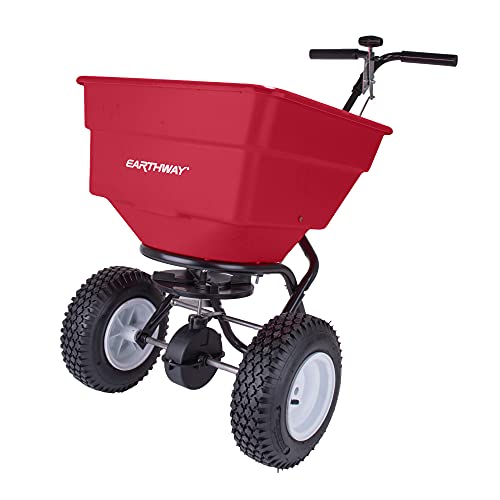
Built to commercial specifications, this EarthWay spreader carries a 100 lb hopper and an adjustable drop rate the manufacturer positions for both broadcast fertilizer and seed spreading on larger properties or new lawn establishment jobs. Large 13 inch pneumatic tires are specified for stability across freshly graded or uneven soil, common on new seeding sites.
Reasons to buy
- 100 lb capacity for large seeding jobs
- Adjustable drop rate
- Heavy duty walk-behind with 13 inch pneumatic tires
- Commercial grade construction
Reasons to avoid
- It is priced and sized for larger, more frequent seeding jobs than an occasional homeowner overseeding project needs.
- A full 100 lb hopper takes real effort to push without a tow vehicle.

CHAPIN 8740A 64 oz All-Season Hand Shaker Spreader
Chapin specifies three interchangeable lid openings on this shaker spreader sized for different particulate types, including grass seed alongside salt and fertilizer, which makes it a low cost option for spot overseeding thin patches rather than a full lawn. Its portability suits touching up bare spots without hauling out a wheeled spreader for a small job.
Reasons to buy
- 64 oz capacity poly bottle
- Three lid openings sized for different particulates including grass seed
- No wheels or assembly required
- Portable for spot overseeding
Reasons to avoid
- Coverage evenness for seed depends heavily on your own shaking technique across a pass.
- It is not practical for reseeding a full size lawn where a wheeled spreader covers ground much faster.

EarthWay 2750 25lb Nylon Bag Seeder Spreader
This model is built and marketed by EarthWay specifically as a seeder rather than a general purpose spreader, which the company positions for everything from residential lawn seeding to food plot seeding for hunters and farmers. Its 25 lb nylon bag design keeps it lighter than a wheeled hopper while still holding enough seed for a substantial overseeding session.
Reasons to buy
- Built specifically as a grass seeder
- 25 lb nylon bag capacity
- Water resistant construction
- Marketed for hunters, farmers, and gardeners seeding food plots
Reasons to avoid
- At 25 lb capacity it holds less than the larger EarthWay broadcast models above for a full lawn renovation.
- It is a hand-operated bag spreader, so it depends on your own consistent crank pace for even seed distribution.

Scotts Whirl Hand-Powered Spreader
Scotts lists seed spreading as one of the explicit uses for this hand-powered spreader, alongside fertilizer and salt, with a capacity up to 1,500 sq. ft. per fill that suits smaller overseeding jobs or a compact lawn. It is lightweight enough to store on a shelf between the spring and fall seeding windows most cool season lawns are seeded in.
Reasons to buy
- Holds up to 1,500 sq ft of product
- Explicitly rated for seed spreading
- Lightweight and easy to store
- Adjustable arm support for comfort
Reasons to avoid
- 1,500 sq ft capacity is limiting for anything beyond a small yard or spot overseeding job.
- Even seed distribution depends on maintaining a steady crank speed and walking pace throughout the pass.
Spreading grass seed evenly is a finer calibration problem than spreading fertilizer granules. Seed particles are typically smaller and lighter than fertilizer pellets, so a spreader’s gate opening and flow settings need to be dialed in differently to avoid seeding too thick in some spots and leaving bare patches in others. Overseeding an existing lawn or establishing a new one from scratch both depend on that even distribution more than raw hopper capacity.
This guide is built specifically around grass seed rather than treating it as an afterthought on a general fertilizer spreader page. The spreaders below either come from EarthWay, a brand built specifically around seeding equipment, or are general purpose broadcast and shaker spreaders that the manufacturers explicitly rate for seed alongside fertilizer, salt, and ice melt. Every capacity and calibration detail comes from the manufacturer listing or Amazon product page.
Adjustable drop rate settings matter more here than on a straightforward fertilizer spreader, since grass seed varies significantly in size and weight between species, from fine fescue to larger rye grass seed. A spreader with a wide range of gate settings lets you dial in the right rate for the specific seed you are using rather than guessing with a fixed opening built primarily for fertilizer granules.
Hopper capacity is worth matching to the job. A large scale reseeding or new lawn establishment benefits from an 80 to 100 lb hopper that covers substantial ground before a refill, while overseeding thin patches in an existing lawn or handling a small yard is often better suited to a lighter hand-powered or hand shaker spreader that is easier to control precisely over a smaller area.
Owner feedback commonly notes that a spreader with a rustproof poly hopper holds up better across seasons of seed, fertilizer, and salt use than one built entirely from unprotected steel, since seed spreading often happens in the damp fall and spring conditions that promote rust.
How we research
What to look for
Calibration for seed versus fertilizer
Grass seed is typically smaller and lighter than fertilizer granules, so a spreader with a wide range of adjustable drop rate settings, like the EarthWay models above, lets you dial in the right flow for the specific seed variety rather than relying on a setting calibrated mainly for fertilizer.
Hopper capacity for the size of the seeding job
A full lawn renovation or new lawn establishment benefits from an 80 to 100 lb hopper that covers substantial ground before a refill, while overseeding thin patches or a small yard is often better handled by a lighter hand-powered or shaker spreader.
Rustproof construction for damp seeding seasons
Grass seeding often happens during damp spring or fall conditions that promote rust. A rustproof poly hopper, used on the EarthWay and Scotts models above, holds up better across repeated seasons than an unprotected steel hopper.
Dedicated seeder versus multi-purpose spreader
EarthWay's seeder-specific models are built around seed distribution as the primary job, while Scotts and Chapin spreaders are multi-purpose units rated for seed alongside fertilizer and salt. Either works, but a dedicated seeder may offer finer calibration for seed specifically.
Our verdict
The EarthWay 2050P is the top pick for grass seed thanks to its adjustable drop rate specifically tuned for seed distribution and an 80 lb capacity that handles a full lawn reseeding without constant refills. For smaller overseeding jobs, the Scotts Whirl hand-powered spreader is a simpler, lower cost option.
FAQs
Not necessarily a different spreader, but you do need different calibration. Grass seed is generally smaller and lighter than fertilizer granules, so the gate or drop rate setting needs to be adjusted for seed specifically. Several spreaders in this guide, including the Scotts and EarthWay models, explicitly list seed as a rated use alongside fertilizer.
For a full lawn renovation or new lawn establishment, an 80 to 100 lb hopper like the EarthWay 2050P or 2170 above reduces refill stops on larger properties. For overseeding thin patches in an existing lawn, a smaller hand-powered spreader in the 1,500 to 5,000 sq ft range is usually enough.
It works well for spot overseeding bare patches or a very small yard, since you control placement directly. For an even, full lawn seeding job, a wheeled broadcast spreader with an adjustable drop rate, like the EarthWay or Scotts models above, generally produces more consistent germination results.
It controls how wide the gate at the bottom of the hopper opens, which determines how much seed, fertilizer, or salt flows out per pass. A wider range of adjustment, specified on the EarthWay models above, lets you dial in a lighter flow appropriate for fine grass seed compared to heavier fertilizer granules.
That depends on your grass type and climate rather than the spreader itself, but cool season lawns are commonly seeded in early fall or spring. Whatever the timing, a rustproof poly hopper like the ones on the EarthWay and Scotts models above holds up better through the damp conditions those seeding windows often bring.
Related guides

Chapin 60116 4-Gallon Backpack Sprayer Review: The Entry-Level Chapin for Weekend Spraying
Scotts Whirl Hand-Powered Spreader Review: A Small-Yard Spreader That Lives on a Shelf
Agri-Fab 175 lb Tow-Behind Drop Spreader Review for Acre Lawns: 42 Inches of Controlled Drop

What the Chapin 61800 ProSeries 4-Gallon Backpack Sprayer Does Well and Where It Falls Short

Solo 425 4-Gallon Piston Backpack Sprayer Reviewed: 90 psi, Four Nozzles and Viton Seals

Best Handheld Fertilizer Spreader for Tiny Lawns: Three Hand-Crank Spreaders That Do Not Stripe a Small Yard

Best Compost Spreader for Uneven Lawns: Three Rolling Mesh Spreaders That Fill the Dips