Quick verdict
The EZ Kut Heavy Duty Ratcheting Pruning Shears are the clearest fit here, built around a ratchet mechanism the manufacturer markets directly at arthritis and weak-hand users, with a 1.5 inch capacity that would otherwise require far more grip strength. Anyone who wants a lighter tool for everyday deadheading rather than thick cuts should look at the VOTREK spring-assisted pick instead, which reduces effort a different way, by making the blades snap back open on their own.

EZ Kut Heavy Duty Ratcheting Pruning Shears
EZ Kut's listing directly markets this ratcheting anvil pruner toward users with arthritis or weak hands, rated for branches up to 1.5 inches thick using a cast aluminum body and a ratchet mechanism the manufacturer says reduces the hand force needed per click, well beyond what most standard pruners of this capacity would require.
Ratchet and lever-assist pruning shears that multiply hand force for arthritis or weak grip, compared by mechanism, cut capacity and handle design.
The picks at a glance
| Tool | Best for | Score /100 | |
|---|---|---|---|
| EZ Kut Heavy Duty Ratcheting Pruning Shears | Best Overall for Arthritis | Check price | |
| gonicc 8-Inch Professional Ratchet Anvil Pruning Shears | Best Multi-Stage Ratchet | Check price | |
| Gerossi Ratchet Pruning Shears Heavy Duty | Best Value Ratchet | Check price | |
| DECERK 8.5-Inch Professional Pruning Shears | Best Lever-Assist Alternative | Check price | |
| VOTREK 8.5-Inch Bypass Pruning Shears | Best Spring-Assisted Opening | Check price |
The picks, reviewed
EZ Kut Heavy Duty Ratcheting Pruning Shears
EZ Kut's listing directly markets this ratcheting anvil pruner toward users with arthritis or weak hands, rated for branches up to 1.5 inches thick using a cast aluminum body and a ratchet mechanism the manufacturer says reduces the hand force needed per click, well beyond what most standard pruners of this capacity would require.
Reasons to buy
- 1.5 inch cut capacity
- Ratchet mechanism reduces hand force
- Shock-absorbing cushioned handle
Reasons to avoid
- Ratcheting takes several smaller squeezes per cut rather than one motion, which is slower on thin stems.
- Cast aluminum construction is lighter than forged steel but generally less rigid over years of heavy use.
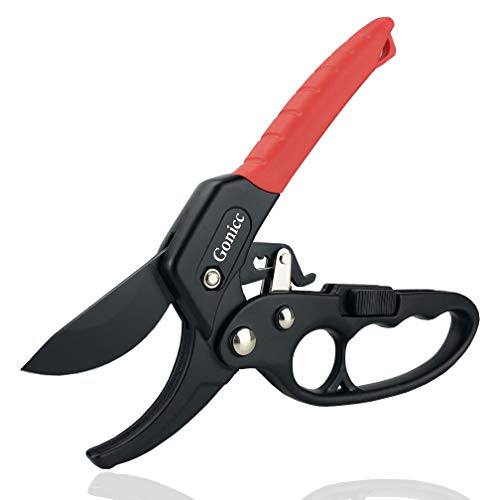
gonicc 8-Inch Professional Ratchet Anvil Pruning Shears
gonicc specifies a ratchet system that multiplies hand force up to 3 times, clicking into successive positions as pressure builds, paired with SK-5 steel blades and chrome vanadium handles built for repeated use rather than occasional cuts.
Reasons to buy
- 3x force ratchet mechanism
- SK-5 steel blades
- Ambidextrous ergonomic handle
Reasons to avoid
- Anvil-style cutting is better suited to dry or dead stems than delicate live growth.
- The listing notes a light protective oil coating on arrival that needs wiping before first use.
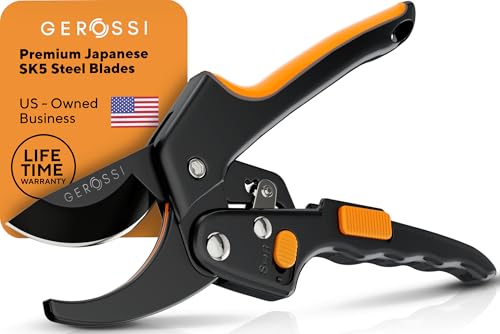
Gerossi Ratchet Pruning Shears Heavy Duty
Gerossi's listing specifically calls out arthritis, weak hands and elderly users as the intended audience for its 3-step ratchet mode, which the manufacturer says triples hand power for cutting stems up to 3/4 inch, while a separate single-cut mode is available for lighter everyday trimming.
Reasons to buy
- Dual single-cut and ratchet modes
- SK-5 steel blade
- One-hand safety lock
Reasons to avoid
- 3/4 inch capacity is lower than the EZ Kut and gonicc picks in this guide.
- Two-mode design (single-cut and ratchet) adds a small learning curve versus a pruner with one fixed action.

DECERK 8.5-Inch Professional Pruning Shears
Rather than a ratchet, DECERK uses a lever-action design the listing says multiplies cutting force up to 4 times in a single squeeze, with the manufacturer specifically describing the non-slip rubber handles as arthritis and seniors friendly for reduced hand and wrist fatigue.
Reasons to buy
- 4x lever-assisted cutting force
- Titanium-coated SK5 blade
- One-hand safety lock
Reasons to avoid
- Lever-assist still requires one full squeeze per cut rather than breaking the motion into smaller ratchet clicks.
- 3/4 inch capacity limits it to smaller branches than the ratchet-anvil picks above.

VOTREK 8.5-Inch Bypass Pruning Shears
Rather than reducing the force needed to close the blades, VOTREK's sealed spring system automatically snaps the blades back open after each cut, which the listing markets toward weak hands and seniors by removing the separate effort of manually reopening the tool between cuts.
Reasons to buy
- Sealed jam-proof spring return
- Ever-sharp SK5 Teflon-coated blade
- Thumb-glide safety lock
Reasons to avoid
- No ratchet or lever multiplier, so closing force for thicker stems is not reduced, only the reopening motion.
- 3/4 inch capacity keeps it in the same range as everyday bypass pruners rather than heavy-duty cutting.
The physical difficulty with pruning shears and arthritis is not usually the initial squeeze, it’s doing that squeeze dozens or hundreds of times through a full cutting motion, and doing it against the resistance of a spring that pushes the blades back open every time you let go. A ratchet mechanism changes that equation directly. Instead of closing a thick branch in one hard squeeze, a ratchet pruner lets you close the blade in two or three smaller increments, each click locking in your progress so the next squeeze builds on the last instead of starting the force over from nothing.
That is the main feature we prioritized in this guide, and it is genuinely different from the compact, small-hands-focused pruners covered elsewhere on this site. A small pruner shortens the reach and grip span, which helps with hand size but does nothing about how much force a single cut requires. A ratchet or lever-assist mechanism multiplies the force your hand does apply, which is the more relevant feature for reduced grip strength or joint pain rather than hand size specifically.
How we chose: we looked for products whose manufacturer listing explicitly described a ratcheting or multi-stage cutting mechanism, and we noted where a listing directly referenced arthritis, weak hands or seniors as intended users, since that generally means the ergonomic handle shape and lock placement were designed with that grip limitation in mind rather than added as an afterthought. We also included one spring-assisted, non-ratchet pick for gardeners who mostly cut soft or moderate stems and want reduced opening resistance rather than a multi-click closing action.
One trade-off worth knowing upfront: ratchet mechanisms take more total hand motions to complete a single cut than a standard one-squeeze pruner, since you are releasing and re-gripping the handle between each ratchet click. That is the mechanism working as intended, trading speed for reduced peak force, but it does mean a thick branch takes longer to cut through than it would with a standard bypass pruner and full hand strength.
How we research
What to look for
Ratchet mechanisms trade speed for reduced peak force
A ratchet pruner closes in two or three smaller clicks instead of one full squeeze, which means less force needed at any single point but more total hand motions to finish a cut. That trade-off is the entire point for reduced grip strength, though it does make each cut take longer than a standard pruner.
Lever-assist is a different mechanism than ratcheting
Some pruners, like the DECERK pick here, use a lever system that multiplies force within a single continuous squeeze rather than breaking the motion into ratchet clicks. It still reduces the force needed per cut, but the motion feels closer to a standard pruner than a true ratchet does.
Check whether the listing addresses arthritis directly
Several manufacturers in this space specifically design handle shape, lock placement and grip cushioning around reduced hand strength, and say so directly in the product listing. That is a reasonable signal the ergonomics were considered deliberately rather than a standard pruner simply being relabeled.
Spring tension on reopening matters as much as closing force
Every pruner needs to reopen between cuts, and a stiff opening spring adds resistance you feel on every single cut across a session. A sealed, lower-tension spring, like the VOTREK pick here, addresses that separate half of the repetitive motion rather than only the closing squeeze.
Our verdict
The EZ Kut Heavy Duty Ratcheting Pruning Shears are the clearest fit here, built around a ratchet mechanism the manufacturer markets directly at arthritis and weak-hand users, with a 1.5 inch capacity that would otherwise require far more grip strength. Anyone who wants a lighter tool for everyday deadheading rather than thick cuts should look at the VOTREK spring-assisted pick instead, which reduces effort a different way, by making the blades snap back open on their own.
FAQs
Instead of closing a branch in one continuous squeeze, a ratchet pruner locks your progress at each click, so releasing and re-gripping the handle lets you build force gradually across two or three smaller squeezes rather than needing the full cutting force all at once. Manufacturers commonly state this multiplies effective hand force by 2 to 4 times.
Both reduce the force needed per cut, but in different ways. A ratchet breaks the cut into multiple smaller squeezes with a lock between each one, while a lever-assist pruner multiplies force within a single continuous squeeze. A ratchet generally suits weaker grip strength better, while lever-assist feels closer to a standard pruner's motion.
Yes, for a single cut. Because a ratchet pruner requires releasing and re-squeezing the handle at each click rather than closing in one motion, a thick branch takes noticeably longer to cut through than it would with a standard bypass pruner and full hand strength, which is the direct trade-off for needing less force per squeeze.
Most ratchet pruning shears use an anvil-style blade rather than bypass, which presses against a flat base instead of slicing past a second blade. That works well on dry or dead wood but can crush delicate live stems more than a bypass pruner would, so for green growth a bypass or lever-assist bypass design is generally the better match.
It varies by mechanism and model. The ratchet-anvil picks in this guide range from 3/4 inch up to a manufacturer-stated 1.5 inches, since the ratchet action is specifically what allows cutting a thicker branch than the same hand strength could manage with a standard single-squeeze pruner.

