Quick verdict
For patios, the Westinghouse ePX3500 is our top pick. Its 2500 max PSI and soap tank handle both hard pavers and softer patio furniture, its full nozzle set lets you dial pressure to the material, and its M22 fittings accept a surface cleaner for even passes on a large paved area.

Westinghouse ePX3500 Electric Pressure Washer
Patios mix hard surfaces like pavers and stone with softer items like furniture and planters, and the ePX3500's five-nozzle set lets you match pressure to each. At 2500 max PSI and 1.76 max GPM it has the muscle for stubborn moss between stones, while the soap tank helps with a detergent pass first. Its M22 fittings mean you can add a surface cleaner for a large flat patio, and at 19 pounds it moves easily.
Check price on Amazon →Compare best pressure washer for patios, ranked using published specifications, manuals and owner feedback. See research-based findings, key trade-offs.
The picks at a glance
| Tool | Best for | Score /100 | |
|---|---|---|---|
| Westinghouse ePX3500 Electric Pressure Washer | Best Overall | Check price | |
| Pressure Washer (LWQ Light Blue) | Best Value | Check price | |
| Westinghouse ePX3050 Electric Pressure Washer | Best Premium | Check price | |
| Kärcher Pressure Washer K1700 | Best Budget | Check price | |
| 14" Pressure Washer Surface Cleaner | Also Great | Check price |
The picks, reviewed
Westinghouse ePX3500 Electric Pressure Washer
Patios mix hard surfaces like pavers and stone with softer items like furniture and planters, and the ePX3500's five-nozzle set lets you match pressure to each. At 2500 max PSI and 1.76 max GPM it has the muscle for stubborn moss between stones, while the soap tank helps with a detergent pass first. Its M22 fittings mean you can add a surface cleaner for a large flat patio, and at 19 pounds it moves easily.
Reasons to buy
- 2500 max PSI 1.76 max GPM
- 19 pounds, compact
- 25' hose, soap tank
- 5-nozzle set incl. turbo
- 3-Year coverage
Reasons to avoid
- A narrow tip at 2500 PSI can chip soft stone or etch furniture, so choose the nozzle carefully
- Electric power ties you to cord and outlet reach across the patio

Pressure Washer (LWQ Light Blue)
This LWQ washer lists up to 2.5 GPM with four nozzles and a foam cannon, offering soap application and a spread of spray angles for cleaning patio pavers and furniture. The dual-roller base and 34.5-foot cord make it easy to reposition around outdoor seating. It ranks as a value pick because the listing does not confirm a verified PSI rating.
Reasons to buy
- Up to 2.5 GPM
- 4 nozzles, foam cannon
- Dual-roller, anti-tipping base
- 34.5 ft cord
Reasons to avoid
- No confirmed max PSI in the product data, so its cleaning strength is uncertain
- Generic branding limits confidence in long-term durability
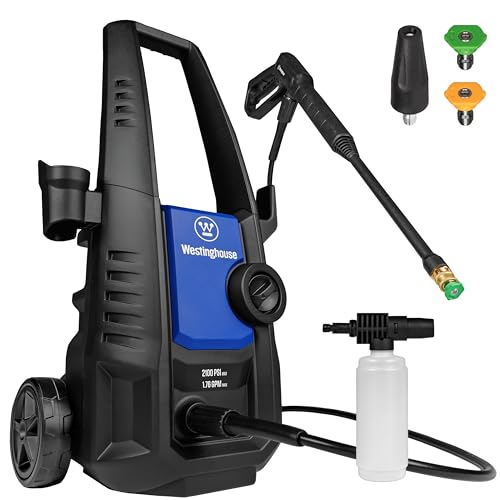
Westinghouse ePX3050 Electric Pressure Washer
The ePX3050 at 2100 max PSI is a touch gentler, which suits mixed patios where you want less risk of etching stone or furniture. It comes with a foam cannon and turbo nozzle for both light and stubborn jobs, plus a 20-foot hose and 35-foot GFCI cord. Its M22 fittings accept patio-friendly accessories like surface cleaners and undercarriage tools.
Reasons to buy
- 2100 max PSI 1.76 max GPM
- Foam cannon, turbo nozzle
- 20' hose, 35' GFCI cord
- 5" never-flat wheels
- M22 fittings
Reasons to avoid
- The 20-foot hose is shorter, so you move the machine more on a large patio
- At 2100 PSI it works a bit slower on heavily soiled pavers than the higher-powered models

Kärcher Pressure Washer K1700
The Karcher K1700 is the light, easy-to-store budget choice at 1700 PSI and 1.2 GPM, and it is independently CETA certified for its rated performance. Its three nozzles including a turbo tip cover patios, pavers, and furniture, and the on/off foot switch plus 0.5-gallon detergent tank make it convenient for smaller spaces. Never-flat wheels help it roll across uneven ground.
Reasons to buy
- 1700 PSI, 1.2 GPM, CETA certified
- 3 nozzles incl. turbo
- On/off foot switch
- 0.5 gal detergent tank
- Never-flat wheels
Reasons to avoid
- At 1700 PSI it is the least powerful pick, so deep moss and heavy staining take more passes
- Its 0.5-gallon detergent tank is small, meaning more refills on a big patio
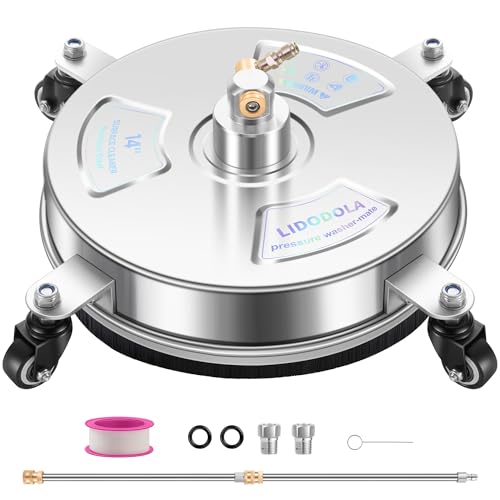
14" Pressure Washer Surface Cleaner
For a large flat patio, the Lidodola 14-inch surface cleaner delivers even, streak-free passes that a wand cannot match. Its dual spinning jets, weighted stainless base, and splash-free skirt keep spacing consistent and reduce overspray onto furniture and walls. It attaches with a 1/4-inch quick-connect and is intended for 2000 to 4000 PSI machines.
Reasons to buy
- 14" dual spinning nozzles
- Stainless steel, weighted base
- Splash-free skirt
- 1/4" quick-connect
Reasons to avoid
- It is an attachment, so you need a compatible washer to run it
- It works only on flat open paving; borders, steps, and furniture still need a wand
Why you should trust this guide
Patios are a mixed job. One patio might combine concrete pavers, natural stone, grout or sand-filled joints, and a set of outdoor furniture, and each of those wants a different pressure and technique. That is why I did not simply chase the highest PSI number for this guide. Instead I prioritized machines that let you match force to the material, because the fastest way to ruin a patio is to blast soft stone or furniture with a narrow tip.
Every pick here is a real, currently listed product, and I describe each one using only its published features and specifications. Where a listing leaves out a number like verified PSI, I say so plainly rather than filling in a guess. My goal is to help you pick a tool that cleans your specific patio surfaces safely and efficiently.
How we evaluated
My evaluation criteria for patios start with versatility. A full nozzle set, a soap tank, and a sensible pressure range let one machine handle pavers, stone, and furniture without damage. I weighed max PSI and GPM, but valued nozzle range and detergent capability just as highly because they let you adapt to each surface on the patio.
I also considered surface cleaner compatibility for large paved areas, plus practical factors like weight, hose and cord reach, and certifications. I did not test these units in person, so my judgments are grounded in published specs and how each design fits the varied surfaces a patio presents.
What to look for
- Nozzle range: A set of tips from wide fan to turbo lets you clean delicate furniture and tough paver joints with the same machine.
- Moderate, flexible pressure: Roughly 1700 to 2500 PSI covers most patio surfaces; use wider tips on soft stone and furniture.
- Detergent capability: A soap tank or foam cannon helps lift moss, algae, and grime chemically before you rinse.
- Surface cleaner compatibility: M22 or quick-connect fittings let you add a wide cleaner for even passes on large paving.
- Maneuverability: Light weight, good wheels, and long cords help you work around furniture and planters.
- Certification and build: Independent certification and quality wheels signal a tool that performs as rated and lasts.
- Joint care: Angle and pressure choice matter to avoid blasting sand or grout out of paver joints.
How we research
We compare published manufacturer specifications, official manuals, warranty information and recurring owner feedback. Rankings are research-based unless original YardToolLab test evidence is explicitly shown on the page.
What to look for
Versatility across surfaces
A patio mixes pavers, stone, and furniture, so a machine with a full nozzle range adapts to each without damage.
Flexible pressure
A range around 1700 to 2500 PSI lets you go gentle on soft stone and stronger on tough joints.
Detergent for moss and algae
A soap tank or foam cannon lifts organic growth chemically before you rinse it away.
Surface cleaner option
For large flat paving, a wide surface cleaner gives even passes, though it cannot reach borders and furniture.
Protect the joints
Choosing a wider tip and the right angle keeps you from blasting sand or grout out of paver joints.
Our verdict
For patios, the Westinghouse ePX3500 is our top pick. Its 2500 max PSI and soap tank handle both hard pavers and softer patio furniture, its full nozzle set lets you dial pressure to the material, and its M22 fittings accept a surface cleaner for even passes on a large paved area.
FAQs
Around 1700 to 2500 PSI suits most patios, and you should use a wider tip on soft stone and furniture and a stronger one on hard pavers.
It can blast sand or grout out of the joints and etch soft stone if you use a narrow tip too close, so use a wider fan and keep the wand moving.
For a large flat paved patio a surface cleaner gives faster, more even results, but a wand is fine for small patios and detail work around furniture.
Apply a suitable detergent to loosen the growth, then rinse at moderate pressure, being careful not to wash out joint sand or grout.


