Quick verdict
For a typical small to mid-size yard covered in fall leaves, the VEVOR 21 inch push sweeper is the pick to start with. Its stepless brush height knob lets you dial in exactly the right depth for a light or heavy leaf drop, and the 3.5 cubic foot mesh bag is easy to remove and empty between passes.

VEVOR 21 inch Push Lawn Sweeper
This 21 inch push sweeper hits a sensible size for most residential yards, and its standout feature is the stepless brush height knob, which lets you fine-tune depth by hand instead of clicking through fixed stops. It uses two spinning brushes and a 3.5 cubic foot mesh hopper that lifts off the frame easily for dumping, and the listing claims roughly 80 percent leaf pickup in a single pass.
Check price on Amazon →Compare lawn sweepers for fall leaf pickup by sweep width, hopper size and brush design, based on real Amazon specs and features.
The picks at a glance
| Tool | Best for | Score /100 | |
|---|---|---|---|
| VEVOR 21 inch Push Lawn Sweeper | Best Overall | Check price | |
| VEVOR 30 inch Push Lawn Sweeper | Best Value | Check price | |
| VEVOR 26 inch Push Lawn Sweeper (Quad Brush) | Best Premium | Check price | |
| VEVOR 26 inch Push Lawn Sweeper (V-Brush) | Best Budget | Check price | |
| VEVOR 44 inch Tow Behind Lawn Sweeper | Also Great | Check price |
The picks, reviewed
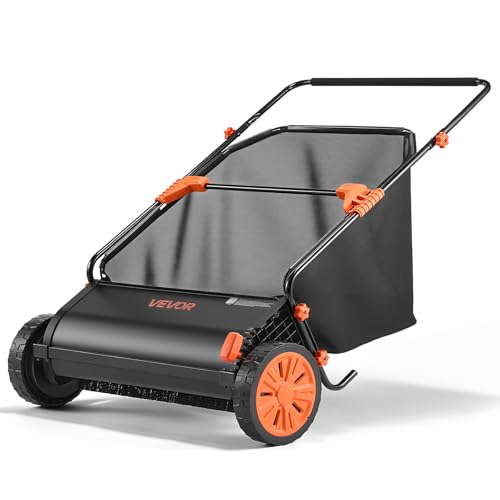
VEVOR 21 inch Push Lawn Sweeper
This 21 inch push sweeper hits a sensible size for most residential yards, and its standout feature is the stepless brush height knob, which lets you fine-tune depth by hand instead of clicking through fixed stops. It uses two spinning brushes and a 3.5 cubic foot mesh hopper that lifts off the frame easily for dumping, and the listing claims roughly 80 percent leaf pickup in a single pass.
Reasons to buy
- 21 inch sweep width picks up 80 percent of debris in one pass
- Stepless brush height adjustment by hand knob
- 3.5 cubic foot mesh hopper bag, two spinning brushes
Reasons to avoid
- The 3.5 cubic foot bag is smaller than the wider models, so you dump more often during a heavy leaf drop
- Wet leaves reduce pickup, as with any brush sweeper
VEVOR 30 inch Push Lawn Sweeper
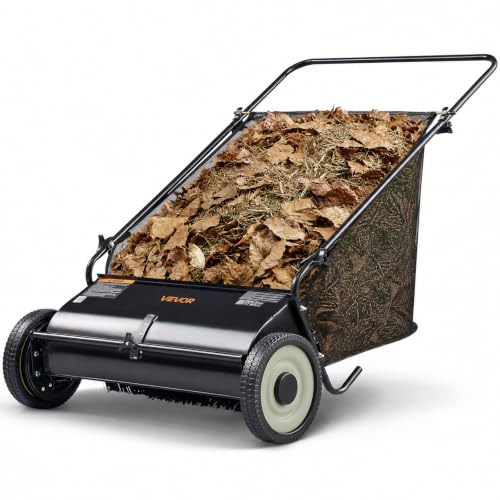
The 30 inch model widens the sweep path significantly and pairs three V-shaped brushes with a 1 to 5 brush-to-wheel ratio for strong brush speed. Its 12 cubic foot hopper is far larger than the 21 inch model, so it is the value pick when clearing a full lawn of fallen leaves means fewer trips to the compost pile.
Reasons to buy
- 30 inch sweep path with 1 to 5 brush-to-wheel ratio
- Three V-shaped brushes with 10-level height adjustment
- 12 cubic foot tear-resistant hopper bag, rubber wheels
Reasons to avoid
- The wider frame is bulkier to store and maneuver in tight spots
- Only 10 fixed height settings rather than stepless adjustment
VEVOR 26 inch Push Lawn Sweeper (Quad Brush)
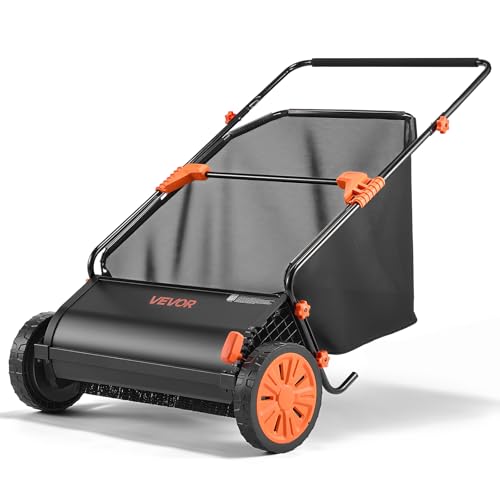
This 26 inch sweeper uses four spinning brushes rather than the usual two or three, which gives it more bristle contact across the path for a heavy leaf drop, and it rides on a heavy-duty steel frame with a tool-free height knob. The 7 cubic foot hopper is a reasonable middle ground, making it a sturdier premium option for owners who want more brush coverage.
Reasons to buy
- 26 inch path with 4 spinning brushes, up to 80 percent pickup
- Tool-free manual knob for brush height adjustment
- 7 cubic foot hopper bag, heavy-duty steel frame
Reasons to avoid
- 7 cubic foot capacity is smaller than the 30 inch model despite the premium framing
- Four brushes add drag, so it takes a bit more push effort
VEVOR 26 inch Push Lawn Sweeper (V-Brush)
This is the budget 26 inch push sweeper with three V-shaped brushes, a 1 to 5 brush-to-wheel ratio, and 10-level height adjustment. It offers a wider path than the 21 inch model at a lower price than the quad-brush version, sharing the same 7 cubic foot hopper, which makes it a practical middle-size choice for a typical leaf season.
Reasons to buy
- 26 inch sweep path with 1 to 5 brush-to-wheel ratio
- Three V-shaped brushes and 10-level height adjustment
- 7 cubic foot hopper bag, rubber wheels
Reasons to avoid
- Three brushes rather than four, so slightly less bristle contact than the premium pick
- Fixed height steps instead of stepless adjustment

VEVOR 44 inch Tow Behind Lawn Sweeper
The 44 inch tow-behind is built for scale, hitching to a lawn tractor and clearing a very wide path of leaves with a 25 cubic foot hopper that you empty using a dumping rope from the seat. For a large property with mature trees, this is far faster than any push model and folds down for storage once leaf season ends.
Reasons to buy
- 44 inch sweep width, picks up 80 percent of debris in one pass
- 25 cubic foot non-woven hopper with tractor dumping rope
- Height-adjustable brushes, foldable for storage
Reasons to avoid
- Requires a riding mower or tractor to pull it
- Its size and 25 cubic foot bag are overkill and hard to store for small yards
Leaves are the most common reason people search for a lawn sweeper, and thankfully also the material these machines handle best. A rotating brush design flicks dry leaves up off the lawn and into a hopper bag far faster than raking, without the noise or exhaust of a leaf blower. The picks below cover the size range most homeowners actually need, from a compact 21 inch push model for a typical suburban lot up to a 44 inch tow-behind unit for a large, tree-heavy property.
We compared current Amazon listings for push and tow-behind lawn sweepers using their published sweep width, hopper capacity, brush configuration and height adjustment. For leaf pickup specifically, brush height adjustment matters most, since leaves piled deep need a different brush depth than a light scattering across short grass, and a fine or stepless adjustment lets you dial that in more precisely than a sweeper with only a few fixed settings.
Hopper size is the other major factor for a leaf-heavy yard. A small bag fills up fast once you are into a full autumn leaf drop, meaning more stops to empty it, while a larger hopper covers more ground between dumps at the cost of a bulkier machine to store and maneuver. If your property has more than a few mature trees, the wider push models or the tow-behind option will save real time over a whole season compared to the smallest units here.
Manufacturer listings and owner feedback both consistently note that these sweepers perform best on dry leaves. Wet or matted leaves clump together and resist the brushes’ lifting action, so timing a sweep for a dry afternoon rather than right after rain will noticeably improve pickup.
Storage is worth a moment’s thought too. Push models fold flat or stand upright in a shed with little floor space, while the tow-behind unit needs enough room to store separately from the tractor it hitches to, which is a real tradeoff for the extra ground it covers each pass through a leaf-heavy yard.
How we research
What to look for
Sweep width
A wider path clears large lawns faster, while a narrower one is easier to steer in tight areas.
Hopper capacity
A larger bag means fewer stops to empty, which matters most during a heavy autumn leaf drop on a big property.
Brush height adjustment
Fine or stepless height control lets you set the brushes correctly for a light scattering of leaves versus a deep pile.
Brush configuration
More brushes and a higher brush-to-wheel ratio generally lift more leaves in a single pass.
Push versus tow-behind
Push models suit smaller yards, while tow-behind units need a riding mower but cover far more ground under a canopy of mature trees.
Our verdict
For a typical small to mid-size yard covered in fall leaves, the VEVOR 21 inch push sweeper is the pick to start with. Its stepless brush height knob lets you dial in exactly the right depth for a light or heavy leaf drop, and the 3.5 cubic foot mesh bag is easy to remove and empty between passes.
FAQs
Spinning brushes flick leaves, grass clippings and other light debris up off the lawn and into a hopper bag as you push or tow the unit forward.
They handle dry leaves best, and pickup drops noticeably on wet leaves because damp material clumps and resists the brushes, so sweep when the lawn is dry.
For small to mid-size yards a 21 to 26 inch push model is plenty, while large properties with many mature trees are far better served by a wide tow-behind sweeper.
Set the brush height so bristles just touch the grass, empty the hopper before it overflows, and store it folded and dry to protect the brushes and bag between uses.
Considerably. A rotating brush sweeper clears a lawn in a fraction of the time raking takes, since it collects continuously as you walk instead of requiring you to gather and lift piles by hand.

