Quick verdict
The Biswing 2-way brass splitter remains the best all-around pick for households running just two lines at once, thanks to its independent ball-valve shut-offs and corrosion-resistant brass body. Anyone managing genuinely separate watering zones, such as a vegetable bed, flower bed and lawn sprinkler, should step up to the RAINPOINT or Cekwiet 4-way splitters instead, since a 2-way unit cannot dedicate a line to more than two zones.

Biswing Garden Hose Splitter 2 Way (Brass)
The Biswing turns one water outlet into two independently controlled lines, each with its own ball-valve shut-off for a tight, drip-free seal. Its heavy-duty brass body resists corrosion for long service, and the standard 3/4-inch inlet and outlet with extra washers fit typical faucets and hoses.
Check price on Amazon →Compare 2-way and 4-way garden hose splitters with independent shutoff valves for running multiple watering zones from one spigot.
The picks at a glance
| Tool | Best for | Score /100 | |
|---|---|---|---|
| Biswing Garden Hose Splitter 2 Way (Brass) | Best Overall (2 Zones) | — | Check price |
| 2 Way Hose Splitter Heavy Duty (Metal Y) | Best Value (2 Zones) | — | Check price |
| SNUTUYA 304 Stainless Garden Hose Splitter 2 Way | Best for Corrosion Resistance (2 Zones) | — | Check price |
| Cekwiet 4 Way Garden Hose Splitter, 304 Stainless Steel | Best for 4 Watering Zones | — | Check price |
| RAINPOINT 4 Way Garden Hose Splitter, 100% Metal | Best Premium (4 Zones) | — | Check price |
The picks, reviewed
Biswing Garden Hose Splitter 2 Way (Brass)
The Biswing turns one water outlet into two independently controlled lines, each with its own ball-valve shut-off for a tight, drip-free seal. Its heavy-duty brass body resists corrosion for long service, and the standard 3/4-inch inlet and outlet with extra washers fit typical faucets and hoses.
Reasons to buy
- Splits one outlet into two
- Heavy-duty brass construction
- Independent shut-off valves
- Ball valves for tight closure
- 3/4 inch inlet and outlet, extra washers
Reasons to avoid
- Brass adds weight compared with plastic splitters
- Not intended for drinking-water systems

2 Way Hose Splitter Heavy Duty (Metal Y)
This value Y-splitter uses brass and metal construction with independent shut-off valves so you can run two hoses at once and control each. Universal 3/4-inch GHT threading fits standard spigots, and rubber washers help create a leak-proof seal for sprinklers or a pressure washer.
Reasons to buy
- Brass and metal construction
- Independent shut-off valves
- Universal 3/4 inch GHT threading
- Rubber washers for a leak-proof seal
- Works with sprinklers and pressure washers
Reasons to avoid
- Mixed-metal build may not match solid brass longevity
- Valve handles are less ergonomic than premium models

SNUTUYA 304 Stainless Garden Hose Splitter 2 Way
The SNUTUYA uses a 304 stainless steel body that is stronger than brass and lead-free, with a full-channel ball valve for maximum flow and minimal resistance. Large stainless handles are easy to operate, and a 360-degree swivel nut makes attaching to any standard faucet simple.
Reasons to buy
- 304 stainless steel body
- Full-flow ball valve design
- Large stainless handles
- 360 degree swivel nut
- 3/4 inch GHT, lead-free
Reasons to avoid
- Stainless build can cost more than basic brass
- Larger handles take up more room at a crowded spigot

Cekwiet 4 Way Garden Hose Splitter, 304 Stainless Steel
The Cekwiet uses 304 stainless steel, which the manufacturer positions as more corrosion resistant than basic brass, and gives you four separate outlets so a single spigot can feed a lawn zone, a flower bed, a vegetable garden and a hose all with independent shut-off valves. The full-flow internal design is built to keep pressure reasonably even across all four outlets rather than dropping sharply once more than one valve is open, and the standard 3/4-inch GHT threading fits typical outdoor faucets.
Reasons to buy
- 304 stainless steel, corrosion resistant
- 4 separate outlets
- Independent shut-off valve per outlet
- Full-flow internal design
- Universal 3/4 inch GHT
Reasons to avoid
- Running all four outlets at once still divides your home's total water pressure between them, so heavy simultaneous use softens flow at each valve.
- Four valves and outlets take up noticeably more space at the spigot than a simple 2-way splitter.
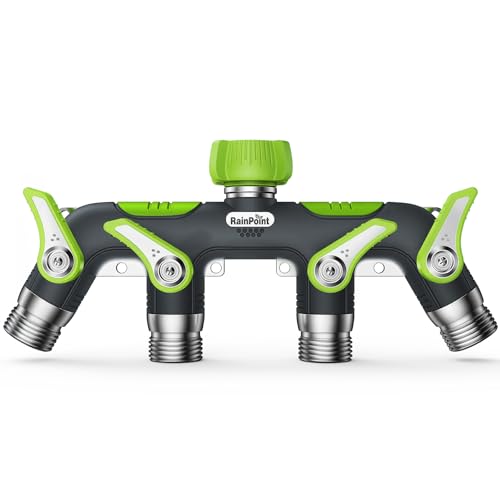
RAINPOINT 4 Way Garden Hose Splitter, 100% Metal
This RAINPOINT splitter uses a fully metal, 1.33 pound body the manufacturer rates to a 600 PSI burst pressure, well beyond normal home water pressure, with four independent metal valves so you can water a lawn, garden, patio and wash a car all from one spigot without switching hoses. A 360-degree brass swivel allows tool-free, hand-tight installation, and the company states it withstands 1500 pounds of pulling force and 50 Newton-meters of torque for durability against accidental yanks or twists.
Reasons to buy
- 1.33 lb all-metal body, 600 PSI rated
- 4 independent metal valves
- 360 degree brass swivel, tool-free install
- Full-port design for max flow
- Rated to 1500 lb pulling force
Reasons to avoid
- All-metal, four-valve construction is heavier and bulkier than a basic 2-way splitter, needing more clearance at a crowded spigot.
- Higher parts count across four valves means more washers and seals to eventually maintain over the unit's life.
Why you should trust this guide
A hose splitter is a simple brass, aluminum or stainless Y or cross fitting, but the differences in valve quality, outlet count, thread precision and flow design decide whether it waters your whole yard cleanly or drips and starves one zone of pressure. I built this guide by comparing the body materials, valve types, outlet counts and flow claims of each splitter so you can run anywhere from two to four separate lines off one spigot without frustration.
My focus is on what makes a splitter actually last and actually serve multiple watering zones: solid brass or stainless construction, full ball valves that close tightly on each outlet, and precise threads that seal with a washer. Where a listing states a pressure rating or flow figure I cannot verify, I present it as the manufacturer’s number rather than as an independently confirmed measurement.
How many zones do you need
A basic 2-way splitter covers most households that just want to run a hose and a sprinkler, or two hoses to opposite sides of a yard, at the same time. If you are actually managing multiple watering zones, a vegetable bed, a flower bed, a lawn sprinkler and a car-washing hose, for example, a 4-way splitter with individual shut-off valves on each outlet lets you dedicate one line per zone from a single spigot instead of constantly reconnecting hoses. The trade-off is that a 4-way unit is bulkier at the faucet and, like any splitter, divides your home’s available water pressure across however many outlets are open at once.
How we evaluated
My evaluation is based on comparing published materials, valve design, outlet count, thread standards and flow claims against the way a splitter is used at a spigot. Material matters most, since brass and stainless resist corrosion and cracking far better than plastic, and valve type matters because a full ball valve seals more reliably than a cheap gate. I did not attach these splitters to a spigot myself, so I report no flow or leak research of my own.
I weighed handle ergonomics, since a splitter you turn dozens of times a week should be easy on the hands, and I checked thread standards to confirm each fits standard 3/4-inch GHT connections. Included washers factored in for sealing, and for the 4-way options I specifically looked at whether the internal design claims to preserve flow across all outlets rather than starving whichever one you open last. When two splitters were close, I favored the one whose materials and valves promised the most reliable, leak-free service for the number of zones it covers.
What to look for
- Body material: solid brass or 304 stainless resists corrosion and cracking far better than plastic bodies.
- Outlet count: a 2-way splitter suits two simultaneous lines, while a 4-way splitter suits genuinely separate watering zones run from one spigot.
- Valve type: full ball valves close tightly and last longer than lightweight gate-style valves.
- Independent shut-offs: separate valves let you run, pause, or adjust each zone without affecting the others.
- Thread standard: a 3/4-inch GHT thread with a rubber washer ensures a leak-free fit on standard spigots.
- Handle ergonomics: long or large handles are easier to turn with gloves or stiff hands.
- Flow design: a full-flow or full-port valve preserves water pressure through each outlet, which matters more as you add outlets.
Related garden hose guides
How we research
What to look for
Body material
Solid brass or 304 stainless resists corrosion and cracking far better than plastic-bodied splitters.
Outlet count for zones
A 2-way splitter suits two simultaneous lines, while a 4-way splitter lets you dedicate a separate line to each genuinely distinct watering zone.
Valve type
Full ball valves seal tightly and outlast the lightweight gate valves found on cheaper units.
Independent shut-offs
Separate valves let you run, pause, or adjust each line without disturbing the others.
Thread fit
A standard 3/4-inch GHT thread plus a rubber washer ensures a leak-free connection to common spigots.
Our verdict
The Biswing 2-way brass splitter remains the best all-around pick for households running just two lines at once, thanks to its independent ball-valve shut-offs and corrosion-resistant brass body. Anyone managing genuinely separate watering zones, such as a vegetable bed, flower bed and lawn sprinkler, should step up to the RAINPOINT or Cekwiet 4-way splitters instead, since a 2-way unit cannot dedicate a line to more than two zones.
FAQs
It attaches to a single outdoor faucet and splits it into two or more separately controlled outlets, each with its own shut-off valve, so you can run multiple hoses, a hose and a sprinkler, or several distinct watering zones at once from one spigot.
A 2-way splitter covers most households running a hose and a sprinkler or two hoses at once. If you manage several distinct zones, such as a vegetable bed, flower bed, lawn sprinkler and a car-washing hose, a 4-way splitter with individual valves lets you dedicate one line per zone without constantly swapping hoses.
Both resist corrosion well. Brass is the traditional durable choice, while 304 stainless is even stronger and lead-free. Either outlasts plastic-bodied splitters by a wide margin, whether you choose a 2-way or 4-way model.
Running multiple outlets at once naturally shares your home's total flow between them, and this effect is more noticeable on a 4-way splitter with all four valves open than on a 2-way model. A full-flow or full-port valve design minimizes pressure loss, and using only the outlets you currently need preserves more pressure to each active line.
Make sure the rubber washer is seated in each connection, hand-tighten firmly without cross-threading, and replace worn washers. Precise threads and a full ball valve also help prevent drips, and with more outlets on a 4-way splitter there are simply more connections to check.
Yes, most standard 3/4-inch splitters work with sprinklers and pressure-washer feeds. Check the pressure rating on higher-demand setups, and prefer a metal or stainless body for durability whether you choose a 2-way or 4-way configuration.


