Quick verdict
The BLACK+DECKER BEHT100 is the top pick for boxwoods because its compact 16 inch dual action blade and T-handle grip give precise control around rounded shapes, while the Spear and Jackson Razorsharp Topiary Shears earn a spot for anyone who prefers the direct feedback of a sharp manual blade on fine detail work.
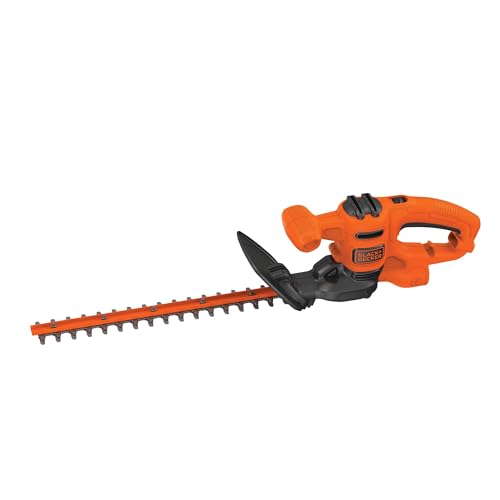
BLACK+DECKER Electric Hedge Trimmer 16-Inch (BEHT100)
At 16 inches this is the shortest powered blade on this page, which makes it easier to follow the curve of a rounded boxwood or a low formal border without overcutting. BLACK+DECKER rates the dual action blade for reduced vibration and the 3.0 amp motor for branches up to 5/8 inch, well beyond what boxwood twigs actually require, so the tool has margin without being oversized for the job.
Compare the best hedge trimmers and detail shears for boxwoods, picked for short blades, precise control and clean cuts rather than raw cutting power.
The picks at a glance
| Tool | Best for | Score /100 | |
|---|---|---|---|
| BLACK+DECKER Electric Hedge Trimmer 16-Inch (BEHT100) | Best Overall | Check price | |
| Spear & Jackson Razorsharp Topiary Shears | Best for Fine Topiary Detail | Check price | |
| Fiskars 23 in Power-Lever Garden Hedge Shears | Best Manual Option | Check price | |
| WORKPRO 7.2V Cordless Grass Shear & Shrubbery Trimmer | Best Lightweight Cordless Detail Tool | Check price | |
| BLACK+DECKER Electric Hedge Trimmer 17-Inch Corded (BEHT150) | Best Value | Check price | |
| Corona Tools PrecisionCUT Aluminum Hedge Shear | Best Lightweight Manual Alternative | Check price |
The picks, reviewed
BLACK+DECKER Electric Hedge Trimmer 16-Inch (BEHT100)
At 16 inches this is the shortest powered blade on this page, which makes it easier to follow the curve of a rounded boxwood or a low formal border without overcutting. BLACK+DECKER rates the dual action blade for reduced vibration and the 3.0 amp motor for branches up to 5/8 inch, well beyond what boxwood twigs actually require, so the tool has margin without being oversized for the job.
Reasons to buy
- 16-inch dual-action hardened steel blade
- 3.0 amp motor cuts up to 5/8 inch
- Compact, lightweight build for maneuvering
- T-handle and full-length trigger for control
Reasons to avoid
- Corded design ties you to an outlet or extension cord while working around a bed or border
- 5/8 inch rated capacity is more cutting power than boxwood needs, precision matters more here than capacity

Spear & Jackson Razorsharp Topiary Shears
These are hand shears rather than a powered tool, built with high carbon steel blades specifically marketed for topiary, hedges and shrub shaping. At 13 inches long and 0.7 pounds, they give you direct, silent control over each cut, which is exactly the kind of feedback experienced boxwood shapers rely on for a clean, precise line on rounded or geometric shapes.
Reasons to buy
- High carbon steel blades for clean, precise cuts
- Ergonomic soft-grip handles reduce hand fatigue
- Purpose-built for topiary, hedges and shrubs
- Lightweight at 0.7 lb for extended detail work
Reasons to avoid
- Fully manual, every cut is powered by your own hand and wrist, which is slower and more tiring across a large planting
- No stated cutting capacity for anything beyond fine boxwood-scale twigs

Fiskars 23 in Power-Lever Garden Hedge Shears
Fiskars builds a compound lever into these manual shears, rated for roughly twice the cutting power of a single-pivot shear, so you get power-tool style ease without a battery or cord to manage around a border. Self-sharpening, serrated blades stay effective on boxwood's fine twigs over repeated seasons, and at 2.6 pounds they stay light for a long shaping session.
Reasons to buy
- Power-Lever compound mechanism doubles cutting leverage
- Self-sharpening, precision-ground steel blades
- Lightweight at 2.6 lb with shock-absorbing bumpers
- Rust-resistant coated blades resist sap buildup
Reasons to avoid
- Still a manual tool, each cut requires you to close the handles yourself rather than relying on a motor
- 23 inch overall length is longer than the dedicated topiary shears, which can be less nimble on tight, small curves

WORKPRO 7.2V Cordless Grass Shear & Shrubbery Trimmer
At just 0.82 pounds this is by far the lightest powered option here, small enough to guide with one hand around a tight boxwood curve. WORKPRO rates the shrub blade for stems under about 5/16 inch, which matches boxwood's fine growth far better than a full-size hedge trimmer's much higher cut rating, and the 2-in-1 head swaps to a grass shear blade for edging beds around the same planting.
Reasons to buy
- Ultra-lightweight at 0.82 lb, one-hand operation
- 2-in-1 grass shear and shrub trimmer design
- 2000mAh battery with USB-C charging convenience
- Top-mounted safety button suited to small hands
Reasons to avoid
- Rated cut capacity of about 5/16 inch means it cannot handle anything thicker than fine boxwood-scale twigs
- Charges via a USB-C cable from a phone charger, laptop or power bank rather than including a dedicated wall charger

BLACK+DECKER Electric Hedge Trimmer 17-Inch Corded (BEHT150)
The BEHT150 steps up slightly to a 17 inch blade while staying compact enough for detail work, and BLACK+DECKER rates the 3.2 amp motor at up to 3,800 cuts per minute for a smooth, low vibration finish on fine boxwood growth. The corded design means unlimited runtime for a border that takes a while to get right.
Reasons to buy
- 17-inch dual-action hardened steel blade
- 3.2 amp motor, up to 3,800 cuts per minute
- Reduced vibration for a cleaner cut
- Cord retention system prevents accidental unplugging
Reasons to avoid
- Corded design limits range to your outlet and extension cord
- 17 inches is still longer than the dedicated shears here, so very tight curves take more careful passes

Corona Tools PrecisionCUT Aluminum Hedge Shear
Corona builds this manual shear around an aluminum handle for balance and reduced fatigue, which matters when boxwood shaping means many small, controlled cuts rather than a few long strokes. The listing markets it specifically for shaping ornamental hedges and landscape borders in tight spaces, the same job description as boxwood detail work.
Reasons to buy
- Lightweight aluminum handle for balance and control
- PrecisionCUT blades for smooth, accurate cuts
- Designed for tight spaces and detailed edges
- Suited to routine, seasonal hedge shaping
Reasons to avoid
- Corona does not publish a specific blade length or branch capacity figure for this shear
- Fully manual, so a large boxwood planting will take noticeably longer than a powered trimmer
Boxwood is the opposite cutting problem from an overgrown privacy hedge. Instead of a thick, woody stem that needs a wide blade gap and raw power, boxwood grows a dense mat of thin, fine twigs that you are shaping into a precise curve, ball or low border. What matters here is control and finish quality, not cutting capacity. A short blade follows a rounded or formal shape far more accurately than a long one, and a light, well balanced tool lets you make small, repeated passes without your hand drifting off line.
Blade sharpness matters more on boxwood than on almost any other hedge plant. A dull or overly aggressive blade tends to tear or crush the fine stem ends instead of slicing them, and torn boxwood tips brown within days, leaving a hedge that looks scorched even though it was cut correctly in shape. That is why several of the picks below are manual shears rather than powered trimmers, a sharp, well ground hand shear gives you direct feedback on each cut and is a common choice among people who shape boxwood topiary and low borders by hand. Where a powered option makes more sense, a short 16 to 17 inch blade or a small handheld shear style trimmer keeps the tool nimble around curves.
Weight and balance decide how long you can work before your hand tires, since boxwood shaping is often slow, careful and repetitive rather than a fast pass down a long straight hedge. A lightweight manual shear under 3 pounds or a compact corded trimmer under 6 pounds both hold a line more steadily than a heavier, longer bladed tool built for thick growth. Reach is rarely the issue with boxwood, most plantings stay low and rounded, so a pole trimmer or a long blade actually works against the precision this job needs.
The picks below mix compact powered trimmers with dedicated manual and detail shears, chosen by comparing current Amazon listings and manufacturer specifications for blade length, weight and stated cutting capacity, then checking the features each brand actually publishes rather than assuming a longer or more powerful tool is automatically better for this job. Nothing here reflects direct research by YardToolLab.
How we research
What to look for
Blade length should follow the curve
A short 13 to 17 inch blade tracks a rounded or geometric boxwood shape far more accurately than a long hedge blade, which tends to flatten curves into facets.
Sharpness matters more than power
Boxwood's fine stems tear and brown if the blade is dull or too aggressive. A well ground manual shear or a dual action powered blade both cut cleanly if kept sharp; raw cutting capacity is rarely the limiting factor.
Manual versus powered is a real choice here
Because boxwood rarely has thick stems, manual shears are a genuinely competitive option, not just a budget fallback. They give direct feedback on each cut, while a powered trimmer moves faster across a longer border.
Weight and balance for repeated small cuts
Boxwood shaping is slow and repetitive rather than one long pass, so a light, well balanced tool under about 3 pounds for shears or 6 pounds for a compact powered trimmer holds a steadier line over a long session.
Cut capacity beyond boxwood is a bonus, not the priority
Several picks here are rated for far more cutting capacity than boxwood needs. That extra margin is useful if you also shape other shrubs, but it should not be the deciding factor for boxwood alone.
Our verdict
The BLACK+DECKER BEHT100 is the top pick for boxwoods because its compact 16 inch dual action blade and T-handle grip give precise control around rounded shapes, while the Spear and Jackson Razorsharp Topiary Shears earn a spot for anyone who prefers the direct feedback of a sharp manual blade on fine detail work.
FAQs
Manual shears are genuinely competitive for boxwood because the stems are thin and fine. A sharp hand shear like the Fiskars or Spear and Jackson picks gives precise control on curves and topiary shapes. A compact powered trimmer is faster across a longer border but is not strictly necessary for boxwood alone.
A shorter blade, roughly 13 to 17 inches, follows a rounded or geometric shape more accurately than a longer hedge blade, which tends to cut flat facets into a curve instead of a smooth line. Boxwood shaping rewards precision over reach.
Browning after a trim is usually a sign the blade tore or crushed the stem ends instead of slicing them cleanly, which points to a dull blade or one that is too aggressive for the plant's fine twigs. Keeping the blade sharp, whether manual or powered, is the main fix.
Boxwood twigs are far thinner than a typical hedge stem, so even a trimmer rated for 5/16 to 5/8 inch, like the picks on this page, has plenty of margin. Cutting capacity matters much more for thick-branch hedges than it does here.
For a small planting or container boxwoods, a lightweight cordless option like the WORKPRO shear can be easier to maneuver one-handed than a full hedge trimmer, though its battery and blade are sized for fine growth only, not anything thicker.
Related guides

Husqvarna 522iHD60 Hedge Trimmer Review: Professional Grade, Connected

Makita XHU08T 30 Inch Hedge Trimmer Kit Review: Maximum Reach on 18V

Black+Decker LHT2436B 40V 24 Inch Hedge Trimmer Review

Ryobi 40V HP Brushless 26 Inch Hedge Trimmer Review: Reach and Capacity for Less

DeWalt DCHT821B 20V MAX 22 Inch Hedge Trimmer Review

Milwaukee M18 FUEL 2726-20 Hedge Trimmer Review: Built Like a Drill
EGO Power+ HT2600 26 Inch Hedge Trimmer Review