Quick verdict
For heavy, off-grid splitting, our top pick is the BILT HARD 25-ton. Its 223cc 4-cycle OHV engine drives 25 tons of force, splits logs up to 24 inches long, switches between horizontal and vertical, and tows on 16-inch DOT tires at up to 45 MPH.

BILT HARD 25
The BILT HARD 25-ton is a top pick because it has the most capability here: a 223cc 4-cycle OHV engine driving 25 tons of force and a hardened 8-inch wedge that splits logs up to 24 inches long. It switches between horizontal and vertical in seconds, tows on 16-inch DOT tires at up to 45 MPH, and ships with hydraulic and engine oil ready to work.
Compare best gas log splitter we recommend using published specifications, manuals and owner feedback. See research-based findings, key trade-offs.
The picks at a glance
| Tool | Best for | Score | |
|---|---|---|---|
| BILT HARD 25 | Best Overall | Check price | |
| BILT HARD 18 | Best Value | Check price | |
| BILT HARD 18 | Best Premium | Check price | |
| 20 | Best Budget | Check price | |
| Landworks Log Splitter Portable 20 Ton Rapid Auto Return Ram | Also Great | Check price |
The picks, reviewed
BILT HARD 25
The BILT HARD 25-ton is a top pick because it has the most capability here: a 223cc 4-cycle OHV engine driving 25 tons of force and a hardened 8-inch wedge that splits logs up to 24 inches long. It switches between horizontal and vertical in seconds, tows on 16-inch DOT tires at up to 45 MPH, and ships with hydraulic and engine oil ready to work.
Reasons to buy
- 25-Ton Splitting Force
- Excellent Portability & Towability
- Dual-Position Operation (Horizontal & Vertical)
- Efficient Performance
- Heavy-Duty Hydraulic System
Reasons to avoid
- A towable 25-ton splitter is heavy and needs real storage space
- The maker lists a 7 HP rating in one line and 8 HP in another, so confirm before buying
BILT HARD 18
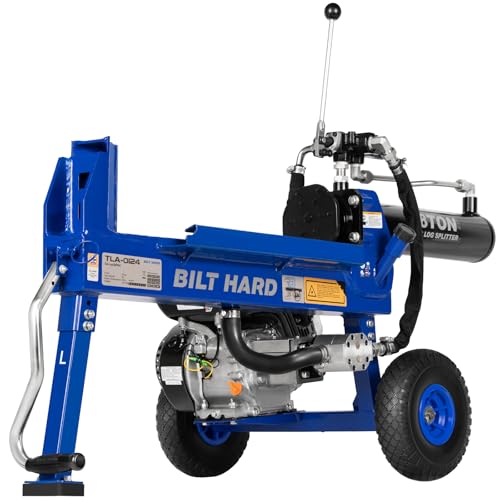
The BILT HARD 18-ton is the value pick, a portable 209cc 7HP splitter delivering 18 tons through a 2-stage gear pump and rapid auto-return. Its standout is a fast 7.5-second cycle time, and it handles logs up to 20 inches long and 16 inches in diameter on 10-inch tires.
Reasons to buy
- Powerful 18-Ton Splitting Force
- Portable Full Beam Design with Steel Wedge
- High-Efficiency Performance
- Heavy-Duty Hydraulic System
- Power & Portability
Reasons to avoid
- The maker notes hydraulic fluid and engine oil are not included
- As a horizontal-only unit you work bent over large rounds
BILT HARD 18
This second BILT HARD 18-ton is the premium equivalent, a 209cc 7HP full-beam splitter with the same 18 tons of force, 2-stage gear pump and fast 7.5-second cycle. It takes logs up to 20 inches long and 16 inches in diameter, with a durable steel wedge and 10-inch tires for portability.
Reasons to buy
- Powerful 18-Ton Splitting Force: This robust gas log splitter delivers a massive 18 tons o
- Portable Full Beam Design with Steel Wedge: Featuring a lightweight design and a durable f
- Heavy-Duty Hydraulic System: The 10.5 GPM hydraulic system ensures long-lasting performanc
- High-Efficiency Performance: With a fast cycle time of just 7.5 seconds, this gas wood spl
- Power & Portability: This wood splitter gas powered generates stronger, more consistent hy
Reasons to avoid
- Specs closely mirror the value 18-ton, so compare current prices
- Fluid and engine oil are again not included
20
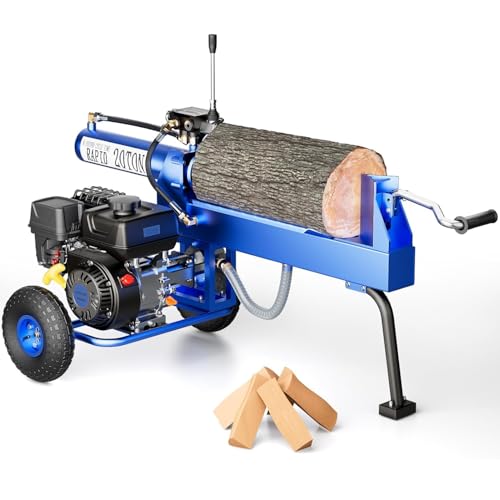
This 20-ton 209cc splitter is the budget high-volume pick, a 7HP hydraulic unit with a 2-stage gear pump and a quick 8-second auto-return cycle. Its 0.74-gallon tank runs 2 to 3 hours, it handles 20-inch by 16-inch logs, and at 132 lbs on 10-inch pneumatic tires it stays movable.
Reasons to buy
- 🔨 20-Ton Splitting Force with Precision Steel Wedge: Equipped with a high-performance hydr
- ⚡ 8-Second Cycle Time + Extended Fuel Capacity: Designed for high-volume productivity, thi
- 🌿 Advanced 4-Stroke Engine—More Power, Less Emissions: Our portable gas wood splitter upgr
- 🔨 Gas-Powered Freedom—No Cords, No Limits: Runs independently of power outlets or cords, m
- Compact, Lightweight, and Built to Move: Weighing just 132 lbs and featuring a compact fra
Reasons to avoid
- The brand is unnamed in the listing, so verify support and warranty
- At 20 tons it is strong but below the 25-ton top pick for the worst knots

Landworks Log Splitter Portable 20 Ton Rapid Auto Return Ram
The Landworks 20-ton is a strong also-great, a 7HP full-beam splitter using a trusted 2-stage Bucher hydraulic gear pump and rapid auto-return. It splits logs up to 20 inches long and 16 inches in diameter, weighs 130 lbs, and rolls on 10-inch transport wheels with a 7.5-second cycle.
Reasons to buy
- SPECS
- PORTABLE DESIGN
- EFFICIENT
- PROPER USE
- SAFETY
Reasons to avoid
- Hydraulic fluid is not included, with AW32 recommended
- Like the others it is horizontal-only, so no vertical mode for huge rounds
Why you should trust this guide
I built this guide from each splitter’s own specifications, ranking them on the factors that decide real-world firewood output: tonnage, engine size, cycle time, log capacity and portability. I have not operated these machines myself, and I state that clearly so you know the ranking rests on manufacturer claims, read carefully rather than field research. Where a listing contradicted itself, as one did by citing both 7 HP and 8 HP, I pointed it out rather than picking the flattering number, because you deserve to know when a spec is not nailed down.
A gas log splitter earns its place when you need power away from an outlet, and the gap between an 18-ton portable and a 25-ton towable is real. Gas units produce more consistent force than electric models and work anywhere, from a remote wood lot to a rural back yard, at the cost of more maintenance and the need to run outdoors. My job is to make that difference plain, along with details like cycle time and vertical operation, so you buy a machine matched to how much wood you split and where you split it.
How we evaluated
My first criterion was splitting force paired with engine size, since together they decide how easily a splitter powers through dense, knotty or green wood. The 25-ton BILT HARD leads that measure, while the 18 and 20-ton units cover heavy home use comfortably. I ranked with that hierarchy in mind, because tonnage is the number that determines whether a stubborn round splits on the first pass or bogs the ram down.
From there I compared cycle time, because a faster reset means far more logs per hour on a big pile, along with log capacity in length and diameter, portability including weight, tire size and towability, and whether the unit offers a vertical mode for oversized rounds you cannot lift onto a beam. Cycle time varied a lot here, from a brisk 7.5 seconds on the 18-ton units to about 17 seconds on the towable 25-ton, and that difference adds up fast across a full cord. I also noted what ships in the box, since several makers exclude hydraulic and engine oil, meaning you need AW32 fluid and oil on hand before the first split. Where a listing was inconsistent or unnamed, I flagged it rather than guessing.
What to look for
- Tonnage and engine: more force and a larger engine power through knotty, green and oversized wood; 18 to 25 tons here.
- Cycle time: a fast reset, from 7.5 to 17 seconds among these, multiplies your output on a big pile.
- Log capacity: check length and diameter; these take 20 to 24 inches long and up to 16 inches across.
- Horizontal versus vertical: a dual-position unit lets you split heavy rounds on the ground without lifting them.
- Portability and towing: DOT tires and a ball coupler allow towing, while lighter units move by hand.
- What is included: confirm whether hydraulic fluid and engine oil come with the machine or must be added.
- Ventilation: gas splitters must be run outdoors in a well-ventilated area.
- Wedge and beam: a hardened steel wedge on a full beam splits cleanly and holds up to knotty, dense rounds over time.
- Fuel capacity and runtime: a larger tank means longer stretches between refills, useful during a big firewood session or seasonal prep.
- Support and warranty: confirm the brand and its support, especially on unnamed listings, so you have help if something goes wrong.
How we research
We compare published manufacturer specifications, official manuals, warranty information and recurring owner feedback. Rankings are research-based unless original YardToolLab test evidence is explicitly shown on the page.
What to look for
Force and engine set the ceiling
Tonnage tells you how tough a log the machine can split, and engine size backs it up. The 25-ton BILT HARD handles the worst knots and biggest rounds, while 18 and 20-ton units are plenty for typical seasoned firewood.
Cycle time drives your output
On a large pile, a faster reset matters more than a few extra tons. The 18-ton BILT HARD units cycle in about 7.5 seconds, so they clear wood quickly, while the towable 25-ton trades a slightly longer cycle for raw power.
Vertical mode saves your back
Only the towable 25-ton here switches to vertical, letting you split large, heavy rounds on the ground instead of lifting them onto a beam. If you handle oversized logs, that dual-position design is worth the size and cost.
Plan for fluids and ventilation
Several of these ship without hydraulic fluid or engine oil, so budget for AW32 and oil before first use. And because they are gas-powered, always run them outdoors in a well-ventilated area, never in a closed garage.
Our verdict
For heavy, off-grid splitting, our top pick is the BILT HARD 25-ton. Its 223cc 4-cycle OHV engine drives 25 tons of force, splits logs up to 24 inches long, switches between horizontal and vertical, and tows on 16-inch DOT tires at up to 45 MPH.
FAQs
For typical seasoned firewood, 18 to 20 tons is plenty, which the BILT HARD 18-ton and 20-ton models deliver. For large, green, knotty or oversized rounds, the 25-ton BILT HARD gives you meaningful extra headroom and a vertical mode.
Gas splitters run anywhere without a power outlet and generally produce more consistent force, which the makers highlight for remote or high-volume work. The trade-off is they must be used outdoors with ventilation and need more maintenance than electric units.
Cycle time is how long the ram takes to extend and reset between splits. The 18-ton BILT HARD units here cycle in about 7.5 seconds, so on a big pile you process far more logs per hour than a slower machine.
It varies. The 25-ton BILT HARD ships with hydraulic and engine oil ready to work, while several 18 and 20-ton units do not include fluid, recommending AW32 hydraulic fluid. Always check the listing so you have what you need on day one.
The 25-ton here has 16-inch DOT tires and a 2-inch ball coupler, so it tows behind an ATV, UTV or truck at up to 45 MPH. That lets you move it to remote wood piles or job sites far more easily than a hand-moved unit.