Quick verdict
For most clay or rocky beds, the Sun Joe TJ604E corded electric tiller is the strongest overall pick because its 13.5 amp motor and 8 inch tine depth break compacted clay without the fuel and maintenance of a gas machine. Gardeners fighting embedded rocks or virgin hard ground should step up to the EARTHQUAKE Victory rear tine tiller, whose counter rotating tines and 209cc engine keep working when a lighter tool would stall or bounce off buried stone.

Sun Joe Corded Electric Garden Tiller & Cultivator
The Amazon listing specifies a 13.5 amp motor with 6 rust proof steel angled tines that till up to 16 inches wide and 8 inches deep, a depth rating that matters on clay because shallow tillers tend to skate across compacted ground instead of breaking it. Being corded means the motor holds constant power on dense clay instead of fading the way some battery tools do under sustained load.
Tillers built for clay and rocky soil, from corded electric models with overload protection to a gas rear tine machine for truly hard ground.
The picks at a glance
| Tool | Best for | Score /100 | |
|---|---|---|---|
| Sun Joe Corded Electric Garden Tiller & Cultivator | Best Overall | Check price | |
| Jardineer Hand Tiller | Best Value | Check price | |
| IncwBo 12'' 10.5AMP Corded Electric Garden Roto Tiller Cultivator | Best Budget | Check price | |
| BARAYSTUS Rotary Cultivator Garden Rotary Tiller Adjustable | Best Premium | Check price | |
| Saker 22V Cordless Electric Garden Tiller Cultivator | Also Great | Check price | |
| EARTHQUAKE Victory Rear Tine Tiller | Best for Heavy or Rocky Ground | Check price |
The picks, reviewed
Sun Joe Corded Electric Garden Tiller & Cultivator
The Amazon listing specifies a 13.5 amp motor with 6 rust proof steel angled tines that till up to 16 inches wide and 8 inches deep, a depth rating that matters on clay because shallow tillers tend to skate across compacted ground instead of breaking it. Being corded means the motor holds constant power on dense clay instead of fading the way some battery tools do under sustained load.
Reasons to buy
- 13.5 amp motor
- 6 rust proof steel angled tines
- Tills up to 16 inches wide and 8 inches deep
- 3 position wheel adjustment for depth
Reasons to avoid
- A power cord limits how far from an outlet you can work, which matters on a larger clay bed.
- Manufacturer depth specs are measured in ideal conditions, so expect a shallower practical depth in truly compacted clay.
Jardineer Hand Tiller
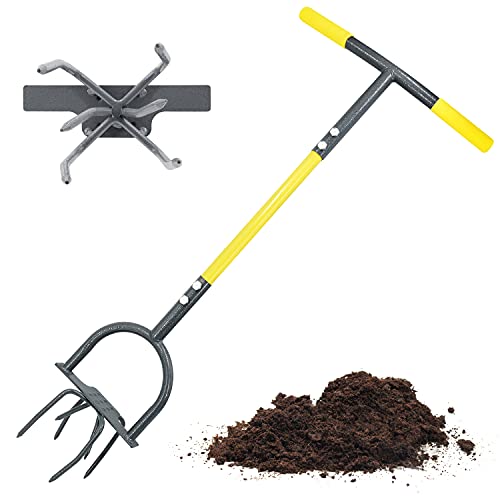
This manual twist tiller pairs an anti slip foot plate with sharp steel tines so you can drive it into hard or clay soil using body weight rather than a motor, which the listing specifically markets for compacted and clay ground. It is sized for raised beds and flower boxes rather than a full plot, making it a genuinely different tool from the powered picks here, not a scaled down version of them.
Reasons to buy
- Anti slip foot plate
- Razor sharp steel tines
- Adjustable handle length
- Assembles in minutes
Reasons to avoid
- Requires real physical effort on dense clay and is not practical for tilling a full garden bed.
- The manufacturer advises watering hard, dry clay or rocky soil in advance to soften it, an extra step powered tillers do not need.

IncwBo 12'' 10.5AMP Corded Electric Garden Roto Tiller Cultivator
Its listing calls out rocks, dense clay, and tree roots by name and describes a mechanical overload protection that stops the motor on contact rather than forcing through, which is the feature that matters most on rocky ground. At 12 inches wide and an 8 inch rated depth it trades some coverage for a lower price than the Sun Joe.
Reasons to buy
- 10.5 amp motor
- 12 inch width, 8 inch depth
- Mechanical overload protection
- Equipment spur for controlling forward force
Reasons to avoid
- The narrower 12 inch width means more passes to cover the same bed as the 16 inch Sun Joe.
- The automatic shutoff on rock contact protects the tool but interrupts your rhythm on very stony ground.

BARAYSTUS Rotary Cultivator Garden Rotary Tiller Adjustable
The adjustable stainless steel pole and interchangeable rotary blade wheels make this a lightweight option for mixing and reseeding soil that has already been broken up, with a four section handle that adjusts to your height. It is a cultivator for finishing work, not a tiller for the first pass through hard ground.
Reasons to buy
- Adjustable stainless steel poles
- 3 interchangeable rotary blade wheels
- Anti rust aluminum tine head
- Tool free assembly
Reasons to avoid
- The manufacturer explicitly warns not to use it in extremely hard or rocky soil, since that can overstress the pole connection.
- It aerates and mixes rather than digging deep, so it will not replace a tiller on genuinely compacted clay.

Saker 22V Cordless Electric Garden Tiller Cultivator
Battery power removes the cord limit of the Sun Joe, which is useful on a clay bed farther from an outlet, and the 22V motor gives it enough torque for routine cultivating once ground has already been broken. It suits maintaining an established hard soil bed more than the initial breaking pass.
Reasons to buy
- 22V battery power
- No cord to manage
- Suited to routine cultivating
Reasons to avoid
- Battery runtime limits continuous work on a large bed compared with the corded Sun Joe.
- Less torque than a corded or gas option, so very compacted clay may still need a first pass from a stronger tiller.

EARTHQUAKE Victory Rear Tine Tiller
Its counter rotating tines turn against the direction of the wheels specifically to break tough clay, compacted soil, and new ground, backed by a 209cc 4 cycle engine and a cast iron transmission with bronze gears built for that resistance. This is the pick for beds where clay and buried rock combine into ground the electric options above cannot push through.
Reasons to buy
- 209cc 4 cycle Viper engine
- Counter rotating tines
- Cast iron transmission with bronze gears
- Tills 16 inches wide, up to 10 inches deep
Reasons to avoid
- Gas power means fuel, oil changes, and more storage space than any of the electric or cordless picks here.
- Its size and weight make it overkill for a small or already established bed; it is built for genuinely hard, uncultivated ground.
Clay and rocky ground are both labeled hard soil, but they fail a tiller in different ways. Clay compacts into dense clumps that cling to tines and can stall an underpowered motor, while rocky ground hides buried stones that chip blades, bend tines, or jam a gearbox if a machine cannot stop itself in time. We built this guide around both failure modes, comparing manufacturer specified motor amperage or engine displacement, tine depth, and any stated overload or auto stop protection, since those are the numbers that separate a tiller that pushes through tough ground from one that gets stuck.
For clay specifically, tilling depth matters more than raw width. The Amazon listing for the Sun Joe TJ604E specifies an 8 inch depth and 13.5 amp motor, which is enough to break packed clay in one or two passes rather than skating across the surface. For rocky ground, the manufacturer’s own warning is often the most useful spec on the page: several corded tillers, including the IncwBo 10.5 amp model, build in a mechanical overload cutoff specifically because roots and rocks are common obstacles, and a machine without that protection risks a bent tine or a stalled motor. Where a listing calls out both hazards by name, we treat that as a meaningful signal the tiller was designed with hard ground in mind rather than generic garden soil.
We also included lighter, non powered options for spot work. A twist style hand tiller such as the Jardineer works clay and rock strewn raised beds where a full size machine would be overkill, though the manufacturer specifically recommends watering dry clay or rocky patches beforehand to soften the ground before you dig. Rotary hand cultivators serve a narrower purpose again, mixing and reseeding loosened soil rather than breaking new hard ground, and the BARAYSTUS listing explicitly warns against forcing it into extremely hard or rocky soil, which we pass along here rather than gloss over.
Finally, for ground where clay and buried rock combine, such as compacted turf that has never been tilled, we added a rear tine gas option. The EARTHQUAKE Victory’s counter rotating tines and 209cc engine are built for exactly that combination, at the cost of more weight, fuel, and storage space than the electric and cordless picks above. Matching the tool to how hard your specific ground fights back, rather than chasing a single best tiller, is the point of this comparison.
How we research
What to look for
Match power to the soil, not the plot size
A small clay bed can still defeat an underpowered tiller, while a large bed of loose soil does not need a rear tine machine. Compare motor amperage or engine displacement and tilling depth against how compacted or rocky your ground actually is, not just the square footage you need to cover.
Look for stated overload protection on rocky ground
Rocks and buried roots are the main cause of bent tines and stalled motors. Listings that specifically mention mechanical overload cutoffs or reinforced tines are telling you the manufacturer designed for that hazard, which is worth more than a generic durability claim.
Depth rating matters more than width on clay
A wide tiller that only bites 3 to 4 inches will skate across compacted clay instead of turning it. An 8 inch or deeper rated tine does the actual breaking work; extra width mainly saves you passes once the ground is already loosened.
Know when a hand tool is the right tool
Manual twist tillers and rotary cultivators are legitimate choices for raised beds, borders, and finishing work, not just budget fallbacks. They are the wrong choice for breaking a large area of genuinely hard ground, where a motor does the work your body would otherwise have to do.
Our verdict
For most clay or rocky beds, the Sun Joe TJ604E corded electric tiller is the strongest overall pick because its 13.5 amp motor and 8 inch tine depth break compacted clay without the fuel and maintenance of a gas machine. Gardeners fighting embedded rocks or virgin hard ground should step up to the EARTHQUAKE Victory rear tine tiller, whose counter rotating tines and 209cc engine keep working when a lighter tool would stall or bounce off buried stone.
FAQs
A corded model with a 13 amp or higher motor and an 8 inch depth rating, like the Sun Joe TJ604E, is generally enough for residential clay beds based on its published specs. Very dense, never tilled clay may still need a first pass from a gas rear tine tiller before a lighter electric tool can maintain it.
Clay mainly resists a tiller through compaction and clumping, while rocky soil risks physically damaging tines, blades, or the gearbox on impact. That is why several corded tillers in this guide specifically advertise a mechanical overload cutoff, a feature aimed at rocks and roots rather than clay density.
Manufacturer instructions for several manual and rotary tools here, including the Jardineer and BARAYSTUS, specifically recommend watering dry, hard, or rocky soil a day in advance to soften it. This reduces strain on both hand tools and powered motors and is worth doing regardless of which tiller you buy.
If your ground combines compacted clay with buried rock, or has never been tilled before, a gas rear tine model like the EARTHQUAKE Victory with counter rotating tines is built for that resistance in a way lighter electric and cordless tillers are not. For beds that are simply dense but rock free, a corded electric tiller is usually enough and easier to store.
No. A cultivator like the BARAYSTUS rotary model is designed to mix and aerate soil that has already been broken up, and its own instructions warn against using it in extremely hard or rocky ground. Use a tiller to break the ground first, then a cultivator for ongoing maintenance.