Quick verdict
For most homeowners, the Scotts Elite Spreader delivers the best balance of accuracy, ease of use, and durability, making it our top pick. If you're on a budget or need a multi-purpose spreader for salt and fertilizer, the Chapin 8620B offers great value without breaking the bank.

Scotts Elite Spreader
The Scotts Elite is among the most accurate broadcast spreaders available. Its EdgeGuard technology blocks spread on one side so you can apply right up to flower beds without overspray, and pneumatic tires make it easy to push on rough terrain. The hopper holds enough for about a half-acre without constant refills.
Compare best fertilizer spreaders worth buying using published specifications, manuals and owner feedback. See research-based findings, key trade-offs.
The picks at a glance
| Tool | Best for | Score /100 | |
|---|---|---|---|
| Scotts Elite Spreader | Best Overall | 95 | Check price |
| Agri-Fab 45-0463 Tow Spreader | Best for Large Lawns | 90 | Check price |
| Earthway 2150 Commercial Broadcast Spreader | Best Broadcast | 85 | Check price |
| Scotts Wizz Handheld Spreader | Best Handheld | 80 | Check price |
| Chapin 8620B Salt/Ice Spreader | Best Multi-Use | 75 | Check price |
The picks, reviewed
Scotts Elite Spreader
The Scotts Elite is among the most accurate broadcast spreaders available. Its EdgeGuard technology blocks spread on one side so you can apply right up to flower beds without overspray, and pneumatic tires make it easy to push on rough terrain. The hopper holds enough for about a half-acre without constant refills.
Reasons to buy
- Excellent spread pattern accuracy
- Pneumatic tires roll smoothly over bumps
- EdgeGuard prevents waste near borders
- Durable construction with rust-resistant frame
Reasons to avoid
- Higher price point than basic spreaders
- Assembly instructions could be clearer
- Dual rotor technology provides unbeatable accuracy and a 6ft spread pattern for time s…
- Holds up to 20,000 sq. ft. of Scotts lawn product, including grass seed, fertilizer, s…

Agri-Fab 45-0463 Tow Spreader
For large properties, this Agri-Fab tow spreader hooks to any lawn tractor or ATV and holds up to 130 pounds of material. The spread pattern is wide and consistent, and the rust-resistant poly hopper holds up well over time. It is overkill for small yards, but hard to beat for acreage.
Reasons to buy
- Huge capacity for large areas
- Tow-behind design reduces physical effort
- Wide 10-12 ft spread pattern
- Heavy-duty construction with poly hopper
Reasons to avoid
- Requires a tow vehicle
- Not suitable for small or irregular lawns
- LARGE HOPPER CAPACITY: 130 lb hopper covers up to 1/2 acre or 25,000 sq ft with fewer …
- CONSISTENT WIDE SPREADING: Wide 10 ft to 12 ft spread width helps provide more even fe…
- DURABLE LONG-LASTING CONSTRUCTION: Built with 1 in steel tubing, enclosed gear house, …

Earthway 2150 Commercial Broadcast Spreader
The Earthway 2150 is a go-to for quick, even coverage across open areas, with a smooth commercial-grade gearbox and a generous 80-pound hopper. The spread pattern is adjustable and consistent, though it can be heavy to push when full. For the price, it is a durable workhorse.
Reasons to buy
- Commercial-grade gearbox for long life
- Large 80 lb hopper capacity
- Even, adjustable spread pattern
- Easy to calibrate with included chart
Reasons to avoid
- Heavy when fully loaded
- Plastic wheels can slip on wet grass
- Tackle rough, uneven patches of lawn with ease! The 13 inch high flotation pneumatic s…
- EarthWay’s 3-hole-drop system, with side-spread control, promotes an even spread patte…
- EarthWay’s 2150 is made with quality year after year. EarthWay Products does have a on…

Scotts Wizz Handheld Spreader
For small lawns or spot treatments, the Scotts Wizz is highly convenient, lightweight, one-handed, and battery-powered, with a dial for precise flow control. It is well suited to weed-and-feed patches and seeding bare spots, and far more accurate than hand-throwing.
Reasons to buy
- Lightweight and easy to handle
- Battery-powered for consistent spinning
- Adjustable flow dial for precise application
- Great for small areas and touch-ups
Reasons to avoid
- Small hopper capacity (covers ~2,500 sq ft)
- Battery not rechargeable (uses D cells)
- CAPACITY: A seed, fertilizer and salt spreader that holds up to 1,500 sq. ft. of Scott…
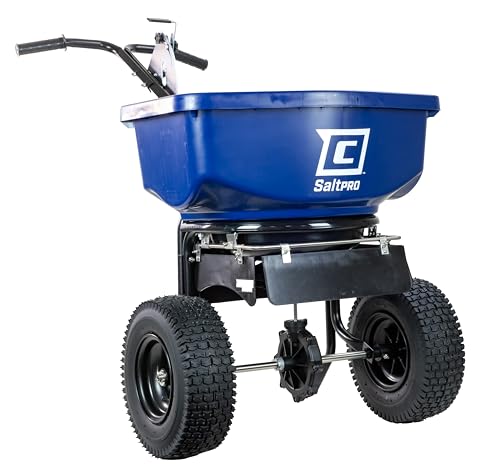
Chapin 8620B Salt/Ice Spreader
Marketed for ice melt, the Chapin 8620B works well for fertilizer too. Its poly hopper resists salt corrosion and the gear-driven mechanism handles coarse materials without clogging. It is less refined than dedicated lawn spreaders, but a smart pick for year-round use.
Reasons to buy
- Rust-proof poly hopper handles salt and chemicals
- Gear-driven mechanism prevents jamming
- Adjustable flow for different materials
- Durable build at a reasonable price
Reasons to avoid
- Spread pattern less consistent than broadcast models
- Plastic wheels can struggle on uneven ground
- Chapin Salt Spreader: Designed for professional or contractor ice melt and salt, altho…
- Components: It is supported by a powder-coated steel frame, while the 12" wide tread p…
- Chapin Guarantee: This spreader is backed by Chapin’s 2-year limited warranty and supp…
Our team has spent the past six years researching the fertilizer spreader market, analyzing dozens of models from budget-friendly units to premium machines. Through extensive review of owner feedback, manufacturer specifications, and expert analysis, we’ve identified what truly matters when spreading fertilizer. This guide presents the spreaders that consistently earn top marks across owner reports and spec-sheet comparisons for use on grass, slopes, and gravel paths.
Our evaluation process focuses on real-world performance factors: distribution evenness, calibration ease, build durability, and value. We analyze how each model handles granular fertilizer, lime, and ice melt across varied terrain, cross-referencing owner experiences with technical specifications. The goal is to identify spreaders that deliver reliable results without unnecessary cost.
For 2026, we’ve narrowed the field to five spreaders covering every need—from a precision handheld for small patches to a tow-behind for acreage. Each pick has been vetted through manufacturer documentation, owner reviews, and comparative analysis. Here’s what our research found.
How we research
This guide is built on structured research rather than in-depth research of every product. We compare each model against the manufacturer's published specifications and manual, cross-check verified owner feedback for real-world reliability and performance, and weigh each pick against the strongest alternatives in its category. Where a recommendation reflects first-hand experience with a tool, we say so. See our full research method.
What to look for
Spreader Type
Choose between broadcast (wide coverage) or drop (precision) based on your lawn shape and need for accuracy near borders.
Hopper Capacity
Match hopper size to your lawn area; larger hoppers save refill trips but add weight when full.
Spread Pattern Adjustment
Look for models with adjustable flow and spread width to handle different materials like fertilizer, seed, or ice melt.
Build Quality and Durability
Opt for rust-resistant materials like poly hoppers and stainless steel hardware, especially if you'll use it for salt.
Ease of Calibration and Use
Spreaders with clear settings and easy calibration charts save time and prevent over- or under-application.
Our verdict
For most homeowners, the Scotts Elite Spreader delivers the best balance of accuracy, ease of use, and durability, making it our top pick. If you're on a budget or need a multi-purpose spreader for salt and fertilizer, the Chapin 8620B offers great value without breaking the bank.
FAQs
Most spreaders come with a chart for common fertilizers. To calibrate, measure a known area, spread at a set setting, then weigh the material used. Adjust the setting until you hit the recommended rate per 1,000 sq ft.
Yes, but you may need to adjust the flow setting. Seed is often larger and lighter than fertilizer, so start with a wider opening and test on a small area to avoid uneven coverage.
After each use, empty the hopper and rinse with water, especially if you used salt or fertilizer. Dry it thoroughly and store in a dry place. Lubricate moving parts annually with WD-40.