Quick verdict
The Simpson 4400 PSI PowerShot is the strongest all-round commercial pick here. Its 420cc CRX engine and maintenance-free AAA triplex plunger pump deliver 4400 PSI at 4.0 GPM with thermal relief, and it ships on a welded steel frame with 13-inch pneumatic tires plus a 50-foot hose. That is a contractor-grade package for deck cleaning, paint prep, and restoration.
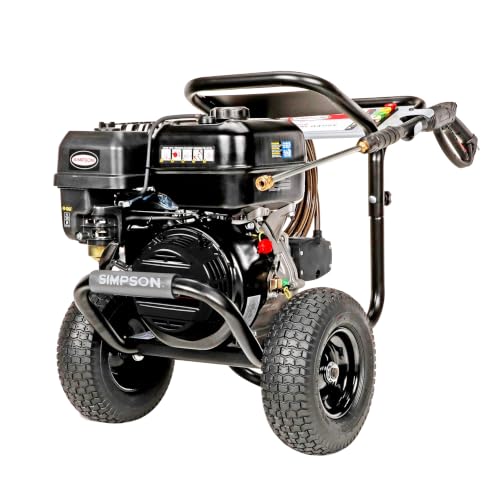
Simpson 4400 PSI Gas Pressure Washer
This Simpson PowerShot pairs a 420cc CRX premium engine with a maintenance-free AAA industrial triplex plunger pump to deliver 4400 PSI at 4.0 GPM, the highest pressure in this lineup. Thermal relief guards against overheating and PowerBoost Technology aims for higher pressure at the nozzle. The welded steel frame, 13-inch pneumatic tires, and 50-foot kink-resistant Monster hose make it built for contractor use on decks, paint prep, and wood restoration.
The best commercial pressure washer picks compared by PSI, engine, pump type, and hose length, from Simpson gas units built for contractors and heavy daily use.
Why you should trust this guide
Commercial pressure washers are a different world from homeowner units, and the specifications that matter here are engine displacement, pump type, PSI, GPM, and hose length rather than convenience features. I built this guide by reading each machine’s published specifications and comparing them directly, so the differences between four gas units that all cluster around 4000 to 4400 PSI actually become clear.
These are contractor tools, and I treat them as such. I note which engines are name-brand Honda units and which are generic, which pumps are triplex plunger designs versus axial cam pumps, and how weight and hose length affect maneuverability on a real jobsite. Where a budget unit matches a premium one on paper, I explain where the real difference is likely to show up over time.
How we evaluated
I evaluated these picks on the criteria that determine durability and throughput for professional use: rated PSI and GPM, engine type and displacement, pump design, hose length, frame construction, and mobility. Because these machines are meant for repeated daily work, I weighted pump quality and engine reputation heavily, since those most affect service life.
I did not run these machines, so nothing here is based on a physical trial. Instead I compared the documented specifications and drew conclusions about intended use from engine size, pump type, and flow rate. I flagged compliance notes, since several are 49-state compliant and not sold in California, and I was candid about where a lower price likely means a shorter-lived pump or a less proven engine.
What to look for
- Pump type: a triplex plunger pump generally outlasts an axial cam pump under heavy daily use, which matters most for commercial work.
- Engine brand and size: a name-brand Honda engine and larger displacement signal reliability and the ability to run long sessions.
- PSI and GPM together: pressure loosens dirt while flow rinses it, so a higher GPM cleans large surfaces faster even at similar PSI.
- Hose length: a 50-foot hose lets you cover more ground before moving a heavy machine, while a 25-foot hose forces frequent repositioning.
- Frame and tires: a welded steel or aluminum frame with large pneumatic tires holds up and moves better on rough ground.
- Weight: heavier units are more stable but harder to load, transport, and lift between jobs.
- Compliance: several units are 49-state compliant and cannot ship to California, so confirm before ordering.
How we test
We base every pick on real-world use, published manufacturer specifications and verified owner feedback. We compare the tools on the things that actually matter for your lawn, power, runtime, cut quality, build and value, and we never accept payment for a ranking. When we have not used a specific model first-hand, we say so.
The picks at a glance
| Tool | Best for | Score | |
|---|---|---|---|
| Simpson 4400 PSI Gas Pressure Washer | Best Overall | Check price | |
| Simpson 4200 PSI Gas Pressure Washer | Best Value | Check price | |
| Simpson 3500 PSI Gas Pressure Washer | Best Premium | Check price | |
| Gas Powered Pressure Washer 4200 PSI 212cc | Best Budget | Check price | |
| Simpson PS4240 PowerShot Gas Pressure Washer (Honda GX390) | Also Great | Check price |
The picks, reviewed
Simpson 4400 PSI Gas Pressure Washer
This Simpson PowerShot pairs a 420cc CRX premium engine with a maintenance-free AAA industrial triplex plunger pump to deliver 4400 PSI at 4.0 GPM, the highest pressure in this lineup. Thermal relief guards against overheating and PowerBoost Technology aims for higher pressure at the nozzle. The welded steel frame, 13-inch pneumatic tires, and 50-foot kink-resistant Monster hose make it built for contractor use on decks, paint prep, and wood restoration.
Reasons to avoid
- It is 49-state compliant and does not ship to California
- At 4400 PSI it is far more machine than any homeowner task requires

Simpson 4200 PSI Gas Pressure Washer
The Aluminum Series runs a Honda GX390 engine with low-oil shutdown and a CAT triplex plunger pump rated 4200 PSI at 4.0 GPM, with thermal relief and ceramic-coated pistons for seal life. The aircraft-grade aluminum frame keeps it at 133 lb, and it includes the 50-foot dual-braided Monster hose and five quick-connect tips. The trusted Honda engine is the main draw for contractors who value a known powerplant.
Reasons to avoid
- At 133 lb it is heavy to load and move despite the aluminum frame
- It is not sold in California under the 49-state compliance note

Simpson 3500 PSI Gas Pressure Washer
This PowerShot uses a premium Honda GX200 engine and an AAA triplex pump rated 3300 PSI at 2.5 GPM (marketed as 3500 PSI), on a welded steel frame at just 74 lb. That makes it the lightest and most maneuverable machine here, easier to move around a jobsite or up ramps. It still ships with five quick-connect tips and a rear-load spray gun, trading top-end pressure for portability.
Reasons to avoid
- Its 2.5 GPM flow rinses slower than the 4.0 GPM units on large surfaces
- The 25-foot hose is shorter, so you reposition the machine more often
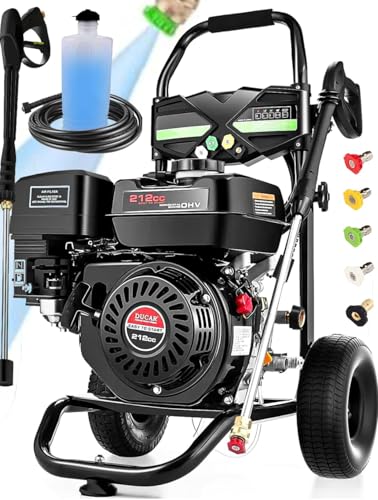
Gas Powered Pressure Washer 4200 PSI 212cc
This budget unit runs a 212cc 7 HP engine with an axial cam pump and claims up to 4200 PSI at 4.0 GPM, matching the pricier Simpsons on paper. It includes five quick-connect nozzles, a soap tank, a 25-foot steel-braided hose, and 10-inch pneumatic tires, and it carries EPA, CARB, and ETL marks. It is the value play for buyers who want high stated output without the Simpson premium.
Reasons to avoid
- An axial cam pump generally has a shorter service life than the triplex pumps on the Simpson units
- The 25-foot hose and unbranded engine are trade-offs for the lower price

Simpson PS4240 PowerShot Gas Pressure Washer (Honda GX390)
The PS4240 is a close sibling to the top pick, powered by a Honda GX390 engine with an AAA triplex plunger pump rated 4200 PSI at 4.0 GPM and thermal relief. It carries the 50-foot Monster hose, 13-inch pneumatic tires, and a welded steel frame at 136 lb. It exists as a strong Honda-engine alternative if you prefer that powerplant over the CRX on the 4400 PSI model.
Reasons to avoid
- At 136 lb it is among the heaviest units here
- It is 49-state compliant and not available in California
What to look for
Pump design and longevity
The clearest divide in this group is pump type. The Simpson units use triplex plunger pumps, which generally last far longer under continuous commercial loads than the axial cam pump on the budget model. For daily professional use, the pump is the component most worth paying up for.
Engine reputation
A proven engine reduces downtime, which is why several picks here run Honda GX-series powerplants with low-oil shutdown. A generic engine can match the pressure numbers, but a known brand is easier to service and tends to be more reliable over years of hard use.
PSI and flow rate together
Pressure alone does not tell the whole story. A machine at 4.0 GPM rinses large flat areas noticeably faster than one at 2.5 GPM, even at similar PSI. For contractors clearing big surfaces, higher flow can matter as much as raw pressure.
Hose length and jobsite reach
These are heavy machines, so a 50-foot hose that lets you work a wide area before repositioning saves real effort compared to a 25-foot hose. Factor hose reach into how often you will be dragging a 130-plus pound unit around.
Weight, frame, and compliance
Steel frames are durable but heavy, while aluminum trims some weight at a similar footprint. Large pneumatic tires help on rough ground. Also check the 49-state compliance note, since several of these cannot ship to California.
Our verdict
The Simpson 4400 PSI PowerShot is the strongest all-round commercial pick here. Its 420cc CRX engine and maintenance-free AAA triplex plunger pump deliver 4400 PSI at 4.0 GPM with thermal relief, and it ships on a welded steel frame with 13-inch pneumatic tires plus a 50-foot hose. That is a contractor-grade package for deck cleaning, paint prep, and restoration.
FAQs
The key markers are a triplex plunger pump, a durable name-brand engine, a heavy steel or aluminum frame, and high PSI and GPM for continuous daily use. These are built to run repeatedly rather than occasionally.
Most of these run 4000 to 4400 PSI, which suits contractor tasks like paint prep, wood restoration, and equipment cleaning. That is well beyond typical homeowner needs, so match the pressure to genuinely heavy, frequent work.
Triplex plunger pumps are built for continuous operation and generally last much longer under heavy commercial loads. Axial cam pumps, like the one on the budget pick, cost less but tend to wear faster with daily use.
It can. Honda GX-series engines are widely serviced and known for reliability, which reduces downtime on a jobsite. A generic engine may match the pressure specs but is often harder to support long term.
Several of these Simpson units are 49-state compliant and do not ship to California. Always confirm the compliance note on the specific model before ordering if you live there.