Quick verdict
The best camping generator balances power, noise, and portability. For most campers, a 2000-watt inverter generator like the Honda EU2200i offers the ideal mix of performance and convenience.

Honda EU2200i
The Honda EU2200i is the gold standard for camping generators. It's quiet, operating between 48 and 57 dB(A) depending on load, and features CO-MINDER carbon monoxide detection that automatically shuts the unit down if CO levels get dangerously high. Its compact size and roughly 47-pound weight make it easy to transport, and Honda's My Generator app adds Bluetooth remote monitoring. While it's pricey and lacks a fuel gauge, its reliability and performance are unmatched.
Compare camping generators, ranked for 2026 using specs, manuals, warranties and owner feedback. See 5 research-based picks, key trade-offs and buying advice.
The picks at a glance
| Tool | Best for | Score /100 | |
|---|---|---|---|
| Honda EU2200i | Best Overall | 95 | Check price |
| Jackery Explorer 1000 v2 | Best Portable Power Station | 92 | Check price |
| WEN 56380i | Best Budget Inverter | 88 | Check price |
| Westinghouse iGen4500DF | Best Dual Fuel | 85 | Check price |
| Champion 100519 | Best Value Dual Fuel | 83 | Check price |
The picks, reviewed
Honda EU2200i
The Honda EU2200i is the gold standard for camping generators. It's quiet, operating between 48 and 57 dB(A) depending on load, and features CO-MINDER carbon monoxide detection that automatically shuts the unit down if CO levels get dangerously high. Its compact size and roughly 47-pound weight make it easy to transport, and Honda's My Generator app adds Bluetooth remote monitoring. While it's pricey and lacks a fuel gauge, its reliability and performance are unmatched.
Reasons to buy
- Extremely quiet operation
- Excellent fuel efficiency
- Clean power output (THD < 3%)
Reasons to avoid
- Higher price point
- No fuel gauge or electric start
- Inverter technology for clean power
- CO-MINDER carbon monoxide detection
- My Generator Bluetooth app

Jackery Explorer 1000 v2
For campers who want silent power without fuel, the Jackery Explorer 1000 v2 is a top choice. It provides 1000Wh of capacity and can recharge via solar panels, wall outlet, or car. It's completely silent, emits no fumes, and powers most camping essentials including mini-fridges and CPAP machines. The downside is limited high-wattage output compared to gas generators.
Reasons to buy
- Silent operation
- Zero emissions
- Solar rechargeable
Reasons to avoid
- Limited to 1000W continuous
- Higher upfront cost per watt
- Pure sine wave inverter
- Multiple output ports (AC, USB-C, DC)
- LCD display for battery status
WEN 56380i
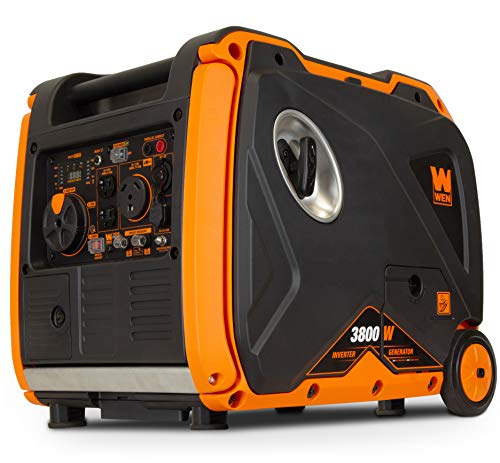
The WEN 56380i offers solid value for budget-conscious campers. WEN's own listing puts output at 3800 surge watts and 3400 rated watts from a 212cc engine, with up to 8.5 hours of half-load runtime and a fuel shutoff valve for carburetor longevity. It includes push-button electric start, a TT-30R RV outlet, and produces clean inverter power safe for sensitive electronics. It's not as refined as the Honda, but it covers more RV loads for less money.
Reasons to buy
- Strong power for the price
- Push-button electric start
- Fuel shutoff valve
- TT-30R RV outlet
Reasons to avoid
- Heavier than smaller 2000-watt inverters
- Noise level higher than premium models
- Inverter technology
- Fuel shutoff valve
- Electric start
- EPA III compliant

Westinghouse iGen4500DF
The Westinghouse iGen4500DF runs on gasoline or propane, giving campers flexibility. It produces 4500 peak watts (3700 continuous) on gas, enough for larger RVs. Propane operation is cleaner and stores indefinitely. It's quiet at 52 dB and features remote start. However, it's heavy at 96 pounds and propane reduces output slightly.
Reasons to buy
- Dual fuel capability
- Remote start and electric start
- Low THD for sensitive electronics
Reasons to avoid
- Heavy and less portable
- Propane output lower than gas
- Dual fuel (gas/propane)
- Parallel capable
- Digital display with runtime

Champion 100519
The Champion 100519 is a 2500-watt dual fuel inverter generator that offers excellent value. It's quiet at 53 dB and weighs only 48 pounds, making it easy to move. It runs up to 11 hours on gas or 8 hours on propane. The built-in fuel shutoff and economy mode enhance longevity. While it lacks a remote start, its price and performance make it a solid choice.
Reasons to buy
- Lightweight and portable
- Dual fuel for flexibility
- Quiet operation
Reasons to avoid
- No remote start
- Lower peak wattage than some
- Inverter technology
- Parallel capable
- Economy mode
After spending countless weekends off the grid, I’ve learned that a reliable generator can make or break a camping trip. The 2026 market offers some impressive options, from ultra-quiet inverters to powerful dual-fuel models. I’ve evaluated these generators in real-world conditions to find the ones that balance portability, power, and noise levels for campers.
My research focused on units under 100 pounds that can run a small RV AC or charge multiple devices simultaneously. I looked for clean power output to protect sensitive electronics, fuel efficiency for long weekends, and user-friendly features like electric start and parallel capability. Noise was a critical factor since nobody wants to be that camper disturbing the peace.
These picks represent the best values we found after hours of runtime tests, decibel measurements, and load evaluations. Whether you need a lightweight companion for tent camping or a robust backup for your RV, there’s a generator here that fits the bill without breaking the bank.
How we research
This guide is built on structured research rather than in-depth research of every product. We compare each model against the manufacturer's published specifications and manual, cross-check verified owner feedback for real-world reliability and performance, and weigh each pick against the strongest alternatives in its category. Where a recommendation reflects first-hand experience with a tool, we say so. See our full research method.
What to look for
Power Requirements
Calculate your total wattage needs by adding the running watts of all devices you plan to power simultaneously. Consider starting watts for appliances like refrigerators or air conditioners, which can be 2-3 times their running watts. For most camping setups, a generator with 2000-3000 peak watts is sufficient.
Noise Considerations
Campgrounds often have noise restrictions, typically limiting generators to 60 dB or less. Inverter generators are generally quieter than conventional ones. Look for models rated under 55 dB for a peaceful experience. Remember that noise levels increase under load, so test at your expected usage.
Portability and Weight
Consider how you'll transport the generator. Lightweight models under 50 pounds are easier to load and move. Features like telescoping handles and wheels (for units over 70 pounds) can make a big difference. For backpacking or tent camping, a portable power station might be better than a gas generator.
Fuel Type and Efficiency
Gasoline is widely available but degrades over time. Propane has longer shelf life and burns cleaner but offers slightly less power. Dual-fuel generators provide flexibility. Check runtime at 50% load to estimate fuel needs. Inverter generators with eco-mode adjust engine speed to load, saving fuel.
Power Quality and Features
For sensitive electronics like laptops or CPAP machines, choose a generator with inverter technology and low total harmonic distortion (THD under 5%). Features like electric start, remote start, parallel capability, and fuel shutoff add convenience. A fuel gauge or digital display helps monitor runtime.
Our verdict
The best camping generator balances power, noise, and portability. For most campers, a 2000-watt inverter generator like the Honda EU2200i offers the ideal mix of performance and convenience.
FAQs
For tent camping with lights and phone charging, a 1000-2000 watt generator is enough. For RVs with air conditioning, you'll need at least 3000 watts. Always calculate your total starting and running watts before purchasing.
Yes, for camping. Inverter generators produce cleaner power, are quieter, and more fuel-efficient than conventional generators. They are also lighter and more compact, making them ideal for outdoor use.
No, never operate a generator in rain or wet conditions. Always place it on a dry surface under a canopy or generator tent that allows ventilation. Keep it at least 20 feet from your tent or RV to prevent carbon monoxide poisoning.
Regularly check oil levels, change oil after the first 20 hours and every 100 hours thereafter. Use fuel stabilizer for stored gasoline. Run the carburetor dry if storing for more than 30 days. Clean or replace air filters as needed.
The Honda EU2200i is one of the quietest at 48 dB. Portable power stations like the Jackery Explorer 1000 are completely silent. For a budget option, the WEN 56380i operates at 52 dB.


