Quick verdict
The FIELD KING 190328 is the top pick for weed control because its 150 PSI internal pump and six nozzle set, including a narrow spot treatment tip, cover both individual weeds and larger patches without needing a battery. For anyone who wants to skip manual pumping, the VASG battery powered model is the best value alternative.
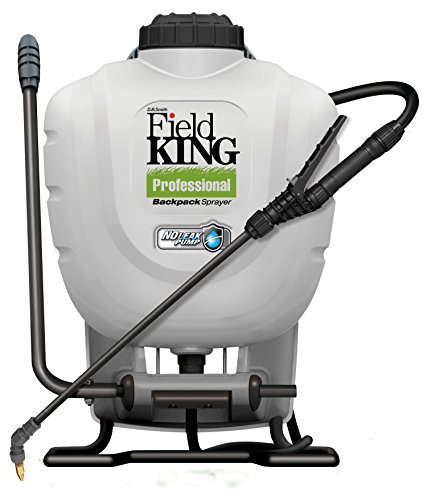
FIELD KING 190328 Backpack Sprayer
The manufacturer builds this 4 gallon tank around an internal no leak piston pump rated to 150 PSI, which is enough pressure to push herbicide through a 21 inch poly wand and still get even coverage on tall weeds and brush. It ships with six interchangeable nozzles, including a low volume narrow fan tip that many owners use for spot spraying weeds along fence lines without soaking nearby grass, plus a lockable shutoff and in line filter to keep debris out during herbicide mixing.
Compare backpack sprayers built for weed control, from manual pump to battery powered models, based on tank size, PSI, nozzles, and battery runtime.
The picks at a glance
| Tool | Best for | Score /100 | |
|---|---|---|---|
| FIELD KING 190328 Backpack Sprayer | Best Overall | — | Check price |
| VASG Battery Powered Backpack Sprayer | Best Value | — | Check price |
| Maygrove 4.2 Gallon Battery Powered Backpack Sprayer | Best Premium | — | Check price |
| CHAPIN 60114 4-Gallon Backpack Sprayer for Lawn, Garden & Weed Control | Best Budget | — | Check price |
| PetraTools HD4000 Battery Powered Backpack Sprayer | Also Great | — | Check price |
The picks, reviewed
FIELD KING 190328 Backpack Sprayer
The manufacturer builds this 4 gallon tank around an internal no leak piston pump rated to 150 PSI, which is enough pressure to push herbicide through a 21 inch poly wand and still get even coverage on tall weeds and brush. It ships with six interchangeable nozzles, including a low volume narrow fan tip that many owners use for spot spraying weeds along fence lines without soaking nearby grass, plus a lockable shutoff and in line filter to keep debris out during herbicide mixing.
Reasons to buy
- Internal no leak piston pump
- 21 inch poly wand with Viton seals
- Lockable brass shutoff with in line filter
- Six included nozzles for different spray patterns
Reasons to avoid
- Manual pumping is required to build pressure, so covering a large weedy area in one session means stopping to re pump every few minutes.
- The 21 inch wand is shorter than some competitors, which can mean more bending to reach low weeds.

VASG Battery Powered Backpack Sprayer
This battery powered model swaps hand pumping for a 21V 2.6Ah lithium battery that the listing rates for about 90 minutes of continuous spraying per charge, which suits homeowners who want to walk a weedy yard perimeter without arm fatigue. It includes two single head nozzles the manufacturer markets for spot treating individual weeds, plus a fan nozzle for broader lawn coverage and an adjustable pressure knob for switching between the two.
Reasons to buy
- 21V 2.6Ah battery rated for 90 minutes continuous spraying
- Dual wand design for different chemical types
- Adjustable pressure knob
- Two single head nozzles for spot treatment
Reasons to avoid
- The 4 gallon tank gets heavy once full, and the dual wand system means swapping wands when moving between water based and acidic herbicide mixes.
- Runtime drops noticeably in cold weather, a common complaint with lithium battery sprayers.

Maygrove 4.2 Gallon Battery Powered Backpack Sprayer
Maygrove's 4.2 gallon tank pairs a 2Ah battery with stepless pressure control up to 100 PSI, and the manufacturer specifies about 25 full tank fills per charge, useful for anyone treating a large weed problem across multiple sessions without recharging. Five interchangeable nozzles are included so an owner can go from a fine mist for delicate garden edges to a stronger stream for stubborn weeds in gravel or driveway cracks.
Reasons to buy
- Stepless pressure control up to 100 PSI
- Rated for about 25 tank fills per charge
- Five interchangeable nozzles
- Padded straps with shock absorbing back support
Reasons to avoid
- At 100 PSI it runs a bit lower pressure than some competitors, so thick or waxy leaved weeds may need a slower pass.
- The one button design has fewer manual pressure tuning options than a knob based system.

CHAPIN 60114 4-Gallon Backpack Sprayer for Lawn, Garden & Weed Control
Chapin markets this 4 gallon backpack directly for weed control, and the Amazon listing highlights a 3 stage filtration system designed to reduce clogging when spraying diluted herbicide mixes. The adjustable poly cone nozzle switches from a coarse stream, useful for reaching weeds at the base of shrubs, to a gentle shower for surrounding plants you want to avoid soaking.
Reasons to buy
- Marketed directly for weed control
- 3 stage filtration system
- Adjustable poly cone nozzle
- Padded shoulder straps and waist strap
Reasons to avoid
- It is a manual pump action design, so larger properties mean repeated pumping to hold pressure.
- The tank opening is smaller than some rivals, which can slow down mixing and refilling.
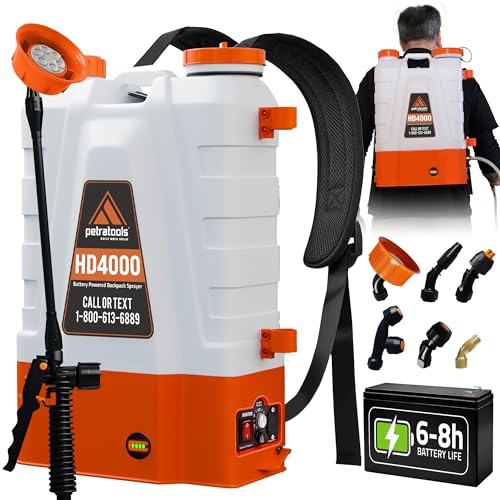
PetraTools HD4000 Battery Powered Backpack Sprayer
The 12V8AH battery is rated by the manufacturer for 200+ gallons per charge and 6 to 8 hours of runtime, making this one of the longer lasting options for a full day of weed treatment on a larger lot. Owner feedback commonly reports the adjustable 40 to 90 PSI range and six nozzles work well for switching between spot killing individual weeds and broader lawn wide herbicide application.
Reasons to buy
- 12V8AH battery rated for 200+ gallons per charge
- 6 to 8 hour runtime
- Adjustable 40 to 90 PSI pressure
- Six versatile nozzles included
Reasons to avoid
- It is a heavier unit once the battery and full tank are combined, and the extendable 34.5 inch wand takes some getting used to for close in weed work.
- Replacement battery cost is a consideration if the pack degrades after a few seasons.
A backpack sprayer earns its keep on the weed control days when a handheld bottle cannot cover enough ground. Whether you are walking a fence line loaded with foxtail, treating a gravel driveway for creeping weeds, or spot spraying broadleaf weeds across a half acre lawn, the right backpack sprayer needs enough tank capacity to finish the job in one trip and a nozzle set that lets you switch between a tight stream for individual weeds and a wider fan for larger infested patches.
This guide is built around that specific use case rather than general garden watering. Herbicide application is different from watering or spraying fertilizer: pressure needs to stay consistent so the chemical lands evenly instead of pooling in one spot, and a locking shutoff matters because herbicide drift onto desirable plants is a real risk. Manufacturer specifications and the features listed on each Amazon product page were the basis for every pick below, from tank material and PSI rating to nozzle counts and battery runtime where the sprayer is battery powered.
Both manual pump action and battery powered backpack sprayers show up here because each has a real advantage for weed control. A manual pump sprayer like the FIELD KING model needs no charging and tends to be simpler to maintain between herbicide seasons, which matters if the sprayer sits in a shed for months at a time. Battery powered models, including the VASG, Maygrove, and PetraTools units below, trade that simplicity for less arm fatigue on larger properties, letting you focus on aiming the wand at weeds rather than pumping a handle every few strides.
Nozzle selection is worth a closer look before buying. A narrow, low volume nozzle concentrates herbicide on a single weed with less overspray onto surrounding grass, while a wide fan nozzle covers broadleaf weed patches across open lawn faster. Several of the sprayers below ship with both styles, which matters if your yard has a mix of spot weeds and larger infested areas. Tank capacity also affects how often you need to stop and remix; a 4 to 4.2 gallon tank, common across these picks, is typically enough to treat a standard residential lot in a single fill.
Owner feedback commonly reports that filtration and shutoff quality make the biggest difference in long term satisfaction, since a clogged nozzle or a leaking valve during herbicide mixing is more than an inconvenience. That is reflected in the filtration and lockable shutoff features called out for each pick below.
How we research
What to look for
Tank capacity versus property size
A 4 to 4.2 gallon tank, the size used by every pick here, typically covers a standard residential lot in one fill when treating weeds. Larger properties or heavier infestations may call for a second fill, so factor in how far you are willing to walk back for a refill mid job.
Manual pump versus battery power
Manual pump action sprayers need no charging and are simpler to store between herbicide seasons, but require repeated pumping to hold pressure on larger jobs. Battery powered models reduce arm fatigue and, per the manufacturer specs above, can run 90 minutes to several hours per charge, though cold weather can shorten that runtime.
Nozzle variety for spot versus broadcast treatment
Weed control often means switching between two jobs: hitting isolated weeds precisely and covering a wider infested patch evenly. Look for a sprayer that ships with both a narrow or single head nozzle and a wider fan nozzle rather than just one spray pattern.
Filtration and shutoff quality
Herbicide concentrate can clog a cheap nozzle quickly. A multi stage filter and a lockable, leak resistant shutoff, both called out in the Amazon listings for these picks, reduce mid job clogging and limit accidental drift onto plants you want to keep.
Our verdict
The FIELD KING 190328 is the top pick for weed control because its 150 PSI internal pump and six nozzle set, including a narrow spot treatment tip, cover both individual weeds and larger patches without needing a battery. For anyone who wants to skip manual pumping, the VASG battery powered model is the best value alternative.
FAQs
Yes. Weed control works best with a narrow or single head nozzle for spot treating individual weeds and a wider fan nozzle for broadleaf patches across open lawn. Most backpack sprayers built for herbicide use, including the picks above, ship with both nozzle styles so you are not stuck with one spray pattern for every job.
It depends on property size. A manual pump sprayer like the FIELD KING needs no charging and holds up well for smaller lots or occasional use. Battery powered options such as the VASG or PetraTools reduce arm fatigue on larger properties where you are walking and spraying for an extended stretch, at the cost of managing battery charge and eventual replacement.
Most of the sprayers above use a 4 to 4.2 gallon tank, which the manufacturers generally size for a standard residential lot in a single fill. If you are treating a larger acreage or a heavy weed infestation, plan on a refill trip or consider a higher capacity tow behind sprayer instead.
Most can, since the tanks and pumps are chemical resistant poly designed for general lawn and garden liquids. That said, owner feedback commonly recommends dedicating a sprayer to herbicide only, or thoroughly rinsing between uses, to avoid accidentally damaging desirable plants with herbicide residue during a later fertilizer application.
Runtime varies by model. The manufacturer specifies about 90 minutes of continuous spraying for the VASG 2.6Ah battery, while PetraTools rates the HD4000 larger 12V8AH battery for 6 to 8 hours and over 200 gallons per charge. Actual runtime depends on pressure setting, temperature, and how often the trigger is held open.


