An outdoor storage bench is picked on four numbers: gallons of storage, seat width, seat weight rating and the lid. Here is how each translates to cushions, people and weather, plus the material trade-offs, placement and winter care.
The short answer
Pick an outdoor storage bench by matching four numbers to the patio: the storage capacity in gallons to what has to go inside, the width to the space and the number of people who will sit, the seat weight rating to those people, and the lid type to how often it will be opened. Then choose a material that suits the climate and the look, and accept that nearly every bench is water resistant rather than waterproof. A 60 to 80 gallon resin bench about 50 inches wide covers most two-person patios; a 100 gallon or larger bench suits a full dining set of cushions or pool gear.
Capacity in gallons versus what actually fits
Makers rate storage benches in gallons, usually from about 50 to 130, with deck boxes that double as seats running up to 150 and beyond. Gallons are an interior volume, and the useful figure is how many cushions that volume holds. A standard 20 by 20 inch seat cushion about 4 inches thick occupies roughly 7 gallons of space, and cushions never pack perfectly, so budget about 10 gallons per seat cushion. That makes a 60 gallon bench good for about six seat cushions, a 90 gallon bench for a four-chair set with backs, and a 130 gallon bench for chaise cushions, a folded umbrella canopy and a small bag of pool toys. Measure the interior dimensions as well as the gallons; a long shallow interior will not take a rolled 72 inch chaise cushion that a shorter deeper box takes with ease. Allow for anything stiff, such as a cushion with a rigid back, which sets a minimum interior length rather than a volume.
Width, depth and the patio
Storage benches run from about 40 to 60 inches wide and 20 to 26 inches deep, with a seat height close to 18 inches. Comfortable seating takes about 20 inches of width per adult, so a 48 inch bench seats two with room and a 60 inch bench seats three. Mark the footprint on the patio with tape before ordering, and leave room for the lid to swing: a hinged lid needs 12 to 18 inches of clearance behind the bench, which rules out a tight wall placement unless the hinges are set forward or the lid stops short of vertical. On a small balcony a 40 inch bench placed against a railing with the lid opening toward the railing is often the only arrangement that works.
Materials: resin, wood-look resin, wicker-look, hardwood and steel
Plain molded resin, usually polypropylene, is the lightest at about 25 to 45 pounds, the simplest to make, and the most weatherproof: it does not rot, rust or need sealing, and UV stabilized grades hold their color for years. Its limits are a plastic look and panels that flex under load. Wood-look resin uses the same plastic molded with a grain texture and a matte color, and it is the usual choice when the bench has to pass as furniture. Wicker-look resin is molded or woven over a resin frame and matches resin wicker seating sets; the woven kind has more joints to collect dirt. Teak, acacia and eucalyptus benches weigh 50 to 90 pounds, feel solid and look right with wood decking, and they need oiling once or twice a year to keep their color and must be kept off wet ground. Powder-coated steel is strong, holds a high seat rating and is often used for the frame under a resin or wood seat; a chipped coating rusts, so it suits dry climates and covered porches best.
Seat weight rating
A storage bench is a lid with a hinge, and people sit on it, so the seat rating matters more than it does for a deck box. Resin benches commonly list about 300 to 500 pounds; framed benches with a steel or hardwood support under the seat list up to 600 or more. Two adults together can exceed 400 pounds, so read the rating as a total, not per person. Check whether the lid has a center support or a ribbed underside; a flat unsupported resin lid over 50 inches wide bows in the middle and creaks. If the bench is going to be stood on to reach a light fitting or trim a plant, choose a framed bench and a rating well above body weight.
Lid type: hinged, piston and hydraulic
A plain hinged lid is the simplest and lasts longest, and it falls shut if let go, which is a pinch hazard for children. A lid with gas pistons or springs stays open at any angle and lifts with one hand while the other holds a cushion; the pistons weaken over years and are usually replaceable. Hydraulic or soft-close lids lower slowly and are the safest around small children. Whatever the type, check the hinge: a full-length piano hinge in stainless or coated steel outlasts two or three small hinges, and plastic living hinges molded into the lid crack in cold weather after a few seasons.
Water resistant versus waterproof, and locks
Almost every outdoor storage bench is described as water resistant, and that is the right phrase. Rain runs off the lid and the seams are overlapped, so cushions stay dry in a shower, but wind-driven rain, hose spray and condensation can find the lid gap, and water that gets in has nowhere to go. Look for a lid lip that overhangs the box, a raised floor or feet that keep the base off puddles, and small drain or vent points in the base. Keep cushions inside in a breathable bag or a cotton sheet rather than plastic, which traps damp and grows mildew. Most benches have a hasp for a padlock; that keeps a lid from blowing open and deters casual pilfering, but a resin box is not a safe and should not hold anything valuable.
Assembly and placement
Resin benches arrive flat in 6 to 12 panels that snap and screw together in 20 to 40 minutes; a second pair of hands helps when the lid goes on. Hardwood benches come in more parts and take an hour with a drill. Place the bench on a flat, drained surface: paving, decking or a gravel pad, not bare lawn, where the base sits in wet grass. A spot under an eave, a pergola or a covered porch roughly doubles the life of the lid finish and keeps rain off the hinge line. Avoid full afternoon sun on dark resin in hot climates, which warps lids over time, and keep it away from a grill, since resin softens with radiant heat.
Winter care
In snow country, empty the bench of anything damp before the first freeze, wipe it out and leave the lid propped an inch on a dry day to air it. Resin and steel tolerate cold; hardwood should be oiled in fall. Brush heavy snow off the lid so a wet load does not sit on it for weeks, and do not let ice build in the hinge line. A fitted cover or a tarp with a bungee keeps meltwater off the seams. In spring, hose it out, check the hinge screws and pistons, and the bench is ready for another season.
How we research
We compare published manufacturer specifications, official manuals, warranty information and recurring owner feedback. Rankings are research-based unless original YardToolLab test evidence is explicitly shown on the page.
FAQs
A standard 20 by 20 inch seat cushion takes about 7 to 10 gallons of space once packing is allowed for, so a 70 gallon bench holds roughly 6 to 8 seat cushions, or two or three chaise cushions folded once. Thick back cushions take more.
Most are water resistant, not waterproof. Rain runs off the lid, but driven rain and condensation can get in through the lid gap. Keep cushions in a breathable bag inside and place the bench under cover where possible.
Resin benches commonly list about 300 to 500 pounds on the seat, and framed hardwood or steel benches often more. Check the rating against two adults, not one, since benches are usually sat on in pairs.
Yes, UV stabilized resin tolerates freezing. Empty damp items, prop the lid open on a dry day to air it, and brush snow off so the lid does not carry a heavy load for weeks.
Related guides
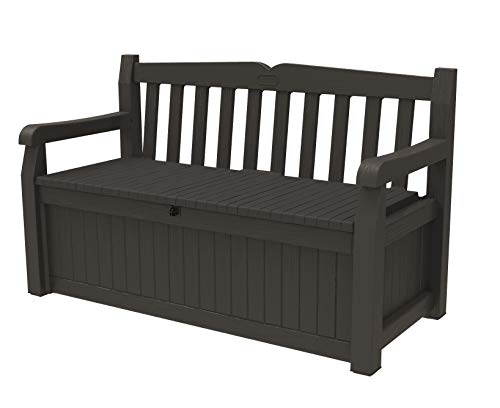
Best Outdoor Storage Bench for Small Patios: Three Resin Benches Under 55 Inches That Seat Two
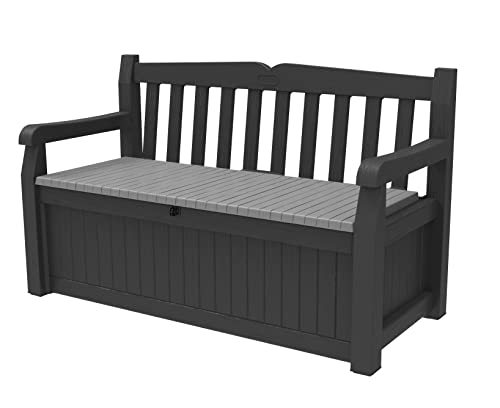
Best Outdoor Storage Benches of 2026
Keter Eden 70 Gallon Storage Bench Review

Sunjoy 54-Inch Wicker Outdoor Storage Bench Review
Lifetime 6-Foot Outdoor Storage Bench Review