An oscillating sprinkler is chosen by rated coverage against your lawn size, width and range adjusters, a metal or plastic build, clog-resistant nozzles and the water pressure at your tap. Here is what each one means and where to place it.
The short answer
An oscillating sprinkler is the right tool for a square or rectangular lawn, and the choice comes down to four things: a rated coverage that matches the lawn with margin, width and range adjusters so you can trim the pattern to the edges, a metal frame and base if it will live outdoors all summer, and a nozzle design that clears debris. A small town lot of 2,000 to 3,000 square feet is served by a compact 16 nozzle model rated to about 3,000 square feet. A larger lawn wants a 20 nozzle model rated to 4,000 or more square feet, or two sprinklers run in turn. Everything else, from timers to turbo gears, is a convenience rather than a requirement.
Coverage in square feet
Every oscillating sprinkler lists a maximum coverage, usually between about 2,500 and 4,500 square feet, often as a rectangle such as 55 by 70 feet. That figure is taken at a high water pressure on an open lawn with no wind. At the 40 to 50 psi most homes deliver through a 50 foot hose, expect two thirds to three quarters of the number. Measure the lawn, multiply length by width, and buy a sprinkler rated at least a third higher than that. A sprinkler running near its maximum throws a thin, misty pattern at the far edge and leaves it dry; one running well inside its range lays down an even band from the base to the end of the throw.
Width and range adjusters
Width control sets how far the spray bar swings toward each side; range control sets how far the water is thrown. Together they let you trim a pattern to a lawn with a sidewalk on one side and a bed on the other. Cheap sprinklers have neither and are aimed by placement alone. Mid-range models have a range dial and width tabs that stop the bar short on one or both sides. The best have independent left and right width stops plus a range dial, so the pattern can be offset as well as shrunk. If any edge of the lawn meets pavement, a driveway or a window, buy a model with both controls.
Nozzle count and the pattern
Nozzle counts run from about 12 on compact units to 20 on full size ones. More nozzles do not mean more coverage; they mean finer spacing of the streams, so the band is more even and the drops are smaller. Twelve to 16 nozzles suit a narrow lawn; 18 to 20 suit a wide one. Look at the pattern as well as the count: a bar with evenly spaced jets and a gentle slowdown at the ends of each sweep waters the near zone and the far zone alike, because the far edge needs more time under the spray to receive the same depth. Some models build that pause into the gearing, and it is worth having on a long lawn.
Metal or plastic
An oscillating sprinkler is a plastic bar on a plastic or metal body, driven by a small water turbine through gears. The plastic bar is fine; plastic bodies and bases crack after a couple of seasons in sun and from being stepped on. A die-cast metal base with a sled or H shape stays put on uneven ground and survives a mower bumping it. Brass hose fittings outlast plastic ones, which strip and leak. Sealed turbo gear drives, with the gears in an oil-filled housing, run smoother and last longer than open gears that grit can reach. A plastic sprinkler is fine for a season or two of light use; metal is the buy for a lawn watered all summer.
Clog resistance
Hose water carries grit, rust flakes and scale, and the nozzles on an oscillating sprinkler are small. Models with a built-in filter washer at the inlet and a cleaning pin for the nozzles stay even; many ship with a pin that pushes through each jet. Some makers use flexible rubber nozzle tips that can be rubbed clean with a thumb. If you are on well water or an older main, a filter and cleanable nozzles move from nice to necessary. Check that the filter can be reached without tools, since one that needs a screwdriver will never be cleaned.
Water pressure
Oscillating sprinklers are designed around about 40 to 60 psi at the inlet and a flow of 3 to 5 gallons a minute. A long thin hose, a splitter or a low-pressure house cuts both. Below about 30 psi the bar slows, stalls at the ends of the sweep and puddles near the base. If your tap fills a 5 gallon bucket in under two minutes you are fine. If it takes longer, buy a smaller sprinkler with fewer nozzles, use a 5/8 inch hose under 50 feet, and skip the turbo models that need pressure to drive their gears.
Timers
Some sprinklers carry a mechanical flow timer that shuts the water after a set number of gallons. It helps anyone who forgets the sprinkler, but it adds a part that can fail and it only counts flow, not time. A separate hose-end timer, mechanical or digital, does the same job for any sprinkler and moves between them. If a built-in timer is the deciding feature, choose the sprinkler on its other merits and add a timer at the tap.
Small lawns, large lawns and placement
On a small lawn, a compact sprinkler with width control, placed at one end throwing the length of the lawn, waters evenly with no overspray. On a large lawn, two sprinklers on a Y connector or one moved between two spots cover more evenly than one giant unit pushed to its limit. Place the sprinkler on level ground at the center of one edge for a rectangle, set the width first and the range second, and run it early in the morning when wind is lowest and evaporation least. Watch the first run and move it a few feet if a strip stays dry; an oscillating sprinkler rewards a minute of adjustment with an even lawn.
How we research
We compare published manufacturer specifications, official manuals, warranty information and recurring owner feedback. Rankings are research-based unless original YardToolLab test evidence is explicitly shown on the page.
FAQs
Rated coverage is usually 2,500 to 4,500 square feet, but at typical home pressure through a 50 foot hose expect about two thirds to three quarters of that. Buy a sprinkler rated a third larger than the lawn.
About 40 to 60 psi and 3 to 5 gallons a minute. Below 30 psi the bar slows, stalls at the ends of its swing and puddles near the base.
A metal base and brass fittings outlast plastic in sun and survive being bumped by a mower. The spray bar itself is plastic on nearly every model, and that is fine.
On level ground at the center of one edge of a rectangular lawn, throwing across the length, with the width stops set so the pattern ends about a foot inside the edges.
Related guides

Small Yard? These Three Oscillating Sprinklers Dial Down to a Strip of Lawn

Budget Oscillating Sprinklers That Still Adjust: Melnor Turbo 2800, Eden Essential and Eden Metal
Best Sprinkler for a Long Narrow Lawn: Three Oscillating Sprinklers With Width Control

Melnor 65079-AMZ Metal Oscillating Sprinkler Review: Big Lawns, Brass Nozzles

Best Sprinklers for Narrow and Rectangular Lawns
Best Oscillating Sprinklers We Recommend
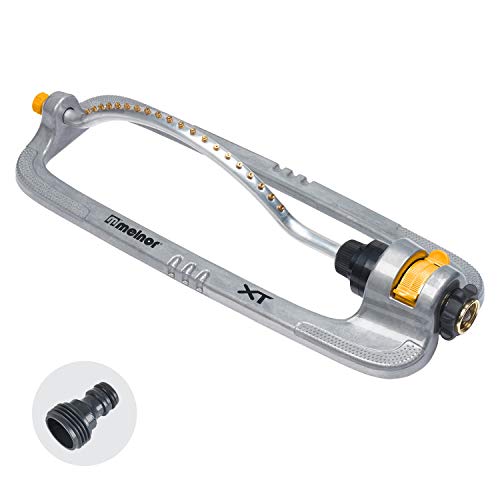
Melnor 65055-AMZ XT Turbo Oscillating Sprinkler Review