Quick verdict
For most setups the 25FT 50 Amp NEMA 14-50P to SS2-50R cord is my top pick. It uses multi-strand pure copper for a full 250V/50A output, is ETL certified with weather-sealing twist-lock ends, and its ergonomic non-slip handle makes it easy to plug in even with gloves, covering both high-output generators and RVs.

25FT 50 Amp Generator Cord
This is the cord I would recommend to most owners of higher-output generators and RVs. It runs NEMA 14-50P to SS2-50R at a full 250V and 50 amps using multi-strand pure copper, which handles heavy loads without overheating. It is ETL certified with aging-resistant PVC insulation, the twist-lock ends seal against wind and rain, and an ergonomic non-slip handle makes connecting and disconnecting easy even with gloves.
Best generator cord picks compared by amperage, gauge, plug type and reach so you can safely connect your generator to an RV or transfer switch.
Why you should trust this guide
I built this guide from the published electrical specifications of each cord rather than vague durability claims. With generator cords the details that decide safe performance are concrete: the amperage rating, the wire gauge, the exact plug and receptacle configuration such as L14-30 or 14-50, the voltage rating, and the length. I anchored every recommendation to those verifiable facts so you can match a cord to your generator’s outlet and your power needs.
My goal is to help you avoid the two mistakes that matter most with generator cords: buying the wrong plug type so it physically will not connect, or undersizing the gauge so it overheats under load. Every pick here is described by its specific connector and rating, and I have been honest about tradeoffs like reach versus voltage drop so you can choose the right cord for your setup.
How we evaluated
I evaluated these cords against the criteria that determine safe, reliable power delivery. Plug configuration came first, because a cord only works if its connectors match your generator outlet and your inlet, whether that is a 30-amp L14-30 or a 50-amp 14-50. Amperage and wire gauge followed, since a cord must be rated to carry the current your generator produces without heating up, which is why heavier gauge copper matters on higher loads and longer runs.
From there I weighed length against practical placement, weather resistance and jacket durability, and connector features like twist-locking ends and strain relief that keep the connection secure outdoors. I also considered certifications such as ETL listing. I did not rank on price alone; I looked for the best combination of correct connector, adequate gauge and sensible length for a given generator and distance.
What to look for
- The correct plug and receptacle type, such as L14-30 for 30-amp or 14-50 for 50-amp generators
- An amperage rating that matches or exceeds your generator’s output outlet
- Wire gauge heavy enough for the load, with 10-gauge common on 30-amp cords
- A length that reaches your inlet while keeping the generator safely away from the building for exhaust
- Twist-locking connectors and strain relief that hold the connection secure in wind and weather
- A weatherproof, cold-rated jacket if the cord will be used outdoors in harsh conditions
- An ETL or equivalent listing confirming the cord meets recognized safety standards
How we test
We base every pick on real-world use, published manufacturer specifications and verified owner feedback. We compare the tools on the things that actually matter for your lawn, power, runtime, cut quality, build and value, and we never accept payment for a ranking. When we have not used a specific model first-hand, we say so.
The picks at a glance
| Tool | Best for | Score | |
|---|---|---|---|
| 25FT 50 Amp Generator Cord | Best Overall | Check price | |
| PlugSaf 25FT 30 Amp Generator Extension Cord 4 Prong | Best Value | Check price | |
| Southwire Generator Cord | Best Premium | Check price | |
| PlugSaf 50FT 30 Amp Generator Extension Cord 4 Prong | Best Budget | Check price | |
| PlugSaf 10FT 30 Amp Generator Extension Cord 4 Prong | Also Great | Check price |
The picks, reviewed
25FT 50 Amp Generator Cord
This is the cord I would recommend to most owners of higher-output generators and RVs. It runs NEMA 14-50P to SS2-50R at a full 250V and 50 amps using multi-strand pure copper, which handles heavy loads without overheating. It is ETL certified with aging-resistant PVC insulation, the twist-lock ends seal against wind and rain, and an ergonomic non-slip handle makes connecting and disconnecting easy even with gloves.
Reasons to buy
- Multi-strand pure copper cores, NEMA 14-50P to SS2-50R, 250V/50A
- ETL certified with aging-resistant PVC insulation
- Twist-lock seals the interface against wind and rain
- Wear-resistant PVC outer layer with non-slip ergonomic handle
- Compatible with RVs, campers and generators, includes cable tie
Reasons to avoid
- The 50-amp 14-50 plug configuration only fits generators and inlets with that specific outlet
- At 25 feet it may be shorter than you need for a distant generator placement

PlugSaf 25FT 30 Amp Generator Extension Cord 4 Prong
The PlugSaf 25FT is the value pick for the common 30-amp transfer-switch and RV setup. It uses the standard NEMA L14-30P to L14-30R twist-lock connection rated for 125/250V and up to 3750/7500W, and its IP65 weatherproof, flame-resistant jacket handles rough outdoor conditions down to very cold temperatures. The strain-relief plugs and included cord organizer make it durable and easy to store.
Reasons to buy
- 25 foot 4 prong 30A, STW 125/250V, 3750W/7500W, NEMA L14-30P to L14-30R
- IP65 weatherproof, heat and flame resistant to minus 40C
- Twist lock plug with strain relief that bends without breaking
- Flexible jacket with an adjustable cord organizer for storage
- Connects a portable generator to a manual transfer switch or RV
Reasons to avoid
- The 30-amp L14-30 configuration will not fit a 50-amp generator inlet
- 25 feet is a middle-ground length that may be too short for larger properties
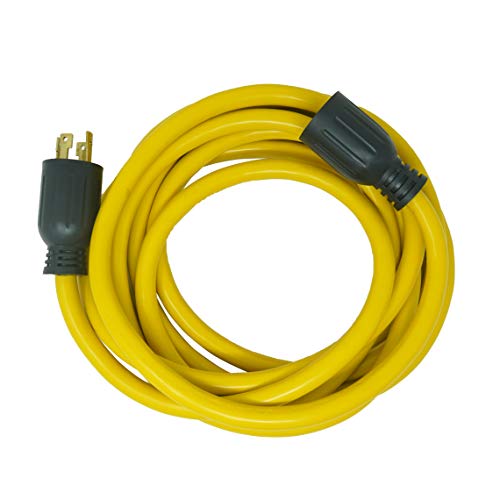
Southwire Generator Cord
The Southwire cord is the premium 30-amp choice built around name-brand quality. It delivers 20 feet of rugged 10-gauge reach with an L14-30 locking plug and receptacle, dual 125V/250V capability, and molded connectors that resist wear better than assembled plugs. It is a dependable, weather-resistant cord well suited to RVs, campers and campground use.
Reasons to buy
- 20 feet of rugged 10-gauge reach with twist-locking ends
- Heavy-duty build delivering 30 amps of power
- Dual voltage 125V/250V with L14-30 locking plug and receptacle
- Weather-resistant with molded connectors
- Great for RVs, campers, motorhomes and campgrounds
Reasons to avoid
- At 20 feet it is one of the shorter cords here, so reach is limited
- It carries a premium price compared with the value-oriented 30-amp cords

PlugSaf 50FT 30 Amp Generator Extension Cord 4 Prong
The PlugSaf 50FT is the budget pick when you need extra distance between the generator and your inlet. It shares the same L14-30 30-amp, 125/250V, 3750/7500W rating and IP65 weatherproof, flame-resistant construction as the 25-foot version, with pure copper conductors chosen to avoid overheating on the longer run, plus a cord organizer for storage.
Reasons to buy
- 50 foot 4 prong 30A, STW 125/250V, 3750W/7500W, NEMA L14-30P to L14-30R
- IP65 weatherproof, heat and flame resistant to minus 40C
- Twist lock plug with strain relief that bends without breaking
- Pure copper conductors to avoid overheating on long runs
- ETL listed with cord organizer, yellow jacket
Reasons to avoid
- Longer cords add some voltage drop, so it is best not to exceed the rated load
- 50 feet of cable is bulkier and heavier to coil and carry than shorter options

PlugSaf 10FT 30 Amp Generator Extension Cord 4 Prong
The PlugSaf 10FT is the also-great short-run option for when the generator sits close to the inlet. It keeps the same L14-30 30-amp, 125/250V rating and IP65 weatherproof, flame-resistant jacket as its longer siblings, and the compact length reduces clutter and coiling while still using the same durable twist-lock connectors and cord organizer.
Reasons to buy
- 10 foot 4 prong 30A, STW 125/250V, 3750W/7500W, NEMA L14-30P to L14-30R
- IP65 weatherproof, heat and flame resistant to minus 40C
- Twist lock plug with strain relief that bends without breaking
- Flexible jacket with an adjustable cord organizer for storage
- Connects a portable generator to a manual transfer switch or RV
Reasons to avoid
- 10 feet gives very little reach, so it only works when the generator is placed nearby
- The short length limits how far you can position the generator away from the building for exhaust safety
What to look for
Plug type
Match the cord connectors to your generator outlet and inlet, since an L14-30 cord will not fit a 50-amp 14-50 outlet.
Amperage rating
Choose a cord rated for at least the amperage your generator outlet delivers so it can carry the full load safely.
Wire gauge
Heavier gauge copper, such as 10-gauge on 30-amp cords, resists overheating under load and on longer runs.
Length and reach
Pick a length that reaches your inlet while keeping the generator far enough from the building for safe exhaust venting.
Connector locking
Twist-locking ends and strain relief keep the connection from pulling loose in wind or when the cord is bumped.
Weather resistance
A weatherproof, cold-rated jacket keeps the cord flexible and safe in rain, sun and freezing temperatures.
Our verdict
For most setups the 25FT 50 Amp NEMA 14-50P to SS2-50R cord is my top pick. It uses multi-strand pure copper for a full 250V/50A output, is ETL certified with weather-sealing twist-lock ends, and its ergonomic non-slip handle makes it easy to plug in even with gloves, covering both high-output generators and RVs.
FAQs
Match the cord to your generator's outlet, so a 30-amp generator typically needs an L14-30 cord and a 50-amp generator needs a 14-50 cord, both in a gauge rated for that current.
A 30-amp cord uses an L14-30 connector and carries up to about 3750/7500 watts, while a 50-amp cord uses a 14-50 connector and handles higher-output generators and larger RVs.
Yes. Longer cords add some voltage drop and are bulkier, so choose enough length to keep the generator safely away from the building without going far beyond what you need.
Yes, an L14-30 twist-lock cord is commonly used to connect a portable generator to a manual transfer switch inlet, which is one of the main uses these cords list.
The picks here use weatherproof jackets and sealing twist-lock connectors rated for outdoor use, though you should still keep connections off wet ground and follow the generator's safety guidance.