Quick verdict
The Westinghouse 14500 Peak Watt is the tri-fuel generator I would put at the top for larger homes. It runs on gasoline, propane or natural gas, produces 11,500 running watts on gas from a heavy 550cc engine, and adds remote start plus low THD output that is safe for sensitive electronics during a long outage.
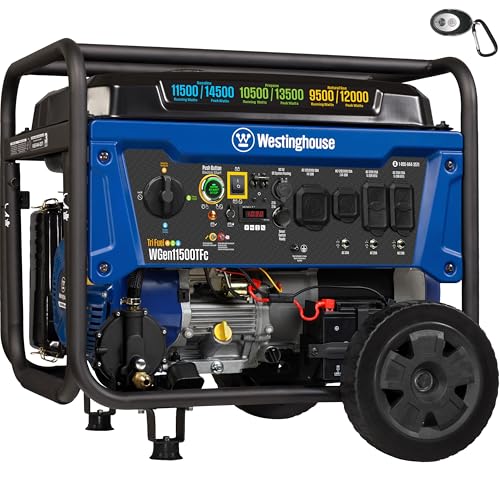
Westinghouse 14500 Peak Watt Tri-Fuel Portable Generator
The Westinghouse 14500 leads because it delivers the most flexible high-output backup here, running on gasoline, propane or natural gas with 11,500 running watts on gas from a durable 550cc engine. Westinghouse lists up to 19 hours on a 9.5-gallon tank, low THD output that is safe for electronics, and remote electric start with a key fob. It is built as backup for a larger home or a dependable jobsite unit, which is exactly the tri-fuel use case.
The best tri fuel generator for whole-home backup. Compared five gas, propane and natural gas models by running watts, engine, outlets and starting features.
Why you should trust this guide
A tri-fuel generator runs on gasoline, liquid propane or natural gas, and switching between them is usually as simple as turning a selector dial. That flexibility is the entire appeal: you can burn gasoline for maximum output, keep propane on hand for clean long-term storage, or tap a natural gas line for effectively unlimited runtime during an extended outage. The important detail is that output drops as you move from gasoline to propane to natural gas, so the running-watt figure you plan around depends on which fuel you intend to use most.
I have not operated these specific generators, and I will not claim to. What this guide does is compare the published specifications, the running watts on each fuel, the engine displacement, the outlet layout, the starting method and the safety features, and translate them into which unit fits a given home. Because these are high-output fuel generators, I also point out the realities a spec sheet skips, like the need to run outdoors and to have an electrician wire in a transfer switch for whole-home use.
How we evaluated
Running watts came first, evaluated across all three fuels rather than just the headline gasoline number. Most of these units land near 8,500 to 11,500 running watts depending on fuel, which is enough to back up a larger home through a transfer switch, so I checked how far each fuel mode dropped and whether the surge rating could start heavy motor loads. I matched those figures to typical whole-home backup needs.
From there I weighed the features that decide how usable the generator is in an emergency. Electric or remote start is far easier than recoil on a big engine, a fuel selector that switches quickly saves hassle, and transfer-switch-ready 120V and 240V outlets are essential for feeding a home panel. I also gave weight to carbon monoxide shutdown sensors, since these units must run outdoors and CO safety is not optional.
What to look for
- Running watts on each fuel, since output falls from gasoline to propane to natural gas and sets your real capacity.
- Surge or starting watts, which must cover the spike when large motors and appliances turn on.
- Fuel selector design, where a quick front-facing dial makes switching fuels far easier in an emergency.
- Transfer-switch-ready outlets at 120V and 240V, needed to feed a home electrical panel safely.
- Starting method, with electric or remote start far easier than recoil on a large engine.
- Carbon monoxide shutdown, a sensor that cuts the engine if dangerous CO builds up outdoors.
- Runtime and tank size, which decide how often you refuel, though a natural gas line removes that concern.
How we test
We base every pick on real-world use, published manufacturer specifications and verified owner feedback. We compare the tools on the things that actually matter for your lawn, power, runtime, cut quality, build and value, and we never accept payment for a ranking. When we have not used a specific model first-hand, we say so.
The picks at a glance
| Tool | Best for | Score | |
|---|---|---|---|
| Westinghouse 14500 Peak Watt Tri-Fuel Portable Generator | Best Overall | Check price | |
| Westinghouse 13500 Peak Watt Tri-Fuel Portable Generator | Best Value | Check price | |
| DuroMax XP13000HXT Tri Fuel Portable Generator | Best Premium | Check price | |
| Generac 12,500 Starting Watt Tri-Fuel Portable Generator | Best Budget | Check price | |
| WEN 14,500-Watt 120V/240V Tri-Fuel Generator | Also Great | Check price |
The picks, reviewed
Westinghouse 14500 Peak Watt Tri-Fuel Portable Generator
The Westinghouse 14500 leads because it delivers the most flexible high-output backup here, running on gasoline, propane or natural gas with 11,500 running watts on gas from a durable 550cc engine. Westinghouse lists up to 19 hours on a 9.5-gallon tank, low THD output that is safe for electronics, and remote electric start with a key fob. It is built as backup for a larger home or a dependable jobsite unit, which is exactly the tri-fuel use case.
Reasons to buy
- Perfect as a backup power source for larger homes or a dependable source of portable power
- 14,500 peak watts, 11,500 running watts (gasoline); 13,500 peak watts, 10,500 running watt
- Powered by a heavy duty 550cc 4-Stroke OHV Westinghouse Engine constructed with a durable
- Engineered with low THD, so it's safe for sensitive electronics. Power phones, computers,
- All Westinghouse portable generators are functionally tested in the factory and may contai
Reasons to avoid
- Natural gas output is lower than gasoline, as with any tri-fuel unit, so plan capacity around your chosen fuel
- It is a large, heavy open-frame generator that must run outdoors

Westinghouse 13500 Peak Watt Tri-Fuel Portable Generator
The Westinghouse 13500 is the value pick because it offers nearly the same tri-fuel capability, 10,500 running watts on gas and 9,500 on propane, from a 500cc engine at a lower price than the 14500. It is transfer-switch ready with an L14-30R and a 50A RV outlet, includes remote start with a key fob, and shows voltage, frequency and lifetime hours on a digital display. It suits buyers who want large-home backup without paying for the top model.
Reasons to buy
- 13500 Peak Watts, 10500 Running Watts (Gasoline); 12500 Peak Watts, 9500 Running Watts (Pr
- Features Two GFCI 120V 5–20R 20A Standard Household Receptacle, One Transfer Switch Ready
- Powered by a Heavy Duty 500cc Westinghouse 4-Stroke OHV Engine Featuring a Long-Lasting Ca
- Plug-and-Play: Comes with a Remote Start Key Fob, 12V Battery Charger, Oil, and Oil Funnel
- All Westinghouse Portable Generators are Functionally Tested in the Factory and May Contai
Reasons to avoid
- Natural gas running watts drop to 8,500, which is a notable step down from gasoline
- As an open-frame unit it is louder than an inverter and needs outdoor operation

DuroMax XP13000HXT Tri Fuel Portable Generator
The DuroMax XP13000HXT is the premium pick for its front-facing fuel selector that lets you switch fuel in seconds, backed by a 13,000-watt output from a 500cc OHV engine. It adds push-button and remote start, a wide outlet set including a transfer-switch-ready 50A outlet, and a CO Alert sensor for safety. It appeals to buyers who want a well-equipped tri-fuel unit with easy fuel switching and whole-home capability.
Reasons to buy
- With 13,000 watts of power, the XP13000HXT Tri Fuel generator will keep your whole home ru
- Run your generator on gasoline, propane, or natural gas. With Tri Fuel, we offer the ultim
- Powerful 500cc OHV Engine: At the heart of this generator resides a robust DuroMax engine
- The XP13000HXT comes with a push button start, a front facing interface that allows you to
- Push Button Start and Remote Start: Turn on your generator with a simple push of a button,
Reasons to avoid
- It is a heavy unit sized for home backup rather than casual portability
- Like all tri-fuel generators, output on natural gas is lower than on gasoline

Generac 12,500 Starting Watt Tri-Fuel Portable Generator
The Generac 12500 is the budget tri-fuel choice, delivering 9,500 running and 12,500 starting watts from a 500cc engine with a simple fuel selector dial. It includes push-button electric start with a rechargeable battery, COsense carbon monoxide detection that shuts the unit down automatically, and a rugged steel frame with never-flat wheels. It is a sensible pick when you want tri-fuel flexibility and Generac's safety system without the top-tier price.
Reasons to buy
- VERSATILE TRI-FUEL FLEXIBILITY
- EFFORTLESS ELECTRIC START SYSTEM
- EXTENDED MULTI-FUEL RUNTIME
- LIFE-SAVING COSENSE PROTECTION
- HEAVY-DUTY JOB SITE CONSTRUCTION
Reasons to avoid
- It is 49-state compliant, so it may not be sold in California
- Runtime figures are quoted at 50 percent load, so heavy loads shorten them

WEN 14,500-Watt 120V/240V Tri-Fuel Generator
The WEN 14500 is a strong also-great with 11,500 running watts on gasoline, 10,300 on propane and 8,750 on natural gas, selectable by a simple dial. It operates at 120V and 240V for transfer switches, adds the WEN Watchdog CO shutdown sensor, electric start on its 500cc engine, and a broad outlet set including 14-50R and L14-30R receptacles plus an included LPG hose and NG adapter. It suits buyers who want a fully equipped tri-fuel kit out of the box.
Reasons to buy
- Switch between gasoline (14500 surge watts, 11500 running watts), propane (12500 surge wat
- Operates at 120V and 240V, making it perfect for transfer switches and emergency backup
- The WEN Watchdog CO Shutdown Sensor helps protect both you and your family by automaticall
- Electric start powers the 500c 4-stroke OHV engine with the turn of a key, while the 8.2-g
- Includes four 120V 5-20R outlet, a 120V/240V transfer-switch-ready NEMA L14-30R outlet, a
Reasons to avoid
- It is a large open-frame unit that trades quiet for high output
- Natural gas is the lowest-output fuel mode, so size loads accordingly
What to look for
Multi-fuel output
Running watts drop from gasoline to propane to natural gas, so plan capacity around the fuel you will use most.
Surge headroom
Starting watts must cover the spike of large motors and appliances, which draw far more than their running load.
Fuel switching
A quick front-facing selector dial makes changing fuels in an emergency much easier than swapping parts.
Transfer-switch outlets
120V and 240V transfer-switch-ready receptacles let an electrician feed your home panel for whole-home backup.
Starting method
Electric or remote start beats recoil on a large engine, especially in cold weather or a stressful outage.
CO safety shutoff
A carbon monoxide shutdown sensor protects your family since these high-output units must run outdoors.
Our verdict
The Westinghouse 14500 Peak Watt is the tri-fuel generator I would put at the top for larger homes. It runs on gasoline, propane or natural gas, produces 11,500 running watts on gas from a heavy 550cc engine, and adds remote start plus low THD output that is safe for sensitive electronics during a long outage.
FAQs
No. Output is highest on gasoline, lower on propane, and lowest on natural gas, so plan your capacity around whichever fuel you intend to use most often.
Tri-fuel adds natural gas, which can give effectively unlimited runtime during an extended outage if your home has a gas line, on top of the gasoline and propane options.
Yes, most of these can approach whole-home coverage through a transfer switch since they produce 8,500 to 11,500 running watts depending on fuel, but an electrician must wire the switch.
No. Natural gas mode requires a connection to your home's gas supply. Without a line you would use gasoline or propane instead.
No. Like all fuel-burning generators they produce carbon monoxide and must run outdoors, well away from the home, even with a CO shutdown sensor.