Quick verdict
For a true portable generator, my top pick is the Oxseryn 4400 Watt inverter. At 3400 running watts it powers RV hookups and essential home circuits, runs up to 14 hours at 25% load in ECO mode, stays under 72 dBA, and weighs just 56 pounds. That mix of output, quiet running and portability suits the most people.

Oxseryn 4400 Watt Inverter Generator
The Oxseryn 4400W inverter is my overall pick because it balances real output with portability and quiet running. It delivers 3400 running watts and 4400 peak, enough for RV hookups and essential home circuits, and it carries two 120V AC ports, a 12V DC port and an RV port. ECO mode stretches runtime to a stated 14 hours at 25% load on its 2-gallon tank, and at under 72 dBA from 23 feet and just 56 pounds, it is easy to live near and move.
The best portable generators compared: gas inverter units from 2350 to 12500 watts plus battery power stations, ranked by output, runtime, noise and
Why you should trust this guide
Portable power is a broad category, and a search for the best portable generator returns two very different kinds of product: fuel-burning inverter and standby generators, and battery power stations. I built this guide by reading each listing carefully and reporting only the published figures, running and surge watts, tank size, runtime, noise level, weight and outlets. I did not invent numbers or overstate any claim, so everything here traces back to what each manufacturer prints.
I also think it is important to be clear about the split in this lineup, because it changes what you can actually run. The Oxseryn, Westinghouse and WEN units are gas generators that produce enough power for appliances or a home but must run outdoors. The MARBERO and Jackery are batteries that are silent and safe indoors but cap out at small electronics. Naming that difference plainly saves you from buying a device that cannot do the job you had in mind.
How we evaluated
My evaluation criteria started with usable output, meaning running or rated watts rather than the higher surge number, since that is what determines which devices you can power continuously. From there I weighed runtime and refueling: tank size, ECO-mode efficiency and, on the battery units, capacity in watt-hours and recharge speed. A generator that runs 14 hours at partial load is far more practical for an overnight outage than one that empties quickly.
Next I looked at noise, portability and safety features. Inverter generators produce cleaner, quieter power that is safer for sensitive electronics, and low-dBA ratings matter for campsites and neighborhoods. Weight and handle design decide whether one person can move the unit, while low-oil shutdown, fuel shutoff, GFCI outlets and a Battery Management System are the safety details I flagged. I treated fuel type and indoor-versus-outdoor use as a fundamental sorting factor rather than a footnote.
What to look for
- Running watts, not surge. Size the generator to your continuous load; the running or rated figure is what you can power steadily.
- Fuel or battery. Gas units run appliances outdoors, while battery stations are silent and indoor-safe but limited to electronics.
- Runtime and refuel. Look at tank size and ECO-mode hours, or watt-hour capacity and recharge time on battery units.
- Inverter output. Inverter generators deliver cleaner power that is safer for phones, laptops and TVs.
- Noise level. A low dBA rating matters for campsites and close neighbors; inverter and battery units are quietest.
- Portability. Weight and handle or wheel design determine whether one person can move it easily.
- Safety features. Prioritize low-oil shutdown, fuel shutoff, GFCI outlets and, on batteries, a Battery Management System.
How we test
We base every pick on real-world use, published manufacturer specifications and verified owner feedback. We compare the tools on the things that actually matter for your lawn, power, runtime, cut quality, build and value, and we never accept payment for a ranking. When we have not used a specific model first-hand, we say so.
The picks at a glance
| Tool | Best for | Score | |
|---|---|---|---|
| Oxseryn 4400 Watt Inverter Generator | Best Overall | Check price | |
| MARBERO 88Wh Portable Power Station | Best Value | Check price | |
| Westinghouse 12500 Watt Dual Fuel Generator | Best Premium | Check price | |
| WEN 2350 Watt Inverter Generator | Best Budget | Check price | |
| Jackery Explorer 300 Power Station | Also Great | Check price |
The picks, reviewed
Oxseryn 4400 Watt Inverter Generator
The Oxseryn 4400W inverter is my overall pick because it balances real output with portability and quiet running. It delivers 3400 running watts and 4400 peak, enough for RV hookups and essential home circuits, and it carries two 120V AC ports, a 12V DC port and an RV port. ECO mode stretches runtime to a stated 14 hours at 25% load on its 2-gallon tank, and at under 72 dBA from 23 feet and just 56 pounds, it is easy to live near and move.
Reasons to buy
- 4400 peak watts and 3400 running watts, gas powered
- Multi-output: two 120V AC ports, one 12V DC port, one RV port
- Up to 14 hours runtime at 25% load with ECO mode, 2 gallon tank with fuel gauge
- Under 72 dBA from 23 feet away
- Lightweight at only 56 lbs
Reasons to avoid
- The 2-gallon tank means refueling sooner under heavier loads than larger units
- As a gas generator it must run outdoors, well away from windows, because of exhaust

MARBERO 88Wh Portable Power Station
The MARBERO 88Wh is the value pick for shoppers who mainly want to keep phones, tablets and small devices alive. It is a tiny 3.2-pound lithium power station with eight outputs at once, a 120W peak AC outlet, USB and USB-C PD ports, and a built-in LED light with an SOS mode. It recharges from 0 to 80% in about two hours and has a Battery Management System for safety.
Reasons to buy
- 88Wh lithium battery power station, charges 0 to 80% in 2 hours
- Compact and portable, about 6.5 x 4.6 x 3.1 inches and 3.2 lbs
- 8 output ports usable at once, 120W peak AC plus USB and USB-C PD
- Bright LED light with three levels and SOS mode
- Battery Management System for voltage, temperature and short-circuit protection
Reasons to avoid
- At 88Wh and 120W peak it cannot run appliances, only small electronics
- It is a battery unit, so once drained it needs recharging rather than a fuel top-up

Westinghouse 12500 Watt Dual Fuel Generator
The Westinghouse 12500W dual fuel is my premium pick for whole-home backup. On gasoline it makes 9500 running and 12500 peak watts, with a propane option, and it is transfer-switch ready with 30A and RV-ready 50A outlets. A 457cc OHV engine with low-oil shutdown, remote electric start via key fob, a digital hour meter and a 3-year warranty make it a serious standby unit that ships ready to run.
Reasons to buy
- 9500 running / 12500 peak watts gasoline; 8500 running / 11200 peak watts propane
- Remote electric start with key fob, up to 12 hours on a 6.6 gallon tank
- Transfer switch ready 30A and RV ready 50A outlets with rubber covers
- 457cc 4-stroke OHV engine with low oil shutdown and digital hour meter
- 3-year warranty, plug-and-play with key fob, battery charger, oil and tools
Reasons to avoid
- This is a large, heavy unit, so it is far less portable than the inverter models
- Running 9500 watts consumes fuel quickly, so plan for frequent refills in a long outage
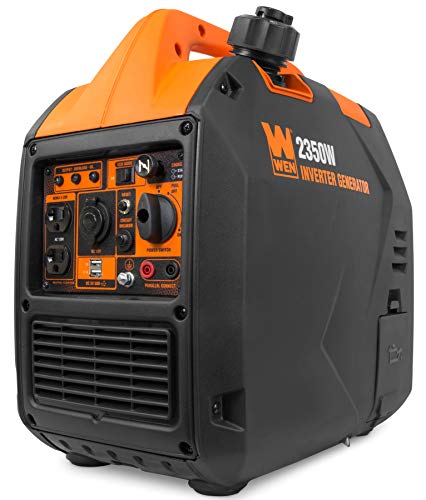
WEN 2350 Watt Inverter Generator
The WEN 2350W is the budget pick and the lightest fuel generator here at 39 pounds. It produces 1900 rated and 2350 surge watts of clean inverter power that is safe for phones, laptops and TVs, runs very quietly at conversation-level noise, and includes a fuel shutoff that clears the carburetor to extend its life. Two 120V outlets, a 12V DC port and dual USB round it out.
Reasons to buy
- Ultralight 39 pound body for easy transport and storage
- Very quiet operation, comparable to a normal conversation
- 2350 surge watts and 1900 rated watts of clean power for sensitive electronics
- Fuel shutoff uses remaining carburetor fuel before shutting down
- Two 120V receptacles, one 12V DC, two 5V USB ports, two-year warranty
Reasons to avoid
- At 1900 rated watts it handles only small loads, not large appliances
- It has fewer outlets and a shorter two-year warranty than the pricier units

Jackery Explorer 300 Power Station
The Jackery Explorer 300 is a strong also-great for silent, fume-free power. This 292Wh LiFePO4 station weighs 7.5 pounds, powers up to six devices through two AC outlets, a 100W USB-C PD port, two USB-A ports and a 120W car port, and delivers 300 watts rated with a 600-watt surge. Its LiFePO4 chemistry is rated for over 4,000 cycles, and it recharges to 80% in about 2.8 hours with a 100W solar panel.
Reasons to buy
- Ultra-lightweight at 7.5 lbs with 292Wh LiFePO4 capacity
- Power for 6 devices: 2 AC outlets, 100W USB-C PD, 2 USB-A, 120W car port
- 300W rated output, 600W peak surge
- LiFePO4 chemistry rated over 4,000 cycles to 70% capacity
- Fast solar charging, 80% in about 2.8 hours with a 100W panel
Reasons to avoid
- Its 300W rated output limits it to electronics and small devices, not power tools or heaters
- The solar panel needed for off-grid recharging is sold separately
What to look for
Usable running watts
Size the unit by its running or rated watts, not the higher surge figure, since that is what you can power continuously.
Fuel versus battery
Gas generators run appliances outdoors, while battery power stations are silent and indoor-safe but capped at small electronics.
Runtime and recharge
Weigh tank size and ECO-mode hours on gas units, or watt-hour capacity and recharge speed on battery stations.
Noise level
A low dBA rating matters near campsites and neighbors; inverter and battery units run the quietest.
Portability and safety
Check weight and handles alongside safety features like low-oil shutdown, fuel shutoff and GFCI outlets.
Our verdict
For a true portable generator, my top pick is the Oxseryn 4400 Watt inverter. At 3400 running watts it powers RV hookups and essential home circuits, runs up to 14 hours at 25% load in ECO mode, stays under 72 dBA, and weighs just 56 pounds. That mix of output, quiet running and portability suits the most people.
FAQs
Add up the running watts of the devices you want to power at once, then choose a generator with a rated output above that total. Leave headroom for motor start-up surges.
A generator burns fuel to make power and must run outdoors, so it can handle appliances. A power station is a battery that runs silently and is indoor-safe but limited to smaller electronics.
Yes for most people. They produce cleaner, more stable power that is safer for phones, laptops and TVs, and they usually run quieter and more efficiently at partial load.
No. Fuel generators emit carbon monoxide and must run outdoors away from windows and doors. Only battery power stations are safe to use inside.
It depends on tank size and load. The Oxseryn is rated up to 14 hours at 25% load, while larger units like the Westinghouse run about 12 hours but consume fuel faster at high output.