Quick verdict
For most people the 21V Cordless Portable Washer is the pick to start with. It pairs a 775 motor rated around 1100 PSI with a 6-in-1 nozzle, foam pot, and a 23-foot hose, and it draws water from a bucket, faucet, or pool. That flexibility makes it the most usable of these handheld units for cars and patios.

Cordless Portable Washer
This 21V unit is built around a 775 motor with an output the listing rates near 1100 PSI, which is enough for cars, bikes, and light patio grime rather than caked-on driveway stains. The 6-in-1 nozzle plus a foam pot cover rinse, wash, and detergent steps, and the 23-foot hose with a weighted filter head lets you pull water from a bucket or pool. A full charge is described as roughly 20 minutes of continuous use or up to 40 minutes of intermittent cleaning.
The best cordless pressure washer picks for cars, patios, and driveways, compared by PSI, runtime, hose length, and water-source flexibility to help you choose.
Why you should trust this guide
Cordless pressure washers are a fast-growing and crowded category, and most of the listings look nearly identical: the same 775 motor, the same 23-foot hose, and PSI numbers that range from about 990 to 1250. I built this guide by reading the actual manufacturer specifications for each unit, comparing the claimed pressure, runtime, hose length, and included accessories side by side, and separating the meaningful differences from the marketing repetition.
My goal is to help you set realistic expectations. These are handheld, battery-powered cleaners, not replacements for a corded electric or gas machine. I describe what each one is genuinely suited for, note where the specs overlap, and flag when two products are effectively the same design in a different color. That way you are choosing based on what the hardware can actually do, not the boldest number in the title.
How we evaluated
I evaluated these picks on the criteria that matter most for a cordless unit: rated pressure, battery runtime per charge, hose length and water-source flexibility, weight, and the completeness of the included accessory kit. Because every one of these is a portable handheld, I weighted runtime and water-source options heavily, since running out of charge or being tied to a single tap is what usually frustrates people first.
I did not run these machines myself, so nothing here is based on a physical trial. Instead I compared the published figures and the accessory lists, and I treated the higher PSI claims with caution because real output depends on the battery charge and the water source. Where a listing overlapped almost exactly with another, I said so plainly rather than inventing a reason to prefer one.
What to look for
- Rated PSI: expect roughly 990 to 1250 PSI in this class, which suits cars, bikes, and light patio work rather than heavy driveway stains.
- Battery runtime: most quote about 40 minutes of intermittent use, which can mean far less continuous spray time, so a spare battery helps.
- Hose length: a longer hose, around 23 feet here, means less shuffling of the water container as you move around a vehicle.
- Water-source flexibility: look for a weighted filter head and adapters that let you draw from a bucket, pool, or faucet.
- Nozzle options: a multi-pattern nozzle plus a foam pot covers rinse, wash, and detergent steps in one tool.
- Weight: lighter bodies near 3.2 lb are easier to carry, though they offer less stability during longer sessions.
- Kit completeness: check whether the charger, connectors, filter, and storage case are all included so you are ready out of the box.
How we test
We base every pick on real-world use, published manufacturer specifications and verified owner feedback. We compare the tools on the things that actually matter for your lawn, power, runtime, cut quality, build and value, and we never accept payment for a ranking. When we have not used a specific model first-hand, we say so.
The picks at a glance
| Tool | Best for | Score | |
|---|---|---|---|
| Cordless Portable Washer | Best Overall | Check price | |
| Cordless Portable Washer | Best Value | Check price | |
| Cordless Portable Washer | Best Premium | Check price | |
| Muzisst Cordless Car Washer | Best Budget | Check price | |
| Cordless Portable Washer | Also Great | Check price |
The picks, reviewed
Cordless Portable Washer
This 21V unit is built around a 775 motor with an output the listing rates near 1100 PSI, which is enough for cars, bikes, and light patio grime rather than caked-on driveway stains. The 6-in-1 nozzle plus a foam pot cover rinse, wash, and detergent steps, and the 23-foot hose with a weighted filter head lets you pull water from a bucket or pool. A full charge is described as roughly 20 minutes of continuous use or up to 40 minutes of intermittent cleaning.
Reasons to avoid
- The 20 minute continuous runtime means keeping a spare charge handy for anything longer than a couple of cars
- PSI in this class is far below a corded washer, so heavy driveway stains will be slow

Cordless Portable Washer
The MIMYTH version uses the same 775 motor design but is rated up to 990 PSI, placing it a step below the 21V pick on raw output. It still ships with the foam pot, a 23-foot elastic hose, and the weighted filter and basket for drawing from open water. For light, frequent jobs like rinsing a car or bike it covers the basics without the higher-PSI premium.
Reasons to avoid
- Rated pressure tops out lower than the other picks here
- Runtime is quoted around 40 minutes of intermittent use, so continuous spraying drains it faster

Cordless Portable Washer
This model highlights an all-copper motor and a light 3.2 lb body, with the listing rating output at 1100 PSI. The complete kit adds a rapid charger, 23-foot hose, foam pot, stop valve, and multiple faucet and garden-hose connectors, so setup options are broad. The low weight makes it easy to carry around a vehicle or up steps.
Reasons to avoid
- At 3.2 lb the light body helps portability but limits stability during longer sessions
- As with all these handhelds, expect roughly 40 minutes per charge at most
Muzisst Cordless Car Washer
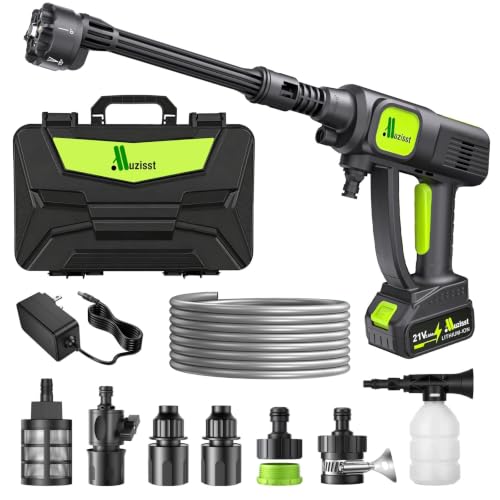
The Muzisst leans on a built-in self-priming system, so you drop the intake hose into a bucket, tank, or tap and start without a fixed water line. The listing quotes 1250 PSI, the highest figure in this group, and it includes a storage case with battery, charger, hose, and filter. That makes it a reasonable grab-and-go option for travel or campsite cleanups.
Reasons to avoid
- The higher PSI figure is a listing spec, and real output depends on the water source and charge level
- The included accessory set is lighter than the multi-connector kits on the other picks

Cordless Portable Washer
This is essentially the same 3.2 lb all-copper-motor platform as the premium pick in a different color, rated at 1100 PSI with the same 23-foot hose and full connector kit. It exists as a close alternative if the other colorway is unavailable, and the feature set is identical. Treat it as a second-choice version of the same design rather than a distinct upgrade.
Reasons to avoid
- It duplicates the premium pick, so there is no performance reason to choose one over the other
- Handheld PSI still caps what it can do on heavy, set-in stains
What to look for
Rated pressure vs. real output
PSI figures in this class run from about 990 to 1250, but that is a listing spec measured under ideal conditions. Actual force at the nozzle depends on battery charge and how the unit draws water, so treat the numbers as a rough ranking rather than a guarantee.
Battery runtime and spares
Most of these quote around 40 minutes of intermittent use, which often translates to closer to 20 minutes of continuous spraying. If you plan to wash more than a car or two in a session, keeping a charged spare battery on hand is the single most useful upgrade.
Water-source flexibility
The strongest advantage of these units is drawing water from a bucket, pool, or tank rather than a hose bib. Look for a weighted filter head that stays submerged and a set of adapters so you are not limited to a single faucet connection.
Hose length and reach
A 23-foot hose lets you circle a vehicle or reach across a patio without dragging the water container along. Shorter hoses force you to reposition the bucket constantly, which is a small annoyance that adds up over a full wash.
Accessory kit completeness
The kits vary in how many connectors, filters, and cases they include. A complete set with a foam pot, multiple faucet and garden-hose adapters, and a storage box means you can start immediately instead of ordering missing parts.
Our verdict
For most people the 21V Cordless Portable Washer is the pick to start with. It pairs a 775 motor rated around 1100 PSI with a 6-in-1 nozzle, foam pot, and a 23-foot hose, and it draws water from a bucket, faucet, or pool. That flexibility makes it the most usable of these handheld units for cars and patios.
FAQs
It can handle light surface dirt, but at roughly 990 to 1250 PSI these handhelds are far weaker than a corded electric or gas washer. Deep, set-in driveway stains will be slow going and may need a stronger machine.
Most of these list around 40 minutes of intermittent use, which usually means closer to 20 minutes of continuous spraying. That is enough for a couple of cars, so a spare battery is worth having for bigger jobs.
All of these picks include a weighted filter head and adapters that let you draw water from a bucket, pool, or tank. That is the main reason to buy a cordless unit over a traditional one.
Not necessarily. The PSI numbers are listing specs and real output depends on charge and water source. Runtime, hose length, and kit completeness often matter more for how these actually perform day to day.
No. They are portable, handheld cleaners for cars, bikes, and light patio work. For serious driveway, siding, or paint-prep jobs you will want a corded electric or gas washer instead.