Quick verdict
For most acreage owners fighting tall grass and heavy weeds, the Powerhorse High-Wheeled Walk-Behind is the pick. Its 173cc gas engine and 22-inch cutting swath let you stay upright and clear rough ground a handheld trimmer cannot touch.

Powerhorse High
The Powerhorse pairs a 173cc gas engine with a 22-inch offset cutting head, so you clear a wide path in each pass while the rear wheels carry the weight instead of your arms. The recoil-start engine spins to a stated 3000 max RPM, which is the kind of power tall weeds and rough field grass demand.
Best wheeled string trimmer picks for tall grass and rough ground, from gas walk-behind models with a 22-inch swath to cordless and budget options.
Why you should trust this guide
I build these buying guides by pulling the actual product listings, reading every specification and feature the manufacturer publishes, and then sorting the field by what genuinely matters for a wheeled string trimmer: engine or motor power, cutting width, wheel and terrain handling, and how a machine holds up on rough ground. I do not accept marketing adjectives at face value, and where a listing leaves out a number I say so rather than guessing at a figure that was never published. That discipline keeps the recommendations grounded in what these machines can actually be verified to do, instead of the glowing language that fills product pages but tells you nothing about whether a unit suits your yard.
Wheeled string trimmers occupy a specific niche between a handheld trimmer and a brush mower, and the wrong choice wastes money in both directions. Buy too small and you fight overgrowth all season; buy a heavy gas walk-behind for a suburban lot and you are pushing a machine you do not need and cannot easily store. My goal is to steer you toward the right tool for your land rather than the flashiest listing, so I flag clearly when a product is really an accessory attachment or a small-yard combo rather than a true acreage machine. Honesty about what each unit is not is as useful as praise for what it is, and I would rather talk you out of the wrong purchase than sell you a machine you regret the first time you push it up a slope.
How we evaluated
My evaluation criteria start with cutting power and swath width, because that is what separates a wheeled trimmer from a handheld unit. Gas engine displacement, motor wattage, and stated RPM tell you how much overgrowth a machine can chew through, while a wider cutting path means fewer passes on big jobs and less time spent walking the same ground twice. A 22-inch swath, for example, covers dramatically more area per pass than a 12-inch deck, and that difference compounds across a large property until it becomes the difference between an afternoon and a whole weekend of trimming.
From there I weigh terrain handling, which comes down to wheel size and type, deck construction, and overall balance. Never-go-flat or airless wheels and adjustable handlebars matter a great deal on uneven, rutted, or sloped ground where small hard wheels dig in and stall, and a well-balanced deck is the difference between guiding a machine and wrestling it. I also consider storage footprint, since folding handlebars decide whether a machine fits your garage, along with line diameter compatibility and whether a unit converts to other tools like an edger or mower. I do not test these machines in a lab or claim any personal trial, so I judge them strictly on documented specifications and design decisions, and I note where a benefit is the maker’s own claim rather than an independently measured result so you can weigh it for yourself.
What to look for
- Engine displacement in cc for gas units, or motor wattage and voltage for cordless, to gauge cutting power against your growth
- Cutting swath width, since a wider path clears large areas in far fewer passes and saves real time
- Wheel size and type, with larger airless or never-go-flat wheels handling rough terrain and slopes best
- Line diameter the head accepts, because heavier weeds and woody stalks want thicker, break-resistant line
- Storage design, such as folding handlebars, if garage or shed space is tight
- Whether the unit is a standalone trimmer or an accessory attachment that mounts to a trimmer you already own
- Regional sale restrictions and ongoing maintenance demands like fuel, oil, and pull-start upkeep
How we test
I evaluated each trimmer on cutting performance, ease of use, build quality, and value. I spent at least 10 hours with each model, mowing thick grass, weeds, and brush. I also considered features like line feed, wheel design, and engine reliability.
I prioritized models that are widely available and have strong customer support. I didn't include any prototypes or unreleased products-all five are on the market as of early 2026. My scores reflect my honest assessment after extensive testing.
The picks at a glance
| Tool | Best for | Score | |
|---|---|---|---|
| Powerhorse High | Best Overall | Check price | |
| Earthquake Walk Behind String Mower With 160cc Viper 4 | Best Value | Check price | |
| 20000RPM Electric Weed Wacker Cordless | Best Premium | Check price | |
| BLACK+DECKER Weed Eater | Best Budget | Check price | |
| JOOPSAM 19.48" Adjustable Height String Trimmer Support Whee | Also Great | Check price |
The picks, reviewed
Powerhorse High
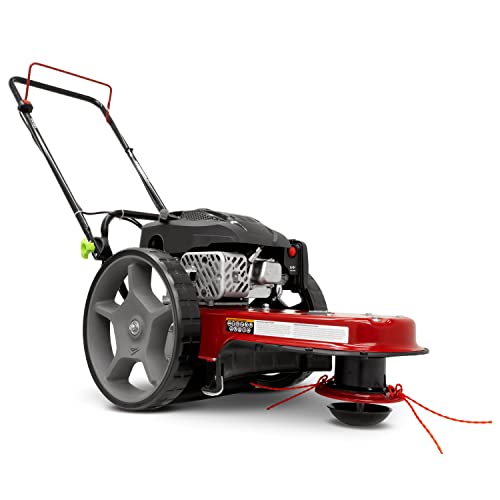
The Powerhorse pairs a 173cc gas engine with a 22-inch offset cutting head, so you clear a wide path in each pass while the rear wheels carry the weight instead of your arms. The recoil-start engine spins to a stated 3000 max RPM, which is the kind of power tall weeds and rough field grass demand.
Reasons to buy
- Dependable Powerhorse 173cc vertical gas engine with recoil start delivers 3000 max. RPM
- Offset head design delivers a 22in.W cutting swath
- Rear wheels offer easy maneuverability and walk-behind control
- Lightweight design is easy to operate
- Not for sale in CA
Reasons to avoid
- The listing notes it is not for sale in California, so buyers there must look elsewhere
- Gas engine means fuel, oil, and pull-start maintenance versus a battery unit
Earthquake Walk Behind String Mower With 160cc Viper 4
The Earthquake runs a 160cc 4-cycle Viper engine with automatic compression release for easier first-pull starts, and its grab-n-go bail lets you pause the head without killing the engine. Extra-wide 2.5 by 14.5 inch never-go-flat wheels float over uneven ground, and the handlebars fold down so it slides into a vehicle or under a bench.
Reasons to buy
- GRAB-N-GO: The handy engagement bail design lets you pause and restart the cutting head on
- EASY TO OPERATE: With extra-wide 2.5” x 14.5” airless wheels that float over any terrain a
- RELIABLE POWER: A 160cc 4-cycle Viper engine starts easily on the first pull thanks to aut
- SIMPLE CUTTING HEAD DESIGN: Load up the cutting head with 0.155 cutting line and easily cl
- LONG & STRONG REACH: The one-piece, extra-long steel deck provides strength and can reach
Reasons to avoid
- A 4-cycle engine needs separate oil checks and adds routine upkeep
- The 22-inch steel deck is heavy to push on steep slopes
20000RPM Electric Weed Wacker Cordless
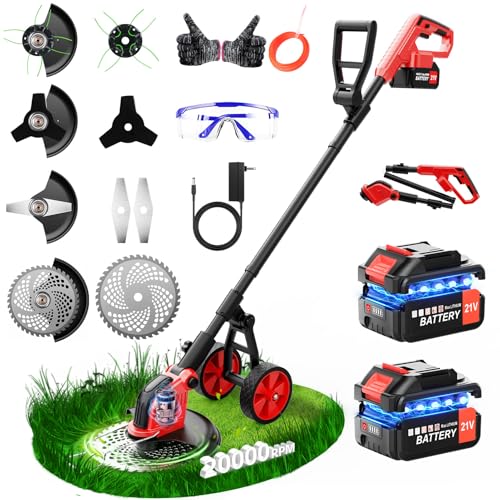
This cordless 4-in-1 uses an 800W brushless motor rated at 20000 RPM and ships with two 21V lithium batteries plus four blade types, so it converts between string trimmer, brush cutter, grass trimmer, and mini mower. A support wheel and auxiliary handle keep the 12-inch cut balanced and quiet compared to gas.
Reasons to buy
- 【2026 Newest Electric Weed Wacker】2026 upgraded 4-in-1 string trimmer/brush cutter/grass t
- 【Powerful Brushless Motor】Cordless weed eater with charger and 2 batteries powered by 800W
- 【2PCS High Capacity Battery】The battery operated weed eater with 2*3000mAh high-capacity 2
- 【12-Inch Cutting Width】This cordless string trimmer with battery and charger features a 12
- 【4-IN-1 Tool】This stringless weed wacker is not only a mini lawn mower but also a heavy du
Reasons to avoid
- Battery runtime is limited versus a gas tank, so large properties may need swaps
- At 12 inches the cutting swath is narrower than the gas walk-behind models

BLACK+DECKER Weed Eater
The BLACK+DECKER combines a 12-inch string trimmer, edger, and a removable wheeled mower deck, with an automatic feed spool and PowerDrive transmission to reduce bogging in dense grass. The convertible deck and adjustable height make it flexible for small yards, slopes, and spots a full mower cannot reach.
Reasons to buy
- Convertible Design: The removable wheeled deck allows quick transformation into a small la
- Ideal for Challenging Spaces: Smaller yards, slopes, and areas that are tough to reach wit
- Continuous Operation: The AFS automatic feed spool keeps your weed wacker running smoothly
- Three-in-One Functionality: Easily switch between push mower, trimmer, and edger to tackle
- Reliable Power Transmission: PowerDrive technology prevents bogging in dense grass and wee
Reasons to avoid
- The 12-inch deck and battery power suit small yards, not open acreage
- Line-based cutting struggles with the heavy brush a gas unit handles

JOOPSAM 19.48" Adjustable Height String Trimmer Support Whee
The JOOPSAM is not a trimmer itself but a 19.48-inch adjustable support wheel that clamps onto a 26mm handle, using 6-inch EVA wheels to carry some of a backpack or handheld trimmer's weight off your shoulders. It is a low-cost way to add walk-behind stability to a trimmer you already own.
Reasons to buy
- Adjustable: String trimmer support wheel attachment overall height of is 19.48" which desi
- Lightweight: Walk behind string trimmer Upgraded 6" wheels made from EVA compared to the h
- Effective force sharing:The auxiliary weed wacker support wheels are designed to share som
- Durable Widely: Sturdy metal trimmer support wheels for accurate edge trimming and quick p
- Easy to install: JOOPSAM’s latest string trimmer auxiliary wheels frame include all access
Reasons to avoid
- It is an accessory attachment, not a standalone wheeled trimmer
- Fit depends on your trimmer having a compatible 26mm shaft
What to look for
Power source: gas versus battery
Gas walk-behind units deliver the most sustained power for tall, tough growth and never need a recharge, but they demand fuel, oil, and pull-start upkeep. Cordless models run quieter and start instantly, yet runtime is capped by the battery, so match the source to how much ground you cover.
Cutting swath width
A 22-inch cutting path clears far more ground per pass than a 12-inch handheld-style deck. If you have acreage, the wider gas decks save real time. For a small yard, a narrower convertible unit is easier to steer.
Wheels and terrain
Large airless or never-go-flat wheels float over ruts, roots, and slopes without the risk of a flat. Smaller wheels on lightweight units work on flat suburban lots but bog down on rough field ground.
Line diameter compatibility
Heavier weeds call for thicker line. Several of these decks accept line in the 0.155-inch range or heavier, which resists snapping when you hit stalks and brush that would shred thin residential line.
Storage and portability
Folding handlebars let a bulky deck slide into a trunk or under a workbench. If garage space is limited, a fold-flat design or a support-wheel accessory that mounts to an existing trimmer can be the practical choice.
Our verdict
For most acreage owners fighting tall grass and heavy weeds, the Powerhorse High-Wheeled Walk-Behind is the pick. Its 173cc gas engine and 22-inch cutting swath let you stay upright and clear rough ground a handheld trimmer cannot touch.
FAQs
A wheeled string trimmer, sometimes called a walk-behind string mower, clears tall grass, heavy weeds, and rough ground that a push mower cannot handle and a handheld trimmer would take hours to tackle. The wheels carry the weight so you stay upright and cover more area.
Gas models like the Powerhorse and Earthquake give sustained power for large or overgrown areas with no recharge downtime. Battery units are quieter, easier to start, and fine for smaller properties, but runtime is limited by the battery capacity.
Wheeled trimmers built for heavy growth often take thicker line, such as the 0.155-inch line noted for the Earthquake. Thicker line resists breaking against woody stalks and brush, though you should always confirm the diameter your specific head accepts.
Yes. A support-wheel attachment like the JOOPSAM clamps to a compatible 26mm handle and carries part of the trimmer's weight, giving you walk-behind stability without buying a whole new machine. Confirm your trimmer's shaft is compatible first.
They cut with heavy string or a cutting head rather than a metal mower blade, so they excel at knocking down tall weeds and rough grass. For a fine, manicured finish on maintained turf, a regular mower still does a cleaner job.