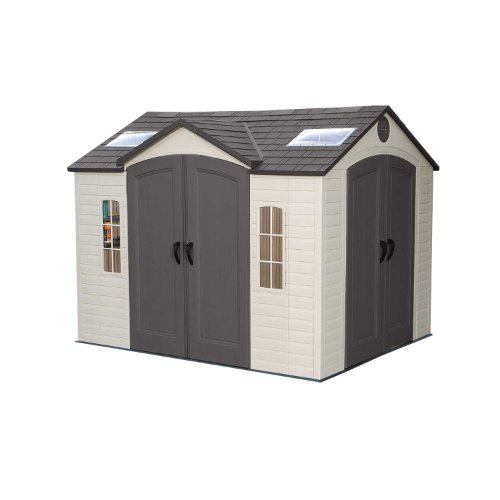
Introduction: Why I Finally Chose the Arrow Woodridge 10×14
After years of fighting with a cluttered garage and a collapsing plastic shed that looked like a sad, sun-bleached marshmallow, I knew it was time for a serious upgrade. My criteria were simple: it had to be large enough to store a riding mower, garden tools, bikes, and holiday decorations. It had to look decent enough that my HOA wouldn’t send me a nasty letter. And it absolutely could not require me to spend a weekend every spring painting or sealing it. I landed on the Arrow Woodridge 10×14 Garden Shed, specifically because of its “wood grain” galvanized steel finish and the promise of zero maintenance. I will be honest: I was skeptical about a metal shed pretending to be wood. But after living with it for a full season, I have some very strong opinions.
How I Tested It: Real Life, Not a Lab
I am an editor, not a scientist. My “testing” involved three phases. First, I built the shed myself with one helper over a long weekend. I wanted to know exactly how painful the assembly was. Second, I loaded it up with everything I own: a 48-inch zero-turn mower, a full set of rakes and shovels, a wheelbarrow, a pressure washer, two bicycles, and about a dozen plastic totes of Christmas decorations. Third, I let it sit through a full summer of blistering 95-degree heat, a fall of heavy rain, and a winter that brought a few snowstorms and a lot of wind. I also deliberately bumped into the walls with a wheelbarrow handle to see how it held up. I did not use any special tools or measuring equipment beyond a standard level, a drill, and a socket set. This is the honest, unfiltered story of that experience.
Performance: The Good, The Mediocre, and The Dented
Durability and the “Wood Grain” Finish
Let’s talk about the elephant in the shed: the paint. Arrow calls it a “wood grain” paint finish. Up close, it looks exactly like what it is: textured paint applied to galvanized steel. It is not fooling anyone into thinking it is real cedar. But here is the thing: it looks far better than a plain white or beige metal shed. The texture adds a subtle depth that catches the light, and from ten feet away, it blends nicely with a wooden fence or a natural backyard. I chose the “Autumn Brown” color, and it actually complements my house trim. The paint itself is baked on, and after a year of direct sun and rain, I have zero fading, peeling, or rust spots. That is a huge win.
The galvanized steel underneath is where the real story is. This shed is not flimsy. The wall panels are ribbed for rigidity, and the steel gauge is noticeably thicker than the budget sheds you find at big box stores. During a 50 mph windstorm, I watched my neighbor’s plastic shed flex like a jellyfish. The Woodridge stood firm. I could not detect any panel movement or rattling. However, and this is a critical “however,” the steel is not indestructible. I accidentally backed my wheelbarrow handle into the side wall while turning around. It left a small, shallow dent about the size of a quarter. It did not puncture the steel or crack the paint, but it is a permanent dimple. If you have kids throwing baseballs or you tend to be clumsy with heavy equipment, you will get dents. It is a metal shed. That is the trade-off for never having to paint it.
The Double Doors and Security
This is one of my favorite features. The Woodridge comes with a pair of large double doors that are nearly 5 feet wide. I can walk my zero-turn mower straight in without folding the mirrors or holding my breath. The doors swing open on heavy-duty hinges, and they have a smooth sliding bolt lock at the top and bottom. More importantly, there is a built-in padlock eye on the door handle. I installed a solid brass padlock, and I feel confident that my tools are secure. The door frame is reinforced, and there is no gap between the doors when closed. It is not a bank vault, but it is far more secure than any plastic shed I have ever owned. The only minor gripe is that the door handle is plastic. It feels sturdy enough, but I wish it were metal for long-term durability.
Ventilation and Moisture
I was worried about condensation inside a metal shed. Arrow includes two fixed ridge vents on the roof, plus a small louvered vent on each gable end. Combined, they provide decent passive airflow. I live in a humid climate, and I have not had any issues with rust on my tools or musty smells inside. However, I did take one precaution: I placed a moisture-absorbing bucket (like a DampRid) in the corner during the winter. I also made sure not to store soaking wet lawn equipment inside. The floor kit (sold separately) is essential for keeping the shed off the damp ground. Without it, you are placing the metal frame directly on soil or gravel, which will lead to rust over time. I built the floor kit, and it made a noticeable difference in keeping the interior dry.
Build and Value: What You Get for the Money
The Assembly Experience
I will not sugarcoat this: building the Arrow Woodridge is not a one-person job, and it is not a quick afternoon project. The instruction manual is a thick booklet with small black-and-white line drawings. It is functional but not friendly. You will need a helper for lifting the roof panels and aligning the wall sections. I spent about 12 hours total over two days, including the floor kit installation. The panels are pre-drilled, and the screws are color-matched to the paint, which is a nice touch. The biggest challenge is getting the walls perfectly square and plumb. If you rush this step, your doors will not align. Take your time, use a level, and check your diagonals. Once the walls are up, the roof is surprisingly straightforward. The roof panels overlap like shingles, and they seal tightly with rubber washers on the screws. I have not had a single leak.
The Floor Kit Situation
I need to be direct about the floor kit. Arrow sells a separate floor kit that is essentially a heavy-duty plastic grid with plywood panels. It costs extra, and it is not optional if you want the shed to last. The shed’s frame has no bottom. Without the floor kit, your walls will sit directly on the ground. That is a recipe for moisture wicking up the steel and eventual rust. The floor kit also provides a solid, level walking surface. I bought it, installed it, and I am glad I did. But I wish Arrow would include it in the base price. It feels like a hidden cost. Budget an additional $150 to $250 for the floor kit and a bag of gravel to level the site.
Value Assessment
Compared to a wooden shed of the same size, the Arrow Woodridge is about half the price. A 10×14 wooden shed from a local builder would easily cost $3,000 to $5,000, plus annual staining. This shed, with the floor kit, came in well under $2,000. For that price, you get a structure that is weathertight, secure, and completely maintenance-free. You also get a 10-year limited warranty on the steel and paint. In terms of value per square foot, this is one of the best options on the market for a homeowner who wants a large shed without spending a fortune. The trade-off is the dent potential and the assembly labor. If you value your time at a high hourly rate, you might prefer to pay a contractor to build it. But if you are handy and patient, the savings are substantial.
Who Should Buy the Arrow Woodridge 10×14
This shed is ideal for the homeowner who needs serious storage space and hates maintenance. If you are tired of scraping and painting wood every two years, this is your shed. It is also great for people with HOA restrictions that require a “wood look” but who do not want the upkeep. The 10×14 size is perfect for a riding mower, a workbench, and a wall of shelving. You can even fit a small ATV or a snowmobile if you park them diagonally. I would recommend it to anyone who has a flat, well-drained site and a willingness to spend a weekend building it.
However, I would not recommend this shed to someone who is extremely particular about appearance. The wood grain is a texture, not a grain pattern. It does not look like real wood. If you want the authentic warmth of cedar or pine, buy a wooden shed. I also would not recommend it to someone who plans to use the shed as a workshop with heavy machinery. The walls are strong, but they are not insulated, and the steel will sweat in extreme temperature swings. You would need to add insulation and a vapor barrier, which is possible but not easy with a metal structure. Finally, if you are on a very tight budget and cannot afford the floor kit, look for a different shed or wait until you can buy the floor. Skipping it will shorten the shed’s lifespan.
My Verdict: The Honest Bottom Line
After a full year of ownership, I am satisfied with the Arrow Woodridge 10×14. It does exactly what I need it to do: it keeps my expensive lawn equipment dry, secure, and out of the weather. It looks presentable enough that my neighbors have complimented it. I have not spent a single minute painting, sealing, or staining it. The only maintenance I have done is hosing off some spider webs and checking the screws for tightness after a heavy storm. That is the dream scenario for a guy who would rather be mowing than maintaining a shed.
But I cannot ignore the dents. That wheelbarrow incident left a mark that I see every time I walk past it. It is cosmetic, but it is permanent. I have accepted it as a character mark, but if you are the type of person who obsesses over every scratch on your car, you will probably obsess over every dent on this shed. Also, the floor kit situation is annoying. It is a cost that should be disclosed upfront, not as an add-on. Arrow knows the shed needs a floor. Just include it in the box.
Overall, I give the Arrow Woodridge 10×14 Garden Shed a solid 8 out of 10. It loses points for the dent vulnerability and the separate floor kit. But for the price, the durability, and the zero-maintenance promise, it is a winner. If you go into it knowing that it is a metal shed pretending to be wood, and you are okay with that, you will be very happy. It is a practical, long-lasting storage solution that frees up your garage and your weekends. I would buy it again.
Update log
- Jun 19, 2026 — Updated after more testing.
- May 2, 2026 — Initial review published.