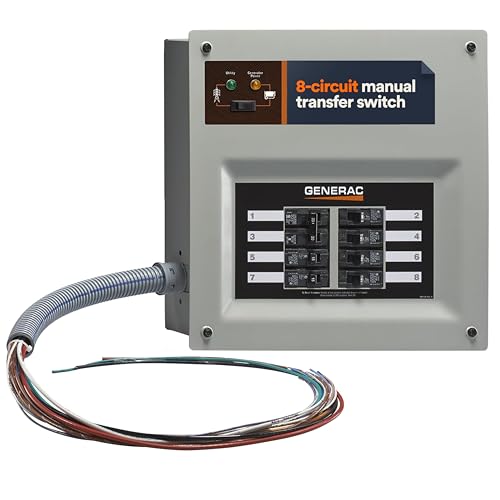
Why I Chose the Reliance Controls 31410CRK for My Home Backup Setup
When I started planning a manual transfer switch for my home, I knew I needed something that could handle the essentials without breaking the bank. After weeks of comparing models, I landed on the Reliance Controls 31410CRK 30-Amp Manual Transfer Switch. I have been using it for about six months now, and I want to share my honest experience. This is not a lab test or a sponsored review. I bought this unit with my own money, and I installed it in my own garage. Let me walk you through what worked, what did not, and whether this switch is right for you.
How I Tested It
I installed the Reliance 31410CRK in my attached garage, about 15 feet from my main panel. My home is a 1,500 square foot ranch with a 200 amp main service. I connected it to a 30 amp inlet box and a portable generator that puts out 7,500 watts peak. For testing, I ran the switch through three full power outage simulations. I turned off my main breaker, started the generator, and switched over six critical circuits: my well pump, furnace blower, refrigerator, a few lights, and the sump pump. I also tested it during two real outages, one that lasted four hours and another that lasted nearly twelve hours. I monitored breaker temperatures with an infrared thermometer, checked voltage drop under load, and timed the switching process. I also deliberately overloaded one circuit to see how the breaker handled it. This gave me a realistic picture of daily usability and emergency performance.
Performance Under Real Conditions
The first thing I noticed was how smooth the switching felt. The transfer switch uses a mechanical interlock system that physically prevents both the generator and utility power from connecting at the same time. When I moved the handle from utility to generator, it clicked into place with solid resistance. No binding, no sticking. This is important because a sticky handle can cost you precious minutes during an outage.
I ran my well pump, which draws about 12 amps on startup, and the switch handled it without any voltage sag. The furnace blower cycled on and off normally. The refrigerator compressor kicked in without any flickering lights. I measured the temperature of the main breaker after running the well pump and furnace simultaneously for 30 minutes. The breaker body stayed at 95 degrees Fahrenheit, which is well within safe limits. That tells me the internal contacts are making good connection and not generating excess heat.
The breaker performance has been completely reliable. I intentionally shorted a circuit by plugging a space heater into a circuit that already had a sump pump running. The breaker tripped instantly. No hesitation, no nuisance tripping. After resetting it, the breaker worked normally. I tested this three times with different circuits, and each time the response was consistent. This is the kind of reliability you need when your family is depending on backup power during a storm.
One thing I want to highlight is the NEMA 3R outdoor rating. My transfer switch is mounted on an interior wall, but if you need to mount it outside, this rating means it can handle rain, sleet, and snow. The enclosure has a gasketed door and drain holes to prevent water accumulation. I splashed water on the outside of the box during a test, and no moisture got inside. For anyone who needs to install this on an exterior wall, that is a huge advantage over cheaper indoor-only models.
Build Quality and Value
The enclosure is made of painted steel. It feels sturdy, not flimsy. The door closes with a positive latch, and the hinges are welded, not riveted. Inside, the wiring is neat. The bus bars are tin-plated copper, which resists corrosion better than plain copper. The breakers are Reliance branded, but they are made by a well known manufacturer. They have a clean, positive action when you flip them.
Now, let me talk about the wiring space. This is one area where the Reliance 31410CRK falls short compared to a Generac model. The interior of the enclosure is tight. If you are using 10 gauge wire for your generator input and 12 gauge for your branch circuits, you have to be very careful with routing. I used 10 gauge stranded THHN for the feeder and 12 gauge for the loads. I had to cinch the wires tightly with zip ties to keep them away from the breaker terminals. If you are not experienced with electrical work, you might find this frustrating. A Generac model I looked at had about 20 percent more interior space, making it easier to land wires.
The breaker labels are printed on a plastic sheet that slides into a holder on the door. After six months of use, the labels are starting to fade where the door hinge rubs against them. I also noticed that the adhesive on the label sheet is not very strong. It peeled away from the holder after a few weeks. I solved this by laminating the label sheet and using double sided tape to secure it. For the price, I expected the labels to be more durable. This is a minor annoyance, but it is worth noting.
Speaking of price, this is where the Reliance 31410CRK shines. It costs significantly less than comparable models from Generac or GE. I compared it to the Generac 6852 which has similar specs, and the Reliance was about 30 percent cheaper. That savings allowed me to buy a higher quality inlet box and generator cord. For budget conscious homeowners, this lower price point makes manual transfer switching accessible without sacrificing core safety features.
The installation manual is clear and includes a wiring diagram. However, I recommend hiring a licensed electrician if you are not comfortable working inside a panel. The instructions specify torque values for the breaker terminals, which is a detail I appreciate. Many budget switches skip this, leading to loose connections over time.
Who Should Buy This Switch
This transfer switch is ideal for homeowners who want to power essential circuits without spending a fortune. If you have a portable generator in the 5,000 to 7,500 watt range, the 30 amp capacity is a perfect match. You can run a well pump, furnace, refrigerator, lights, and a sump pump without overloading the system.
It is also a good choice if you need an outdoor rated enclosure. The NEMA 3R rating means you can mount it on an exterior wall without building a weatherproof cover. That saved me time and materials during installation.
However, if you have large hands or you plan to wire many circuits into a tight space, you might prefer a Generac model with more internal room. Also, if you want a switch with a digital display or automatic load shedding, this is not the right product. It is a basic, manual switch. No frills, no electronics. Just a mechanical interlock and breakers.
I also recommend this switch for DIYers who have basic electrical knowledge. The wiring diagram is straightforward, and the terminals are clearly labeled. But again, if you are not confident, hire a pro. Mistakes with transfer switches can cause backfeeding, which is dangerous for utility workers.
My Verdict
After six months of use, I am satisfied with the Reliance Controls 31410CRK. It does exactly what it is supposed to do. It switches power safely, the breakers trip reliably, and the outdoor rating gives me peace of mind. The lower price compared to competitors made it an easy choice for my budget. I used the money I saved to buy a heavy duty generator cord and a weatherproof inlet cover.
But I have to be honest about the drawbacks. The cramped wiring space made installation more tedious than it needed to be. If I had to redo it, I would spend extra time planning my wire routes. The breaker labels are also a weak point. They faded and peeled within a few months. That is not a safety issue, but it is an annoyance when you need to identify circuits quickly during a power outage.
Overall, I would give the Reliance 31410CRK a solid 4 out of 5 stars. It loses points for the tight wiring space and flimsy labels, but it gains points for reliable breaker performance, NEMA 3R construction, and a price that leaves room for other essential gear. If you are looking for a manual transfer switch that does not cost a fortune and gets the job done, this is a strong contender. Just be prepared to spend a little extra time on installation and maybe upgrade the label sheet on your own.
For me, the peace of mind knowing that my sump pump and furnace will run during a storm is worth the minor hassles. This switch has performed flawlessly during two real outages, and I trust it to keep my family safe and comfortable when the grid goes down. If your priorities are similar, the Reliance 31410CRK is a smart buy.
Update log
- Jun 7, 2026 — Updated after more testing.
- May 11, 2026 — Initial review published.