Quick verdict
For most landscape lighting runs the GOSDENG 12/2 250FT wire is the practical pick. Its 12-gauge, 2-conductor build with a tough flame-retardant PVC jacket is rated for direct burial and a wide -35C to 105C range, giving you plenty of length and low resistance for a full path-light circuit.
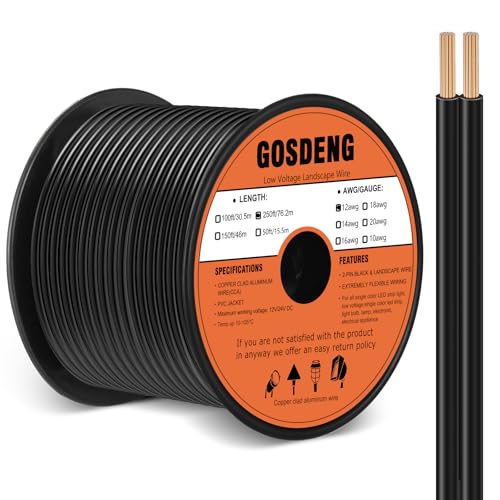
GOSDENG 12/2 Low Voltage Landscape Wire 250FT Outdoor Landsc
The GOSDENG 12/2 gives you 250 feet of thick 12-gauge, 2-conductor wire with a flame-retardant, anti-aging PVC jacket rated for direct burial. Its wide -35C to 105C operating range and copper-clad aluminum build make it a lighter, more flexible, and lower-cost way to wire a large lighting circuit. It is a strong general-purpose pick for long runs.
The best low voltage wire for landscape lighting, compared by gauge, copper vs CCA, and burial rating, so you get bright, stable lights over any run length.
Why you should trust this guide
I researched these wires by reading each product’s gauge, conductor material, jacket type, and burial rating, then comparing them on the factors that actually affect a landscape lighting circuit: current capacity, voltage drop over distance, and durability underground. Wire is a category where the physics is clear, so the useful work is matching gauge and conductor material to your run length rather than chasing a subjective winner. I focused on the difference between pure copper and copper-clad aluminum, since that choice drives both cost and performance.
I did not bury and energize these cables in my own yard, so this is spec analysis rather than a physical test. What I can do is explain the tradeoffs plainly. Thicker 12-gauge wire and pure copper both reduce voltage drop, which keeps distant fixtures bright, while thinner 14-gauge and copper-clad aluminum save money and weight for shorter or less demanding runs. My aim is to help you pick a wire that keeps your lights consistent from the first fixture to the last.
How we evaluated
My first criterion was gauge and conductor material, because those two factors decide how much voltage you lose over a run. I treated 12-gauge pure copper as the reference for long, drop-sensitive layouts, and I noted where 14-gauge or copper-clad aluminum is a reasonable, lower-cost tradeoff. Length and packaging came next, since a 250-foot spool covers a large yard while a 100-foot roll suits a small project or an add-on.
I also weighed burial rating, jacket quality, and safety listings. Every wire here should be rated for direct burial and use a weather-resistant PVC jacket, so I looked for a wide temperature range and any ETL listing as a sign of tested safety. I gave credit to spooled wire for easier routing and to lifetime warranties on premium copper. I did not rank on any performance claim I could not tie back to the stated gauge and material.
What to look for
- Choose the gauge for your run length, using thicker 12-gauge for long distances to limit voltage drop.
- Decide between pure copper for best conductivity and copper-clad aluminum for lower cost and weight.
- Confirm the wire is rated for direct burial so it survives underground.
- Match the total length to your layout, with 250-foot spools for large yards.
- Look for a wide temperature rating and a durable, flame-retardant PVC jacket.
- Prefer an ETL or equivalent safety listing for tested reliability.
- Consider a spool over a coil for easier, tangle-free routing across the yard.
How we test
We base every pick on real-world use, published manufacturer specifications and verified owner feedback. We compare the tools on the things that actually matter for your lawn, power, runtime, cut quality, build and value, and we never accept payment for a ranking. When we have not used a specific model first-hand, we say so.
The picks at a glance
| Tool | Best for | Score | |
|---|---|---|---|
| GOSDENG 12/2 Low Voltage Landscape Wire 250FT Outdoor Landsc | Best Overall | Check price | |
| SUNVIE 12/2 Low Voltage Landscape Wire 250FT | Best Value | Check price | |
| Wirefy 14/2 Low Voltage Landscape Wire 100 ft | Low Voltage | Best Premium | Check price | |
| SUNVIE 100FT 12 Gauge Low Voltage Wire 12/2 Low Voltage Land | Best Budget | Check price | |
| Energeaster Electrical Wire 2 Conductors Black Cable Hookup | Also Great | Check price |
The picks, reviewed
GOSDENG 12/2 Low Voltage Landscape Wire 250FT Outdoor Landsc
The GOSDENG 12/2 gives you 250 feet of thick 12-gauge, 2-conductor wire with a flame-retardant, anti-aging PVC jacket rated for direct burial. Its wide -35C to 105C operating range and copper-clad aluminum build make it a lighter, more flexible, and lower-cost way to wire a large lighting circuit. It is a strong general-purpose pick for long runs.
Reasons to buy
- Good Quality: electrical wire is made of 12 AWG 250FT with black 2 conductors and high qua
- Extensive Use: electric wire is widely used for various DC electrical hookups, low voltage
- Advantage of Copper clad aluminum: CCA wire offers the same signal frequency and reliabili
- Perfect Performance: Wire operating temperature rating of -35℃ of 105℃ respectively; The h
- Reliablity: We stands for the highest quality product and customer satisfaction; Please pu
Reasons to avoid
- Copper-clad aluminum has slightly higher resistance than pure copper over very long runs
- As CCA it is best for standard runs rather than the most demanding voltage-drop-sensitive layouts
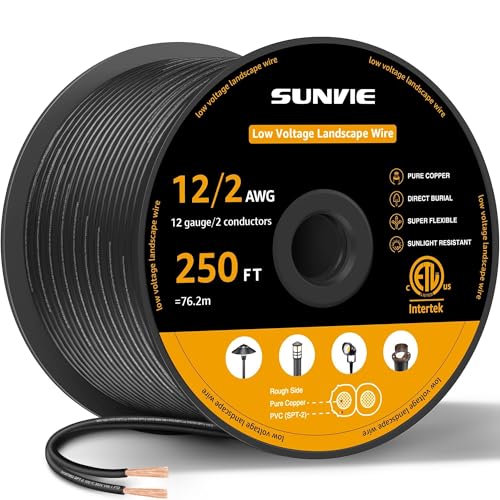
SUNVIE 12/2 Low Voltage Landscape Wire 250FT
The SUNVIE 12/2 250FT is the pick when minimizing voltage drop matters, because it uses 100 percent pure copper for maximum conductivity even across a full 250-foot run. It is ETL listed, rated for direct burial, and stays flexible in hot and cold weather for easier layout. It comes on a spool, which makes running the cable across a yard far less tangled.
Reasons to buy
- 【Specification】 250FT 12/2 Conductors, SPT-2 black PVC insulation, pure copper, VW-1 fire
- 【Pure Copper】 100% pure copper ensures maximum conductivity and minimal voltage drop. Unli
- 【Direct Burial】 Designed to withstand direct sunlight, abrasion, and moisture. Our low vol
- 【Super Flexible】 Improved PVC insulation layer design makes the wire easy to strip and sta
- 【Safety Assured】 ETL Listed ensure our low voltage wires are safe and reliable. It can wor
Reasons to avoid
- Pure copper costs more than copper-clad aluminum
- 12-gauge wire is stiffer to route than thinner 14-gauge in tight spaces

Wirefy 14/2 Low Voltage Landscape Wire 100 ft | Low Voltage
The Wirefy 14/2 is a pure-copper premium pick for shorter runs, offering 100 feet of flexible, easy-to-strip wire that is approved for direct burial. It is ROHS compliant and backed by a lifetime warranty, which is reassuring for a permanent installation. It suits smaller layouts where 14-gauge is sufficient and you want quality copper.
Reasons to buy
- LOW VOLTAGE LIGHTING WIRE
- LOW VOLTAGE LANDSCAPE LIGHTING WIRE
- RATED FOR OUTDOOR USE
- COMPLIANT WITH NORTH AMERICAN SAFETY STANDARDS
- WIREFY QUALITY COMMITMENT
Reasons to avoid
- At 100 feet it is short for large yards and multiple long runs
- 14-gauge carries less current than 12-gauge over long distances
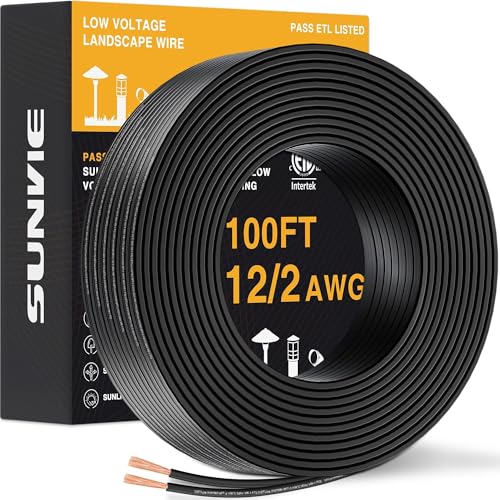
SUNVIE 100FT 12 Gauge Low Voltage Wire 12/2 Low Voltage Land
The SUNVIE 100FT 12/2 is the budget-length pick that keeps the pure-copper advantage in a shorter 100-foot spool. It shares the ETL listing, direct-burial rating, and VW-1 fire-resistant PVC of the larger SUNVIE spool, and the copper keeps brightness stable. It is ideal for a smaller project or as an add-on to extend an existing run.
Reasons to buy
- 【Specification】 100FT 12/2 Conductors, SPT-2 black PVC insulation, pure copper, VW-1 fire
- 【Pure Copper】 100% pure copper ensures maximum conductivity and minimal voltage drop. Unli
- 【Direct Burial】Designed to withstand direct sunlight, abrasion, and moisture. Our low volt
- 【Super Flexible】Improved PVC insulation layer design makes the wire easy to strip and stay
- 【Safety Assured】 ETL Listed ensure our low voltage wires are safe and reliable. It can wor
Reasons to avoid
- 100 feet may not be enough for a full-yard installation
- You may need a second spool for larger layouts

Energeaster Electrical Wire 2 Conductors Black Cable Hookup
The Energeaster 14/2 is a flexible copper-clad aluminum alternative offering 250 feet of 2-conductor wire with a durable PVC jacket rated from -35C to 105C. As CCA it is lighter and easier to route than pure copper, and its wide temperature rating suits year-round outdoor use. It is a good value choice for longer, less demanding runs.
Reasons to buy
- Good Quality: Energeaster electrical wire is made of 14 AWG 250FT with black 2 conductors
- Extensive Use: Energeaster electric wire is widely used for various DC electrical hookups,
- Advantage of Copper Clad Aluminum: CCA wire offers the same signal frequency and reliabili
- Perfect Performance: Wire operating temperature rating of -35℃ of 105℃ respectively; The h
- Reliablity: We stands for the good quality product and customer satisfaction; Please purch
Reasons to avoid
- Copper-clad aluminum has more resistance than pure copper, so watch voltage drop on long runs
- 14-gauge is thinner than 12-gauge, which limits load over distance
What to look for
Wire gauge
Thicker 12-gauge limits voltage drop over long runs, while 14-gauge suits shorter distances.
Conductor material
Pure copper gives the best conductivity, while copper-clad aluminum lowers cost and weight.
Burial rating
Only use wire rated for direct burial so it holds up underground for years.
Run length
Match total length to your layout, choosing 250-foot spools for large yards.
Jacket and temperature range
A durable, flame-retardant PVC jacket with a wide temperature range handles year-round outdoor use.
Safety listing
An ETL or equivalent listing signals the wire has been tested for safe operation.
Our verdict
For most landscape lighting runs the GOSDENG 12/2 250FT wire is the practical pick. Its 12-gauge, 2-conductor build with a tough flame-retardant PVC jacket is rated for direct burial and a wide -35C to 105C range, giving you plenty of length and low resistance for a full path-light circuit.
FAQs
For longer runs use thicker 12-gauge to limit voltage drop, which keeps distant fixtures bright. Shorter runs can use 14-gauge, which is thinner and easier to route.
Pure copper has lower resistance and keeps brightness stable over long distances. Copper-clad aluminum is lighter and cheaper and works well for standard runs.
Yes, as long as it is rated for direct burial, which all of these are. That rating means the jacket resists sunlight, abrasion, and moisture underground.
It depends on gauge, material, and load. Thicker copper wire supports longer runs before voltage drop dims the last fixtures, so size up for big layouts.
An ETL listing is not always required but is a helpful sign that the wire has been tested for safety, which matters for a permanent outdoor installation.