Quick verdict
The SUNVIE 300W Low Voltage Landscape Transformer is the pick for most larger setups. It offers two independently controlled zones, five timing modes including dusk-to-dawn, a removable photocell on a 6.8-foot cord, and built-in circuit protection with a memory function, which covers almost any real landscape lighting layout.
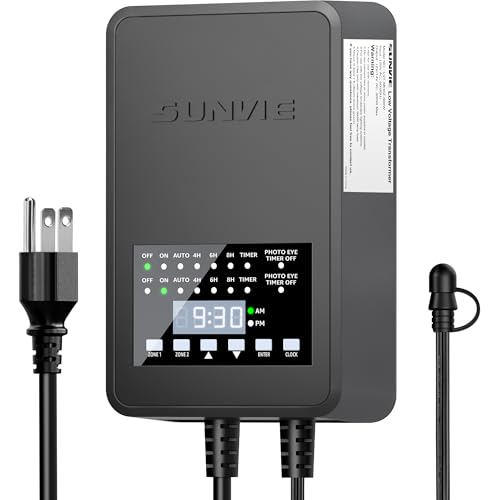
SUNVIE 300W Low Voltage Landscape Transformer
The SUNVIE 300W is the most capable pick here, with two independently controlled output zones so you can run different schedules on different parts of your yard. It offers five modes including auto dusk-to-dawn, countdown, and timer, plus a removable photocell on a 6.8-foot cord that lets you mount the transformer indoors. Built-in circuit protection and a memory function add real reliability.
The best landscape lighting transformer picks, compared by wattage, timer modes, and photocell control, from 60W budget units to 300W two-zone models.
Why you should trust this guide
I researched these transformers by reading each unit’s wattage rating, control modes, photocell design, and safety features, then comparing them on what actually determines whether a transformer fits your yard: total capacity, how you want your lights to switch on and off, and how the unit protects itself and your fixtures. Sizing is the heart of this category, so I paid close attention to the wattage of each model and the standard guidance to stay under 80 percent of the rated load.
I did not wire these into a live lighting system myself, so this is spec and feature analysis rather than a physical installation test. What I can do is translate the feature lists into plain choices, such as when a two-zone 300W unit earns its extra capacity, when a 60W or 100W unit is the smarter and cheaper fit, and which models support halogen versus LED only. That way you buy the right size the first time.
How we evaluated
My first evaluation criterion was capacity, since a transformer that is too small forces the whole system to run near its limit, and a transformer that is too large is money spent on unused headroom. I compared wattage ratings directly and factored in the common rule of loading a transformer to no more than 80 percent. From there I looked at control modes, because dusk-to-dawn sensing, countdown timers, and true clock timers each suit different routines.
I also weighed photocell design, memory function, and circuit protection. A removable photocell on a long cord lets you mount the transformer indoors while sensing light outside, which is a genuine convenience, and a memory function that survives a power loss saves you from resetting schedules. I gave credit to units that clearly state whether they support LED only or halogen too, and I did not rank on any claim I could not tie to the stated specs.
What to look for
- Size the wattage to your fixtures and keep total load under about 80 percent of the rating.
- Check the control modes you need, such as dusk-to-dawn, countdown, or a set-time timer.
- Confirm whether the unit supports LED only or LED plus halogen fixtures.
- Look for a removable photocell on a long cord if you want to mount the transformer indoors.
- Prefer a memory function so your schedule survives a power outage.
- Verify built-in circuit protection to guard the transformer and your fixtures.
- Consider multiple zones if you want different schedules for different areas of the yard.
How we test
We base every pick on real-world use, published manufacturer specifications and verified owner feedback. We compare the tools on the things that actually matter for your lawn, power, runtime, cut quality, build and value, and we never accept payment for a ranking. When we have not used a specific model first-hand, we say so.
The picks at a glance
| Tool | Best for | Score | |
|---|---|---|---|
| SUNVIE 300W Low Voltage Landscape Transformer | Best Overall | Check price | |
| DEWENWILS 120W Low Voltage Landscape Transformer | Best Value | Check price | |
| SUNVIE 100W Low Voltage Landscape Transformer Weatherproof L | Best Premium | Check price | |
| DEWENWILS 60W 120V AC to 12V DC Outdoor Low Voltage Transfor | Best Budget | Check price | |
| WILAWELS 300W Low Voltage Landscape Transformer | Also Great | Check price |
The picks, reviewed
SUNVIE 300W Low Voltage Landscape Transformer
The SUNVIE 300W is the most capable pick here, with two independently controlled output zones so you can run different schedules on different parts of your yard. It offers five modes including auto dusk-to-dawn, countdown, and timer, plus a removable photocell on a 6.8-foot cord that lets you mount the transformer indoors. Built-in circuit protection and a memory function add real reliability.
Reasons to buy
- LOW VOLTAGE TRANSFORMER WITH EXTERNAL PHOTOCELL SENSOR
- 2 ZONES INDIVIDUALLY CONTROLLED
- 5 SETTING MODES
- CIRCUIT PROTECTION & MEMORY FUNCTION
- WEATHERPROOF & DURABLE
Reasons to avoid
- Remember to keep total load under 80 percent of the rated power across both zones
- 300W is more capacity than a small path-light run needs

DEWENWILS 120W Low Voltage Landscape Transformer
The DEWENWILS 120W is a sensible mid-size value with a built-in dusk-to-dawn sensor and a 1-to-9-hour countdown timer. It converts 120V to 12V, mounts directly to an outdoor wall, and keeps its setting through a power loss thanks to the memory function. It is a good match for a moderate LED lighting layout.
Reasons to buy
- [Built-in Dusk to Dawn Sensor] Landscape lighting that is connected to this transformer wi
- [Countdown Timer] Light control timing has 1-9-hour countdown. With this option, the trans
- [Easy to Operate and Install] To select Always On, Auto, or Countdown Timing mode, press u
- [Memory Function] You won't need to alter the low voltage transformer too often because it
- [Durable and Waterproof] High performance metal material, corrosion resistant, withstands
Reasons to avoid
- The maker warns against using it with a dimmer switch
- At 120W it is not ideal for a large, expanding system

SUNVIE 100W Low Voltage Landscape Transformer Weatherproof L
The SUNVIE 100W is the pick for smaller LED-only setups, converting 120V to 12V DC for spotlights, path lights, and step lights. It includes an external photocell on a replaceable 6.8-foot cord, a countdown timer with memory, and a built-in automatic circuit breaker. It is a clean, well-featured choice when you do not need 300W of headroom.
Reasons to buy
- 120V AC TO 12V DC TRANSFORMER
- DUSK TO DAWN
- COUNTDOWN TIMER & MEMORY FUNCTION
- CIRCUIT PROTECTION
- WEATHERPROOF & WARRANTY
Reasons to avoid
- This model is not intended for halogen fixtures, only LED
- 100W limits how many fixtures you can add later

DEWENWILS 60W 120V AC to 12V DC Outdoor Low Voltage Transfor
The DEWENWILS 60W is the budget pick for a modest run of a few LED fixtures. It has a dusk-to-dawn sensor, a 2/4/6/8-hour countdown, a memory function, and an automatic circuit breaker for overload and short-circuit protection. It is ETL listed and mounts directly to an outdoor wall, making it an easy entry point.
Reasons to buy
- [Dusk to Dawn Sensor] Connected to this dusk till dawn transformer, the landscape lighting
- [Countdown Timer & Memory Function] Press the select button to set the 2/4/6/8 hour countd
- [Easy Installation & Weatherproof] Built-in hanging hole, 3.3ft power cable, mount it on o
- [Automatic Circuit Breaker] This low voltage transformer equipped with an automatic circui
- [Wide Application] Compatible with all low-voltage LED landscape lights, spotlights, garde
Reasons to avoid
- 60W is only enough for a small number of fixtures
- Not intended for halogen lighting

WILAWELS 300W Low Voltage Landscape Transformer
The WILAWELS 300W is a strong alternative to the top pick, with six modes including a test mode and support for both LED and halogen fixtures. It is ETL certified, uses a detachable dusk-to-dawn photocell, and includes circuit protection with a memory function. It is a good choice if you want high capacity plus halogen compatibility.
Reasons to buy
- Low-Voltage Transformer with Photocell Sensor: ETL-certified 300W low-voltage transformer
- Dusk-to-Dawn Photocell Sensor: With a detachable photocell sensor, the outdoor landscape t
- Six Setting Modes: The landscape transformer offers six modes: manual on/off (always on/of
- Circuit Protection and Memory Function: Our low-voltage transformer comes with built-in ci
- Built to Last in All Conditions: Constructed from premium materials, this low-voltage land
Reasons to avoid
- The sensor cord is rated for outdoor installation only
- Like any 300W unit, it is overkill for a very small setup
What to look for
Wattage capacity
Size the transformer to your fixtures and stay under about 80 percent of its rated load.
Control modes
Dusk-to-dawn, countdown, and set-time timers each suit different lighting routines.
Bulb compatibility
Confirm whether the unit is LED-only or also supports halogen fixtures.
Photocell design
A removable photocell on a long cord lets you mount the transformer indoors.
Memory function
A memory feature keeps your schedule set after a power outage.
Circuit protection
Built-in overload and short-circuit protection safeguards the transformer and fixtures.
Our verdict
The SUNVIE 300W Low Voltage Landscape Transformer is the pick for most larger setups. It offers two independently controlled zones, five timing modes including dusk-to-dawn, a removable photocell on a 6.8-foot cord, and built-in circuit protection with a memory function, which covers almost any real landscape lighting layout.
FAQs
Add up the wattage of all your fixtures, then pick a transformer rated higher, keeping total load under about 80 percent of the rating for safe, stable operation.
It uses a photocell to turn your lights on automatically when it gets dark and off again at dawn, so you never have to switch them manually.
Some models support both, but several are LED-only. Check the listing, since the SUNVIE 100W and 300W DC models are for LED, while the WILAWELS 300W supports halogen too.
It saves your selected mode and schedule so that after a power outage the transformer resumes the same settings instead of resetting.
Two zones let you run different schedules for different areas, such as keeping path lights on all evening while accent lights run only a few hours.