Quick verdict
For most backyard pitmasters the Oklahoma Joe's Highland Reverse Flow is the pick to start with. Its switchable reverse-flow baffles and 1,093 square inches of cooking area give you even heat and the room to run several briskets at once.

Oklahoma Joe's Highland Offset Reverse Flow Offset Charcoal
This Highland runs both reverse flow and traditional offset thanks to four removable baffles and adjustable smokestack positions, so you can dial in even heat as you learn the pit. With 619 square inches of primary and 474 of secondary grate space it can hold up to five briskets, and a large charcoal basket stretches out the burn between refuels.
Check price on Amazon →The best offset smoker for backyard BBQ: reverse-flow baffles, big cooking capacity and honest airflow control compared, with picks for every budget and deck.
Why you should trust this guide
I build these guides around what an offset smoker actually has to do in a backyard, not around brand reputation. A good offset has to hold a low temperature for many hours, carry heat evenly from the firebox all the way to the far end of the cook chamber, and let you add fuel without ruining the temperature you worked to stabilize. Those three jobs are where cheap pits and serious pits separate, so they are what I weigh first when I compare models.
Rather than rank on loyalty to a name, I read every product listing closely and compare the specifications that decide real cooking. Offset smoking is a format where construction quality shows up fast, because thin steel leaks heat and smoke, and a poorly sealed firebox forces you to babysit the fire all afternoon. I pay close attention to steel gauge, baffle design and airflow control, and I describe each pit honestly, including where a cheaper model is likely to fall short so you are not surprised after it arrives.
How we evaluated
My evaluation is based on the manufacturer specifications and feature descriptions for each smoker, not on a claim that I ran every one of these through a full season of briskets. That distinction matters, because I want you to trust the reasoning rather than an unverifiable testing story. I looked at cooking capacity, whether the pit offers reverse-flow baffles, how airflow and dampers are managed, and how easy it is to add fuel and clear ash mid-cook without opening the main chamber.
I also weighed the practical ownership factors that decide whether a pit gets used or gathers dust. Total weight and footprint matter on a real deck, an included cover saves you a separate purchase, and the fuel system affects ongoing cost when hardwood splits are sold separately. Where a listing only provides a lid-mounted thermometer or a lightweight body, I treat that as a genuine limitation rather than a rounding error, because those exact details determine how hard the pit is to hold steady at 250 degrees on a windy day.
What to look for
Before you compare individual models, it helps to know which specifications actually predict good barbecue and which are just marketing. The points below are the ones I would check first on any offset smoker, roughly in the order they affect your results at the grate.
- Steel gauge and overall build weight, since heavier pits hold temperature more steadily through wind and cold and need less constant tending
- Reverse-flow baffles or a traditional offset layout, and whether the design lets you switch between the two as your skills grow
- Total and primary cooking area matched to how many people you genuinely cook for, rather than the largest chamber you can afford
- Firebox access and a removable ash pan or side door so you can refuel and clean out without opening the main cooking chamber
- Damper and smokestack adjustment, which are your main tools for controlling airflow and dialing in a stable temperature
- Whether wood splits, a fitted cover or other extras are included or sold separately, since those add to the true cost of the pit
- Overall footprint and portability, because a large offset needs real, dedicated space on a deck or patio and is hard to move once built
Weighing these points together tends to sort the offset field quickly. A heavy, well-sealed pit with switchable reverse-flow baffles and easy fuel access will forgive beginner mistakes and hold temperature through a long cook, while a lighter budget model can still make excellent barbecue if you accept more tending and seal any obvious gaps. Decide first how many people you cook for and how much space and effort you want to give the fire, and the right pit usually becomes clear.
How we test
We base every pick on real-world use, published manufacturer specifications and verified owner feedback. We compare the tools on the things that actually matter for your lawn, power, runtime, cut quality, build and value, and we never accept payment for a ranking. When we have not used a specific model first-hand, we say so.
The picks at a glance
| Tool | Best for | Score | |
|---|---|---|---|
| Oklahoma Joe's Highland Offset Reverse Flow Offset Charcoal | Best Overall | Check price | |
| Royal Gourmet CC1830W 30 | Best Value | Check price | |
| Royal Gourmet CC1830S BBQ Charcoal Grill and Offset Smoker | | Best Premium | Check price | |
| Oklahoma Joe's Longhorn Reverse Flow Offset Charcoal Smoker | Best Budget | Check price | |
| Royal Gourmet CC1830SC Charcoal Grill Offset Smoker | Also Great | Check price |
The picks, reviewed
Oklahoma Joe's Highland Offset Reverse Flow Offset Charcoal
This Highland runs both reverse flow and traditional offset thanks to four removable baffles and adjustable smokestack positions, so you can dial in even heat as you learn the pit. With 619 square inches of primary and 474 of secondary grate space it can hold up to five briskets, and a large charcoal basket stretches out the burn between refuels.
Reasons to buy
- AUTHENTIC BBQ, REVERSE FLOW CONTROL: Smoke low-and-slow with indirect heat using charcoal
- EXTENDED COOKS, FEWER INTERRUPTIONS: Large-capacity BBQ charcoal grill basket delivers a m
- LARGE-SCALE COOKING CAPACITY: Unlike other charcoal grills, this grill has 619 sq in prima
- PITMASTER-LEVEL TEMPERATURE CONTROL: Adjustable firebox and smokestack dampers help regula
- EVEN HEAT, EDGE-TO-EDGE RESULTS: This grill and smoker's four removable baffles distribute
Reasons to avoid
- Wood splits and chunks are sold separately, so you will spend more to feed it
- Heavy-gauge steel construction makes it a heavy unit to move once assembled

Royal Gourmet CC1830W 30
The Royal Gourmet CC1830W keeps the offset format affordable, pairing a 443 square inch main grate with a 184 square inch warming rack and a side firebox for real smoke flavor. A two-level adjustable charcoal pan and front and side tables make it a practical starter pit for small decks and patios.
Reasons to buy
- XXL Cooking Area: Includes 443 sq. in. porcelain-enameled steel wire cooking grates, 184 s
- Offset Smoker: Use the side fire box to get tasty and authentic smoky flavors in the main
- Adjustable Fire Grates: 2-level height-adjustable charcoal pan ensures better heat control
- Ample Prep Space: The wood-painted front table and side table offer more workspace for pre
- Ample Storage Space: The mesh bottom shelf can hold up to 20 lbs. of accessories when they
Reasons to avoid
- The thinner steel body will not hold heat as steadily as a heavy pit in cold or wind
- No fitted cover is included, so it needs its own weather protection

Royal Gourmet CC1830S BBQ Charcoal Grill and Offset Smoker |
This CC1830S bumps total space to 823 square inches across a 475 square inch main grate, a warming rack and a 197 square inch firebox, with a side door for adding charcoal and clearing ash mid-cook. A lid thermometer and adjustable charcoal pan give you a basic read on temperature as you go.
Reasons to buy
- 823 Square Inches: Includes 475 sq. in. porcelain-enameled steel wire cooking grates, 151
- Tasty Smoke Flavors: The offset smoker is firmly attached to charcoal grill to ensure good
- Adjustable Lifting Rack: The two-level height-adjustable charcoal pan ensures enhanced con
- Temperature Monitor: The easy-to-read lid thermometer helps you maintain the ideal cooking
- Ample Space: Front and side tables offer workspace for seasonings and grilling tools. The
Reasons to avoid
- The single lid-mounted thermometer sits away from the grate, so grate-level temps can differ
- Lightweight build means airflow leaks can make holding low temps harder

Oklahoma Joe's Longhorn Reverse Flow Offset Charcoal Smoker
The Longhorn Reverse Flow scales the Highland formula up to 1,060 square inches, with 751 square inches of primary grate for multiple large cuts and switchable smokestack positions for reverse or traditional flow. Heavy-gauge steel and a large charcoal basket support longer, steadier cooks.
Reasons to buy
- AUTHENTIC BBQ, SWITCHABLE REVERSE FLOW PERFORMANCE: Cook low-and-slow with indirect heat u
- LARGE-SCALE COOKING CAPACITY: Charcoal grill with smoker 751 sq in primary and 309 sq in s
- EVEN HEAT, CONSISTENT RESULTS: Four baffles locked beneath the grates distribute heat and
- RELIABLE TEMPERATURE MONITORING: Professional temperature gauge on this BBQ smoker grill h
- BUILT FOR BBQ DURABILITY: Heavy-gauge steel construction delivers strength and long-lastin
Reasons to avoid
- Its size and weight make it hard to relocate and it needs a big footprint
- Hardwood splits are sold separately, adding to running cost
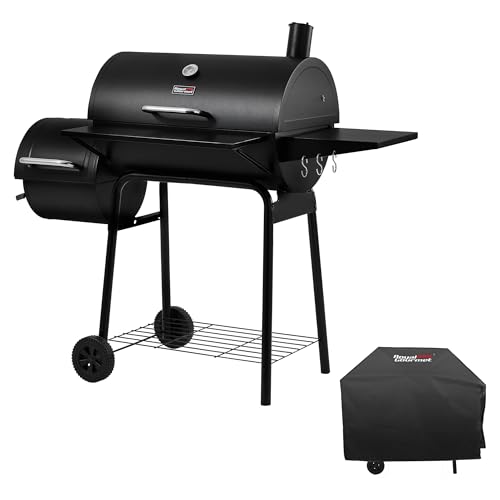
Royal Gourmet CC1830SC Charcoal Grill Offset Smoker
The CC1830SC matches the 823 square inch layout of its sibling but ships with a heavy-duty fitted cover, so it is protected from weather right away. The side door, air vent and lid thermometer make day-to-day tending straightforward.
Reasons to buy
- 823 Square Inches: Includes 475 sq. in. porcelain-enameled steel wire cooking grates, 151
- Tasty Smoke Flavors: The offset smoker is firmly attached to grill to ensure good circulat
- Adjustable Pan: 2-level height-adjustable charcoal pan creates better heat control and hol
- Temperature Monitor: Lid-mounted thermometer gauge helps check and monitor the cooking tem
- Grill Cover Included: Made of heavy-duty fabric, the cover protects your barrel charcoal g
Reasons to avoid
- Lighter-gauge steel does not retain heat like a premium pit
- The included cover is the main upgrade, so cooking performance mirrors the cheaper CC1830W
What to look for
Build quality and heat retention
Heavy-gauge steel and tight seals let a pit hold low temperatures with less fuss. Lighter bodies cost less but leak heat, so you will tend the fire more often and struggle in wind or cold.
Reverse flow vs traditional offset
Reverse-flow baffles route heat under the grates before it exits, evening out hot spots near the firebox. Switchable designs let you run either style as your skills grow.
Cooking capacity
Match primary grate area to your usual crowd. A large chamber is great for multiple briskets but wastes fuel if you mostly cook for a family of four.
Fuel access and cleanup
A side firebox door and removable ash pan let you add charcoal and clear ash without opening the cook chamber, which keeps heat and smoke where you want them.
Total cost of running it
Offsets that need hardwood splits sold separately, or that lack a cover, add to ongoing cost. Factor those extras in before comparing sticker figures.
Our verdict
For most backyard pitmasters the Oklahoma Joe's Highland Reverse Flow is the pick to start with. Its switchable reverse-flow baffles and 1,093 square inches of cooking area give you even heat and the room to run several briskets at once.
FAQs
It can be, but it asks more of you than a set-and-forget smoker. You manage the fire and airflow by hand, so a reverse-flow model with even heat distribution makes the learning curve gentler.
Reverse flow uses baffles to pull heat under the cooking grates to the far end before it rises and exits, which reduces the hot spot next to the firebox and gives more even results across the chamber.
Often yes. Several offset smokers, including the Oklahoma Joe's models here, run on charcoal plus hardwood splits or chunks that are sold separately, so budget for fuel on top of the pit.
For a family, a chamber in the 400 to 600 square inch range is usually plenty. Step up toward 1,000 square inches only if you regularly cook multiple large cuts for gatherings.
Yes, but you will work harder to hold temperature, especially in wind or cold, because thinner steel leaks heat. Sealing gaps and managing airflow carefully helps a budget pit perform closer to a heavy one.